

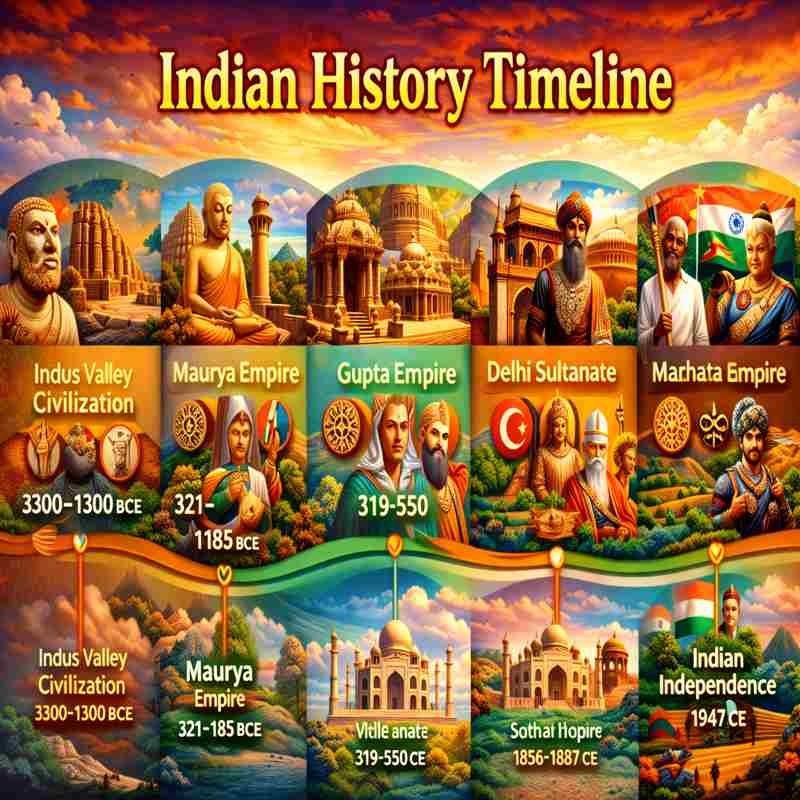
Indian History Timeline: Ancient, Medieval & Modern India Explained
Indian history is among the world’s most ancient and richest tales. It spans thousands of years and traces the evolution of societies, cultures, and ideas. Looking at the history of India timeline, you find that it is a smooth flowing event- starting with the existence of primitive man, the ancient kingdoms, the rule, and then the independence.
This paper provides a simple, clear explanation of Indian history, covering the ancient, medieval, and modern periods, as well as the crucial events that have shaped the nation.
Table of Contents
Ancient Indian History: The Birth of the Civilization.
The Indus Valley civilization is one of the world’s oldest and part of ancient Indian history.
Indus Valley Civilization
In approximately 2500 BCE, cities such as Harappa and Mohenjo-Daro were highly urbanized. Individuals lived in well-structured houses with drainage systems, and trades were practiced. This demonstrates that the primitive Indians were well-versed in urban life.
Vedic Period
Following the fall of the Indus Valley period, the Vedic period started. This is the period during which the Vedas were composed; they are among the oldest books in the world. This was predominantly a rural society, and citizens relied on farming. Early Indian traditions, beliefs, and social structures also developed during this era.
Rise of Kingdoms and Empires
Over time, small groups of tribes were transformed into kingdoms. The Maurya Empire was one of the earliest empires. During the reigns of such rulers as Chandragupta Maurya and Ashoka, India experienced political unity and administrative power.
It is known that Ashoka began preaching the message of peace and Buddhism after the Kalinga War. His thoughts not only affected India but also most of Asia.
The Gupta Empire ushered in a golden age in ancient Indian history. Science, mathematics, literature, and art were successful during this period. Scholars such as Aryabhata contributed significantly to mathematics and astronomy. Ancient Indian history laid the foundation for the cultural values, language, and traditions that remain.
Medieval Indian History: A Period of Change and Cultural Sameness.
Indian history, as of the Medieval period, begins in the 8th century and continues through the 18th century. It was the era of new masters, new faiths, and cultures.
Early Medieval Period
The Gupta Empire collapsed, and India was split into numerous regional kingdoms. These kingdoms were not only struggling with their power but also sponsoring art, architecture, and literature. The monuments and temples constructed during this period remain a testament to artful craftsmanship.
Delhi Sultanate
Indian history changed significantly with the coming of the Muslim rulers. The Delhi Sultanate was founded in the 13th century. It established new systems of government and introduced Central Asian cultural influences. It was also an era of the rise of cities and trading networks.
Mughal Empire
Among the most significant periods of Indian medieval history is the Mughal Empire. Babur established it, and it reached its peak during the reigns of Akbar, Jahangir, Shah Jahan, and Aurangzeb.
Akbar is remembered for his policy of religious tolerance and good governance. Taj Mahal is one of the most renowned monuments in the world, constructed by Shah Jahan. Art, music, and architecture also reached their peak during the Mughal period. The fusion of cultures was also evident, giving rise to modern Indian society. The history of Medieval India reveals the ways of how various cultures interacted and shaped one another.
Modern Indian History: Road to Independence.
The history of modern India begins with the arrival of European traders, especially the British.
Arrival of the British
The British East India Company was introduced in India to trade but gradually acquired political power. They extended their domination in the country through battles and alliances.
This marked the start of colonial rule, which significantly influenced the Indian economy, society, and government.
British Rule and Its Impact
India faced economic challenges during British rule. They took resources to Britain, and the local industries were crippled. Meanwhile, the British brought railroads, a system of civil education, and the rule of law. There were positive and negative influences of these changes on the Indian society.
Indian Freedom Movement
One of the most significant aspects of contemporary major events in Indian history is the struggle for independence. The reason was that people of other backgrounds united to struggle towards freedom. Mahatma Gandhi, Jawaharlal Nehru, and Subhas Chandra Bose were such leaders. Millions of people were motivated by Gandhi’s strategy of non-violence. Unity was proved in movements such as the Non-Cooperation Movement, the Civil Disobedience Movement, and the Quit India Movement.
Independence and Partition
On the 15th of August, 1947, India eventually attained independence. But it was split into India and Pakistan, which resulted in massive migration and violence. But despite the difficulties, India has started its path to becoming a democratic country. Contemporary major events in Indian history demonstrate the power, stability, and solidarity of the Indian people.
Important Incidents in Indian History
Several important incidents in Indian history have defined the country. The Indus Valley Civilization experienced both an upsurge and a decline, indicating the presence of an organized society. Ashoka promoted the spread of Buddhism, which had an impact on several regions. The building of the Mughal Empire introduced culture and architectural marvels.
The British invasion altered India’s political and economic landscape. The first major revolt against British rule was the Revolt of 1857. The struggle to achieve freedom brought the people of the nation together. And the last point is independence in 1947, which marked the beginning of a new chapter. All of these events contributed to the development of modern India.
Indian History, Cultural and Social Impact.
The history of India is not merely of conquerors and battles. It also presents the culture, traditions, and the development of social values. Various historical times have affected languages, festivals, food, and clothing. The blend of Hindu and Islamic cultures of the medieval period can, however, be observed in music, architecture, and food.
Antique writings and teachings are still used in everyday life. The concept of diversity as unity is deeply embedded in Indian history. You can look at Indian history to see how various influences united to create a distinct identity.
Why Indian History Matters Today.
Knowing the history of Indians will make you relate to the past and appreciate the present. It demonstrates how societies evolve and how human beings respond to difficulties.
History also teaches lessons about leadership, unity, and resilience. It reminds you of the hardships and successes that made the country what it is today. For students, learners, and even those interested, Indian history is very enlightening for understanding culture, politics, and human behavior.
Conclusion
The Indian story is long, complicated, and meaningful. From the dawn of civilization to the present-day democracy, every stage has helped shape the country’s identity. This journey is made evident through the history of India timeline. The roots lie in ancient Indian history, cultural blending is evident in medieval Indian history, and the struggle for freedom is emphasized in modern Indian history.
As you read about the key moments in Indian history, it dawns on you how each influenced the country. Indian history is not only about the past. It is an alive narrative that will continue to dominate the present and the future.
FAQs
Why are the three key periods of Indian history?
Indian history is divided into ancient, medieval, and modern periods. Various political systems, cultures, and developments characterize every era.
Why is the history of ancient India relevant?
The significance of ancient Indian history lies in its role as the foundation of the culture, traditions, and systems of knowledge present today.
What is the definition of medieval Indian history?
The Delhi Sultanate and the Mughal Empire characterized medieval Indian history as defined by regional kingdoms. It is also characterized by cultural mixing and architectural success.
What are the significant historical events in India?
Others include the Indus Valley Civilization, the Maurya and Gupta empires, Mughal rule, British colonization, the Revolt of 1857, and India’s independence in 1947, all of which are key events in India’s history.
What was the process of the Indian acquisition of independence?
India fought a long battle for independence, with the help of leaders such as Mahatma Gandhi. It was largely contributed to by non-violent demonstrations and mass mobilization.
Why do you need to learn Indian history?
Learning about Indian history will help you understand the cultural background, social transformation, and the lessons the past has taught. It also raises awareness of the country’s process.