

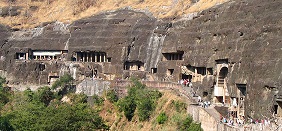
History Ajanta Ellora Caves
The Ajanta Caves and the Ellora Caves are among the most appealing historical sites in India. These Rock-cut caves re-purpose stories of faith, art and human labour, dating back more than a millennium. They are regarded as UNESCO heritage caves in India and are worthy cultural destinations, sanctuaries for international visitors.
If you are interested in India’s history or planning to visit it, it can be helpful to know the Ajanta Ellora caves history of these caves to understand the value they have retained to the present day.
Table of Contents
Ajanta Ellora Caves History
The Ajanta and Ellora Caves were carved at different times, yet both illustrate the numerous spiritual beliefs of ancient India.
The Ajanta caves date to the 2nd century BCE and the 6th century CE. They were mainly established during the reigns of the Satavahanas and the subsequent Vakataka dynasties. These caves were constructed within Buddhist monasteries and monks’ prayer halls. As time went on, they were forgotten and had no say until they were discovered in 1819 by a British officer on a hunting mission.
Quite to the contrary, the Ellora caves were built between the 6th and 10th centuries CE. The distinction concerning Ellora is that it is varied. It boasts Buddhist, Hindu, and Jain caves. This shows the fact that different religions coexisted peacefully during this period.
The Ajanta and Ellora caves provide a clear understanding of the relationship between art, religion, and culture in ancient India.
Ajanta Caves Paintings
One of the most salient characteristics of this place is its wall art. The Ajanta caves paintings are renowned for their beauty, detail, and narratives.
The subjects of these paintings are largely the life of the Buddha and tales of his reincarnation in the Jataka tales. The artists used natural colours derived from plants and minerals. The colours are inconceivably fresh despite a long lapse of time.
The peculiarity of such paintings lies in the depth of their emotions. The facial expressions, the characters’ postures, and the detailing of clothes and jewellery are realistic. You do not look at art alone; you associate yourself with stories.
Another testament to the quality of ancient Indian art is the cave art. At such an age, they were making paintings on non-smooth surfaces, such as rocks, with no modern techniques, yet the results are phenomenal to experts in the present era.
Ellora Caves Architecture
The structure of an Ellora is referred to if Ajanta is recognised by its paintings. The Ellora Caves are built with great care, patience, and outstanding craftsmanship.
The caves were excavated directly from the rock and built without the use of discrete stones. Workers tore down the rock surrounding it to the bottom, which entailed some calculations. One disciplinary action would have ruined the entire building.
The most famous cave is the Kailasa Temple at Ellora, dedicated to Lord Shiva. It is considered one of the largest monolithic buildings in the world. The temple looks like a structure resting on its own legs, yet it was carved from a rock.
The various caves at Ellora are observed to represent the various styles. Buddha caves are simple and calm; Hindu caves are more advanced and grand, and finer, subtler work is observed in Jain caves. This is what makes Ellora a great place to visit, as one can see different styles of art within the same location.
Religion and Cultural Significance
The American caves, Ajanta caves, and Ellora caves are not merely sightseeing sites; they are places of faith and belief. Ajanta is, first of all, a Buddhist site. The caves that served as homes to the monks were also prayer halls. They were schools, too, for teaching and praying.
The combination of religions at Ellora tells us a broader tale. It portrays how citizens of different religions lived harmoniously. This is one of the greatest things about these caves.
The two sites feature carvings, sculptures, and paintings with messages that touch on life, goodness, and spiritual development. Even in modern times, they leave the visitors trying to think of something deeper.
Ajanta Ellora Tourism
Ajanta Ellora tourism has been rising in recent years. Tourists do not go there only to study the past; they also need a contrasting experience to city life. It is located in caves near Aurangabad, Maharashtra, and is easily accessible by road, rail, and air. The winning season would be October and March, when the weather is ideal for striking.
Touring Ajanta would entail a stroll along a naturally horseshoe-shaped cliff, with caves facing a river. The natural scenery adds to this serene setting. Ellora, on the other hand, is larger in area. One may walk from one cave to another and trace the changes in style and design.
One has to follow the recommendations. The paintings or carvings must not be touched, as they are easily damaged. Compliance with them will preserve the caves for future generations.
Workmanship and Techniques of Art
The tricks applied in the formation of these caves continue to amaze the scientists. At Ajanta, the artists used a fresco technique. They coated the surface with a thick layer of mud, lime, and organic material, then painted it. This helped the colours remain strong over a long period.
The carving was planned at Ellora. Employees excavated huge rock masses, preserving the forms of pillars, halls, and statues. Design: The symmetry and balance of the caves provide an insight into design.
Such techniques were created in the absence of contemporary machines. It was all hand-drawn, which makes the overall result even more unbelievable.
Why are these caves still here?
Even today, the Ajanta and Ellora caves are of value. They remind us of the Indian heritage in art and culture. They demonstrate what people can get done with limited resources and great effort. To students, researchers, and travellers, these caves can offer an opportunity to study the past in a truly tangible and substantial way. You can read the past with your eyes and fingers rather than your book.
They contribute to who we are in India. The fact that they have been declared UNESCO heritage caves in India gives them international significance.
The struggles and the Conservation.
Natural and artificial factors have influenced the caves over time. Moisture, temperature fluctuations, and human activity can damage paintings and structures. As a result, the government has made efforts to preserve them.
Ultraviolet light, restricted access to certain locations, and routine upkeep contribute to the Conservation of the caves. Rules are also designed to prevent visitors from causing harm. Conservation is not solely the government’s responsibility. Your behaviour also helps make these sites safe when you visit them.
Conclusion
Not only are the Ajanta and Ellora caves ancient structures, but they are also UNESCO heritage caves in India. They are tales that are hewn in stone and painted on walls. They demonstrate that art, faith, and human effort can come together to achieve something that will last.
You might be a historian, an artist, or an adventurer, but there is something to be gained from these caves. The complete Ajanta Ellora caves history, the exquisiteness of the Ajanta caves’ paintings, and the power of the Ellora caves’ architecture make this site one of the most precious treasures of the Indian world. You do not only see the past when you visit it, but you also relate to it.
FAQs on Ajanta Ellora Caves
What is the distinction between the Ajanta and Ellora caves?
The caves of Ajanta are known primarily for their Buddhist paintings. Ellora caves contain Buddhist, Hindu, and Jain caves and are famous for their rock-cut structures.
What is the fame of the Ajanta and Ellora caves?
They are known for their antique art, elaborate carvings, and historical significance. They also appear on UNESCO’s World Heritage Sites list in India.
What is the age of the Ajanta Ellora caves?
The Ajanta caves are dated to the 2nd century BCE, and the Ellora caves were developed between the 6th and 10th centuries CE.
Which of the two- Ajanta or Ellora is better to visit?
The two experiences are quite different. Ajanta is a place where you can enjoy its paintings and a serene environment. Ellora is preferable when you wish to view some grand structures and carvings.
When is the ideal time to visit Ajanta Ellora?
Victor favours visiting from October to March, since the weather is also good for travel and exploration.