

Windows 1.0 & 2.0 – ISO, Product Key, Installation Steps & Release Date
Think about the last time you opened a laptop. You clicked an icon, dragged a window around, maybe had two or three programs open side by side without a second thought. None of that was obvious back in the mid-1980s.
Computers talked to you in text, and you talked back the same way, typing commands and crossing your fingers you didn’t fat-finger something. Then Microsoft came along with an idea that sounded almost silly to some people at the time: what if you could just point at things with a little device called a mouse instead?
That idea became Windows. It didn’t land perfectly the first time, or even the second. But Windows 1.0 and Windows 2.0 are where the whole story starts, and honestly, they’re a lot more interesting than most people give them credit for. Here’s a look at what these two versions actually were, when they showed up, what they could do, and why they mattered even though barely anyone uses them today.
Table of Contents
Why Microsoft Even Bothered
Before Windows existed, MS-DOS ran the show on IBM-compatible PCs. It got the job done, but you had to know what you were doing. There was no clicking, no icons, nothing to look at except a blinking cursor waiting for your next command.
Meanwhile, Apple had already started showing off machines with actual graphical screens, and people noticed. Bill Gates and his team at Microsoft didn’t want to get left behind, so they set out to build something that let regular PC owners use a mouse and see little pictures instead of memorizing commands.
That’s really the whole motivation in a nutshell. Nothing dramatic, just a company watching a competitor pull ahead and deciding to catch up.
Windows 1.0 Release Date and What It Was Actually Like
The Windows 1.0 release date landed on November 20, 1985. That’s later than Microsoft originally promised, by the way. They’d announced the project a couple years earlier and kept pushing the date back, which is a pretty familiar story if you’ve followed software launches since.
Once it did ship, Windows 1.0 wasn’t really its own operating system in the way we think of Windows now. It ran on top of MS-DOS, more like a coat of paint over the existing system than a total replacement.
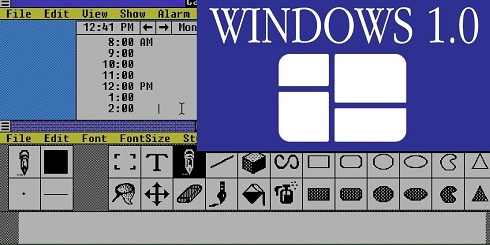
You’d boot up and land in something called MS-DOS Executive, which handled your files, and from there you had access to a handful of little built-in programs. Nothing fancy — Paint, Notepad, Calculator, Calendar, Clock, Cardfile, Write, Terminal, and a simple game of Reversi rounded out the lineup. Small stuff, sure, but putting it all under one roof with a mouse-driven look was new territory for most PC owners at the time.
What It Got Right
Give Windows 1.0 some credit — it let people run more than one MS-DOS program at the same time, which doesn’t sound like much now but was genuinely useful back then.
It also shipped with drivers for mice, keyboards, printers, video cards, and serial devices, giving hardware makers a shared foundation to build around instead of everyone doing their own thing. That groundwork ended up mattering a lot more than anyone realized in 1985, since later versions of Windows built directly on top of it.
There was a quirky limitation, though. You couldn’t stack windows on top of each other. Everything had to sit side by side in a tiled layout. That wasn’t a technical accident — Microsoft was being careful to avoid a fight with Apple over similar-looking window behavior. It made the whole thing feel stiff, and honestly, kind of awkward to use.
Why It Never Really Took Off
Here’s the thing about Windows 1.0: it asked people to buy a mouse when barely anyone owned one. Mice weren’t a standard accessory on PCs at the time, so Microsoft was essentially betting that people would go out and buy new hardware just to use its software properly. That’s a tough sell for any product.
On top of that, the system needed more memory and processing power than most machines had lying around, so it often ran slow and clunky rather than smooth. New users didn’t get much help figuring out this strange new point-and-click world either, which didn’t do it any favors.
If you wanted to actually run it, you needed MS-DOS 2.0, at least 256 KB of memory, a monochrome or color monitor, and two double-sided disk drives. Given all that, it’s really no surprise Windows 1.0 didn’t set the world on fire. Microsoft did price it low, around 99 dollars, which was a fraction of what other graphical systems cost at the time — so at least curious buyers had a low barrier to try it.
Windows 2.0 Release Date and the Upgrade That Actually Helped
The Windows 2.0 release date came about two years later, on December 9, 1987. And this time, Microsoft actually listened to the complaints.
Overlapping windows finally showed up, meaning you could stack program windows on top of each other and drag them around freely instead of being stuck in that rigid tiled layout from before. Sounds minor written out like that, but it changed how the whole desktop felt to actually use.
Windows 2.0 also swapped out some of the odd early terminology. “Iconize” and “Zoom” became “Minimize” and “Maximize,” which are terms you probably still use today without thinking twice about where they came from. Keyboard shortcuts got more sophisticated as well, and Microsoft introduced the Control Panel for the first time, giving people one central place to tweak system settings instead of digging around for scattered tools.
This version also didn’t arrive all at once. It rolled out in waves — the initial 2.0x release in 1987, followed by 2.1 in 1988 and 2.11 in 1989. Along the way, Microsoft also put out two variants: Windows/286 and Windows/386, each tailored to make better use of the different processors people had in their machines at the time. The 386 version in particular could tap into extended memory more effectively, which made programs run a bit less painfully.
Where It Still Fell Short
Windows 2.0 wasn’t some overnight success either, if we’re being honest. Programs built for it weren’t designed with protected mode in mind, so they couldn’t just run on Windows 3.0 or later without being rewritten first. VGA graphics did show up in this release, but you were capped at 16 colors, which felt basic even by the standards of the late 1980s. Commercially, it still struggled to really break through against everything else on the market.
The Apple Lawsuit Nobody Talks About Enough
Here’s a detail that gets skipped over a lot: Apple actually sued Microsoft in 1988, arguing that Windows 2.0 copied the look and feel of the Macintosh interface a little too closely. That case dragged on for years in court.
Microsoft eventually came out on top, largely thanks to a licensing agreement tied back to Windows 1.0 that gave it more legal cover than people expected. That outcome mattered a lot, because it meant Microsoft could keep building and refining its graphical interface without constantly worrying about getting sued into a corner.
Why Any of This Still Matters
Neither Windows 1.0 nor Windows 2.0 made Microsoft rich, and neither one turned every PC owner into a mouse-clicking convert overnight. What they did do was set the stage for everything that came after.
The way programs interact, the built-in utilities, the driver setup, even words like “minimize” and “maximize” that you use without thinking — all of it traces back to these early, rough-around-the-edges releases. Windows 3.0 came out in 1990 and is usually remembered as the version that finally clicked with everyday users, but it stood on the shoulders of the two versions before it. If you want to actually understand the history of Microsoft Windows, it makes sense to start here, glitches and all, rather than jumping straight to the versions people actually remember fondly.
Frequently Asked Questions
When did Windows 1.0 release?
Windows 1.0 came out on November 20, 1985, as Microsoft’s first attempt at a graphical shell running on top of MS-DOS.
When did Windows 2.0 release?
It followed on December 9, 1987, bringing overlapping windows and a Control Panel along with it for the first time.
Could you use Windows 1.0 or 2.0 without a mouse?
Technically, yes, since keyboard commands still worked. But the whole interface was designed around mouse input, so skipping the mouse made things feel clunky pretty fast.
Why didn’t Windows 1.0 let you overlap windows?
Microsoft played it safe on this one, avoiding overlapping windows to steer clear of a possible dispute with Apple, and stuck with a tiled layout instead.
What programs came bundled with these early versions?
You’d find small tools like Notepad, Paint, Calculator, Calendar, Clock, Cardfile, Write, Terminal, and even a simple game called Reversi packed in.