

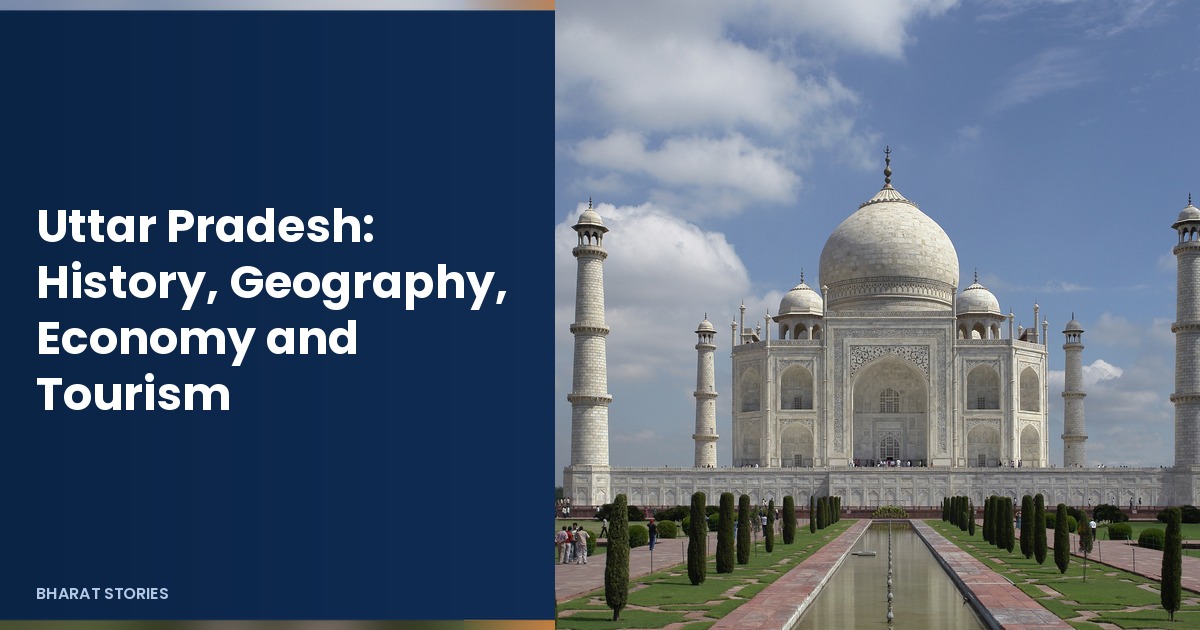
 Photo: Yann; edited by King of Hearts, CC BY-SA 4.0, via Wikimedia Commons
Uttar Pradesh: History, Geography, Economy and Tourism
Uttar Pradesh is India’s most populous state and one of its largest by area, stretched across the fertile Ganga plain in the north of the country. Lucknow is the capital. The state holds some of the best known places in Indian history and faith, from Varanasi and Ayodhya to Agra’s Taj Mahal. It shares borders with several states, including Madhya Pradesh to the south and Rajasthan to the west; see our profiles of Madhya Pradesh and Rajasthan for those neighbours.
This updated profile covers Uttar Pradesh’s history, geography, government, economy and tourism, with figures checked for November 2026. The old version of this page was brief, so it has been rewritten in full.
Table of Contents
Uttar Pradesh at a Glance
| Item | Detail |
|---|---|
| Capital | Lucknow |
| Area | About 2,40,928 square km |
| Population | 19,98,12,341 (Census 2011), the highest of any state |
| Districts | 75 |
| Chief Minister | Yogi Adityanath (since March 2017) |
| Governor | Anandiben Patel (since July 2019) |
| Legislature | 403 seat assembly; 80 Lok Sabha seats |
| Main languages | Hindi and Urdu; many local dialects |
History of Uttar Pradesh
Ancient and classical eras
The Ganga plain has been a centre of farming, cities and faith for thousands of years. Sites linked to the Buddha’s life, the kingdoms of the Mahajanapadas, and later Magadha and other powers sit within or beside today’s state borders. Cities such as Varanasi grew as places of learning and pilgrimage long before modern maps were drawn.
Medieval and Mughal periods
Delhi Sultanate and Mughal rule left deep marks on the west of the state. Agra served as a Mughal capital; Fatehpur Sikri was built nearby by Emperor Akbar. The Taj Mahal, completed in the seventeenth century under Shah Jahan as a tomb for Mumtaz Mahal, stands as the most famous Mughal monument in India and a UNESCO World Heritage Site.
Awadh, colonial rule and the modern state
The Nawabs of Awadh made Lucknow a centre of culture, music and cuisine. After 1857 and through the colonial period, the region was central to political change. After independence the state took its present name, Uttar Pradesh. Uttarakhand was carved out as a separate hill state in 2000.
Geography
The Ganga plain
Most of Uttar Pradesh is flat alluvial plain watered by the Ganga, Yamuna, Ghaghara, Gomti and other rivers. The soil supports dense farming and dense settlement. Summers are hot; the monsoon brings most of the rain; winters are cool and foggy in many districts.
The southern fringe
Toward the south, the land rises into parts of the Vindhyan plateau and Bundelkhand, with rockier ground and different cropping patterns. The far north once included Himalayan districts that are now in Uttarakhand.
Administrative divisions
The state has 75 districts grouped into divisions. Lucknow, Kanpur, Agra, Varanasi, Prayagraj, Ghaziabad and Noida are among the largest urban centres. The western districts near Delhi are tightly linked to the national capital region’s economy.
Government and Politics
Uttar Pradesh has a 403 member legislative assembly, the largest in India, and sends 80 members to the Lok Sabha. Yogi Adityanath has been Chief Minister since March 2017. Anandiben Patel has been Governor since July 2019; as of early November 2026 she remained in office. State politics often influences national coalitions because of the large Lok Sabha seat count.
Economy
Agriculture
Uttar Pradesh is a leading producer of wheat, sugarcane, potatoes and milk. Canal and tube well irrigation support large areas. Food processing and sugar mills are important rural industries.
Industry and services
Kanpur has a long industrial history. Noida and Ghaziabad host IT, electronics and manufacturing linked to Delhi. Lucknow’s services and administration employ many people. Handloom and handicraft clusters make silk, carpets, brassware and glass; our guide to Indian crafts places these traditions beside those of other states.
Tourism and pilgrimages
Agra, Varanasi, Ayodhya, Mathura, Vrindavan, Prayagraj and Lucknow draw millions of visitors for heritage and faith. Expressways and airports have shortened travel times on several corridors in recent years.
Top Places to Visit
- Agra: Taj Mahal, Agra Fort and nearby Fatehpur Sikri, all UNESCO listed.
- Varanasi: the Ganga ghats, temples and a living pilgrimage city.
- Ayodhya: a major centre of faith with renewed temple and city works in recent years.
- Lucknow: Imambaras, gardens and Awadhi food.
- Prayagraj: the Sangam of Ganga and Yamuna; host of the Kumbh at long intervals.
- Mathura and Vrindavan: linked to Krishna traditions.
- Jhansi and Bundelkhand forts: for history away from the main river towns.
October to March is the most comfortable season on the plain. Summer heat is severe; monsoon travel needs extra time for storms and wet roads.
People and Culture
Hindi and Urdu literature, Kathak dance, classical and folk music, and rich festival calendars shape cultural life. Awadhi and Bhojpuri traditions differ across regions. Cuisine ranges from Lucknow’s dum pukht dishes to street foods and festival sweets. Large fairs and processions need planning if you travel during peak holy seasons.
Travel Practicalities in Uttar Pradesh
Airports at Lucknow, Varanasi, Ayodhya and other cities, plus dense rail links, make the state relatively easy to enter. The Golden Triangle route ties Agra to Delhi and Jaipur for first time visitors. Inside the state, expressways have shortened several road journeys that once took a full day.
Summer heat from April to June is intense on the plains; plan indoor museum hours at midday. Winter fog can delay trains and flights in December and January. Monsoon storms slow road travel but also green the countryside.
Varanasi and other pilgrimage cities are crowded at dawn and during festival weeks. Hire guides from known hotel desks if you want help with temple routes. Boat rides on the Ganga should use life jackets when offered and avoid overloaded craft.
Awadhi food in Lucknow rewards slow meals: kebabs, biryani styles and sweets. Street food is tasty but choose busy stalls with high turnover. Vegetarian options are everywhere; Jain and other special meals can be requested in many hotels.
Hindi works statewide; English appears in hotels and larger stations. Keep small notes for autos where meters are missing, or agree the fare before the ride. App cabs operate in big cities.
Security lines at major monuments such as the Taj Mahal mean early arrival helps. Tripods and large bags may face extra checks. Respect photo bans inside some tomb chambers.
Business travellers use Lucknow and Noida as hubs. Students fill large university towns. The same roads that carry pilgrims also carry freight, so build buffer time around harvest and festival peaks.
Heritage hotels in former havelis and nawabi homes offer a different stay than chain hotels, though prices vary with season.
Calligraphers and chikankari shops in Lucknow repay careful browsing; buy from places that treat artisans fairly.
River cruise offerings at some cities are short tourist loops rather than long voyages; read the duration before you pay.
Students preparing for national exams fill libraries in several UP cities; quiet cafes near campuses fill in the evenings.
Keep digital copies of hotel bookings when travelling between Agra, Lucknow and Varanasi in one trip.
Craft clusters around places such as Firozabad for glass and Bhadohi for carpets repay day trips for design students.
Late evening Ganga aarti times shift; confirm with the hotel the same day you go.
Shared prepaid taxis from airports reduce haggling after late flights.
Carry a paper city map backup when mobile data slows during huge festivals.
Frequently Asked Questions
Who is the Chief Minister of Uttar Pradesh in 2026?
Yogi Adityanath, in office since March 2017.
Who is the Governor of Uttar Pradesh?
Anandiben Patel, in office since July 2019.
How many Lok Sabha seats does Uttar Pradesh have?
80, the most of any state.
What are the UNESCO sites in Uttar Pradesh?
The Taj Mahal, Agra Fort and Fatehpur Sikri.
When is the best time to visit?
October to March for milder weather on the plains.
Delhi, Agra and Jaipur together form the popular Golden Triangle route for first time visitors.
Fog can delay trains and flights in north India in December and January.
Dress codes at major temples are modest; footwear is left outside.
Expressway tolls and new airports have changed road and air travel patterns since 2020.
Hindi is widely understood; English is common in hotels in large cities.
Keep drinking water handy in summer; afternoon sightseeing is hard in May and June.
Festival dates shift with the lunar calendar, so check before you book.
Local buses and autos are cheap; agree fares or use meters where they exist.
Museum tickets at major Agra sites sometimes include timed entry; check before you queue.
Night markets in Lucknow are lively; keep phones secure in crowds.
Photographers should respect privacy at cremation ghats and funerals.
Train side lower berths help older travellers on overnight trips across the state.
Local Melas can close roads; ask the hotel for diversion tips.