

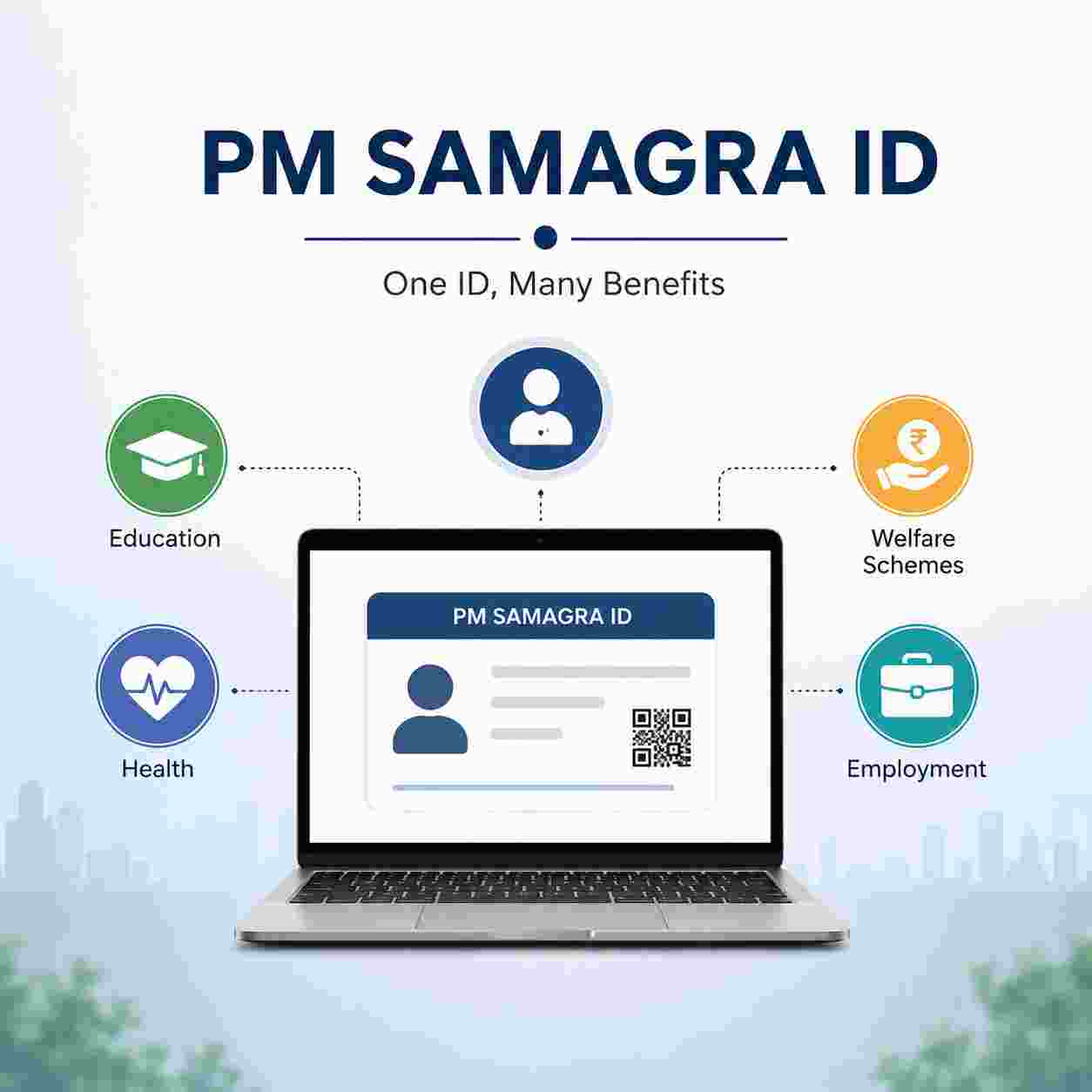
PM Samagra ID: Everything You Need to Know
If you live in Madhya Pradesh and haven’t heard of the Samagra ID yet, there’s a good chance you’re missing out on government benefits that are already meant for you. This ID has become one of the most important documents for MP residents — right up there with Aadhaar. Scholarship for your child, pension for an elderly parent, ration through the public distribution system — the state government uses the Samagra ID to decide who gets what. No ID, no benefit. It’s that simple.
So let’s get into it. What is this ID, how do you apply, what documents do you need, and why does it matter so much for anyone trying to access government services in India’s most scheme-heavy states?
Table of Contents
What Is the Samagra ID?
The Samagra Portal at samagra.gov.in is basically a giant database that the Madhya Pradesh government built to keep track of every family and individual in the state. The whole idea is to make sure welfare schemes actually reach the people they’re meant for — not get lost in paperwork or eaten up by middlemen.
Think of it as MP’s own identity system that works alongside Aadhaar. Aadhaar tells the country who you are. Samagra ID tells the state of Madhya Pradesh who you are, where you live, what your family looks like, and what benefits you might be eligible for. The Samagra Social Security Mission (SSSM) has been running since 2010, and over the years it has become the backbone of almost every welfare program the state runs.
Before this system existed, people had to run from one government office to another for different schemes. Documents got lost. Deserving families got skipped. Fake beneficiaries slipped through. The Samagra system was built to fix all of that — one database, one ID, everything in one place.
Two Types of Samagra ID — and Why Both Matter
This is something a lot of people don’t realise upfront. The Samagra system doesn’t just give you one ID. It gives two — one for your family as a whole, and one for each individual member.
The Samagra Family ID is an 8-digit number assigned to the entire household. Every scheme that targets the family unit — ration cards, housing benefits, family-level welfare programs — uses this ID. The Member Samagra ID is a 9-digit number that belongs to each person individually. Scholarships, pensions, disability support — anything personal uses the member ID.
One important thing to know: the member ID can only be issued after the family has already been registered. So if you’re trying to get a member ID for yourself or someone in your household, and the family registration hasn’t been done yet, that’s the first step. Family registration comes first, always.
Why the Samagra ID Actually Matters
Here’s the straightforward reality — without this ID, you simply can’t access most of what the state government offers to its residents. Scholarships, pensions, ration cards, health schemes — all of these now require a valid Samagra ID as a basic eligibility check.
What makes it genuinely useful is that it connects your Aadhaar, your family details, your bank account, and your scheme eligibility all in one place. So when you apply for something, the government doesn’t need you to submit a pile of documents every single time. Your information is already verified in the system. That’s a real difference from how things used to work.
And for the government’s side — it helps them track who’s actually receiving what, so the same benefit doesn’t go to five different people because they submitted five different applications at five different offices. The system has genuinely reduced duplication and made the whole process more honest.
How Samagra ID Registration Works
The Samagra ID registration process isn’t complicated. If you have internet access, you can do the whole thing from home.
Go to samagra.gov.in and look for the “Family Registration” option. You’ll fill in details about the head of the family — name, address, mobile number, Aadhaar number, and some basic income details. Upload the required documents, fill in the form carefully, and submit. Once the application goes through and gets verified, the system generates your Samagra Family ID along with individual Member IDs for each person in the household.
If online registration feels like too much to figure out on your own, just walk into your nearest Gram Panchayat, Nagar Panchayat, or District Office. They’ll help you with the process in person. Local Common Service Centres (CSCs) and Lok Seva Kendras also do this regularly — it’s a very routine thing for them.
One small but important tip: before you start the registration process, check whether your Samagra ID already exists. A lot of MP residents were registered without knowing it, especially in rural areas where local authorities registered households directly. You can check on the portal by entering your name, mobile number, or Aadhaar.
Documents You’ll Need
The document list is not overwhelming. For Samagra ID application, you’ll need your Aadhaar card as the primary identity proof — this is also what’s used for eKYC, so it’s non-negotiable. Other than that, a PAN card, voter ID, driving licence, or passport can serve as supporting identity proof depending on what you have. A ration card helps establish family composition and residence.
Of all these, Aadhaar is the one you absolutely cannot skip. Everything else can usually be worked around, but Aadhaar is central to the whole verification process.
What You Can Actually Access With It
The range of schemes tied to the Samagra family ID is quite wide. Ration through the public distribution system, old-age pensions, widow pensions, scholarships for students, marriage assistance for girls from lower-income families, maternity benefits, disability welfare support — all of these run through the Samagra system in Madhya Pradesh.
Basically, if the state government is running a welfare scheme, there’s a very high chance that Samagra ID is a required document to apply for it. That’s how central it has become to the whole system of government services in the state.
How to Download or Print Your Samagra ID
Once your registration is done, you can access your ID anytime online. Visit samagra.gov.in, click on “Know Your Samagra ID,” choose whether you want the Family ID or Member ID, enter your details, and search. From there you can view, download as a PDF, or print it directly.
If you run into trouble — especially if your OTP isn’t coming through — your nearest Gram Panchayat or Ward Office can pull up your record and give you a printout. That’s always an option.
Updating Your Details
If something in your Samagra record is wrong — a name spelling, an old address, missing Aadhaar linkage — it can be corrected through the portal or by visiting a Lok Seva Kendra. You’ll need to go through eKYC again after making changes to get them verified, so keep your Aadhaar-linked mobile number with you when you do this.
For helpline support, you can call 0755-2700800 or email [email protected].
Frequently Asked Questions
What is the Samagra ID and who can apply for it?
The Samagra ID is a unique identification number issued by the Madhya Pradesh government to its residents. Only permanent residents of MP are eligible, and it is used to access state welfare schemes and government services.
What is the difference between the Family Samagra ID and the Member Samagra ID?
The Family Samagra ID is an 8-digit number for the entire household. The Member Samagra ID is a 9-digit number assigned individually to each family member for personal scheme eligibility.
Is Samagra ID registration free?
Yes, completely free. There is no charge for registering on the Samagra portal.
How long does it take to get the Samagra ID after applying?
Usually between 7 to 15 working days after the application is submitted and verified.
What if my OTP isn’t coming during Samagra portal login or eKYC?
If the OTP isn’t coming through, visit your nearest Lok Seva Kendra or CSC. They can complete the eKYC process using biometric verification instead.
Is the Samagra ID the same as Aadhaar?
No, they are different. Aadhaar is a national identity document issued by the central government. The Samagra ID is a state-level system specific to Madhya Pradesh, though the two are linked through eKYC.
Which helpline can I call for Samagra portal issues?
You can call 0755-2700800 or email [email protected] for any queries or technical issues.