


Bhubaneswar: Prime Minister Narendra Modi on Sunday, 25 October 2026, inaugurated the new RBI data centre and a Cybersecurity Training Institute at Jatni on the edge of Bhubaneswar, the Reserve Bank of India said in a statement. The central bank called the opening a significant milestone in strengthening the technology base of India’s financial system.
The campus is spread across 18.55 acres at Info Valley II in Jatni and cost about Rs 169 crore, Hindustan Times reported. Its foundation stone was laid by then RBI Governor Shaktikanta Das on 22 March 2023. Union Finance Minister Nirmala Sitharaman, RBI Governor Sanjay Malhotra, Odisha Governor Brajmohan Ram, Chief Minister Mohan Charan Majhi, Union Tribal Affairs Minister Jual Oram, Deputy Chief Ministers Kanak Vardhan Singh Deo and Pravati Parida, and MPs Manmohan Samal and Aparajita Sarangi attended the event.
Table of Contents
What the new RBI data centre will run
The facility will house mission critical payment and settlement systems, including Real Time Gross Settlement (RTGS) and National Electronic Funds Transfer (NEFT), both of which run round the clock, Governor Malhotra said, according to ETBFSI. It will also support the e Kuber platform, through which the RBI handles banking for the central and state governments and for banks, along with applications that regulated entities use for licences and approvals.
Malhotra explained that the Unified Payments Interface is operated by the National Payments Corporation of India, but final settlement of UPI transactions passes through RBI data centres and applications. That makes the new site important for ordinary digital payments as well as large interbank transfers.
The data centre carries the highest Tier IV accreditation from the Uptime Institute and will have four independent data centres inside it, which the Governor said would add strength and resilience. He said it would help the RBI improve uptime, reduce downtime of critical services and offer better quality, more efficient services.
Why Bhubaneswar was chosen
This is the RBI’s fourth data centre. The other three are in Maharashtra, and Malhotra said Bhubaneswar is geographically distant from them and sits in a different seismic zone, so a natural disaster in one region is less likely to hit all sites at once. The availability of technical talent in the city was another reason, ETBFSI reported.
The Governor also stressed that the RBI does not rely on third party cloud providers for this work and runs its own facilities. He said this sovereign setup would add to the central bank’s strength and resilience.
A training institute for the whole financial sector
Two thirds of the campus is set aside for the Cybersecurity Training Institute, with the remaining third for the data centre. The institute will not be limited to RBI staff. It will also train employees of banks and other financial sector organisations in cybersecurity, artificial intelligence, big data analytics, quantum technology and blockchain, and it will carry out research.
“Cyber security is increasingly becoming important especially in the wake of AI,†Malhotra said. The Prime Minister’s Office had earlier said the institute would provide an institutional platform for cybersecurity and enterprise technology training, research and sector wide capability building, Hindustan Times reported.
What PM Modi said
“Today’s program is proof of how the approach to Governance has changed in India,†Modi said, according to the Prime Minister’s website. He said a rising economic power must protect its financial system from cyber looters and cyber terrorists, and that outdated training tools have to be replaced with modern infrastructure and skilled people. Hindustan Times quoted him as saying that wars are now fought not only conventionally but also by attacking economies.
Modi linked the digital push to financial inclusion, citing nearly 60 crore Jan Dhan accounts and 13 crore first time entrepreneurs under the Mudra scheme. He also described eastern India as a growth engine for a developed India and said Odisha is pairing its mineral industries with semiconductors, electronics, data centres and advanced computing. “You will see, Odisha, from mines to microchips, is going to write a new future,†he said.
Sitharaman calls it a vault for the digital age
“A data centre is the vault in the digital age,†Sitharaman said, The New Indian Express reported. She said the campus reflected the government’s Purvodaya vision for faster development of eastern India.
The Finance Minister said more than 59 crore people had joined the formal banking system through Jan Dhan, and that over 60 crore collateral free Mudra loans worth more than Rs 43 lakh crore had been sanctioned, with women making up 65 per cent of beneficiaries. She added that UPI now handles around 2,400 crore transactions a month, close to 80 crore a day, and recalled that data centres were given infrastructure status in 2022.
Why it matters
Almost every digital rupee movement in India, from salary credits to UPI settlement, depends on systems the RBI runs. A fourth site in a separate seismic zone, built to the top uptime standard and kept off third party clouds, is meant to keep those systems running even if another site fails. The training institute is aimed at the skills gap that banks face as cyber threats grow.
For more background, read our explainer on India’s data centre policy and power needs, our story on UPI’s record transactions, and our report on the RBI’s recent repo rate decision.
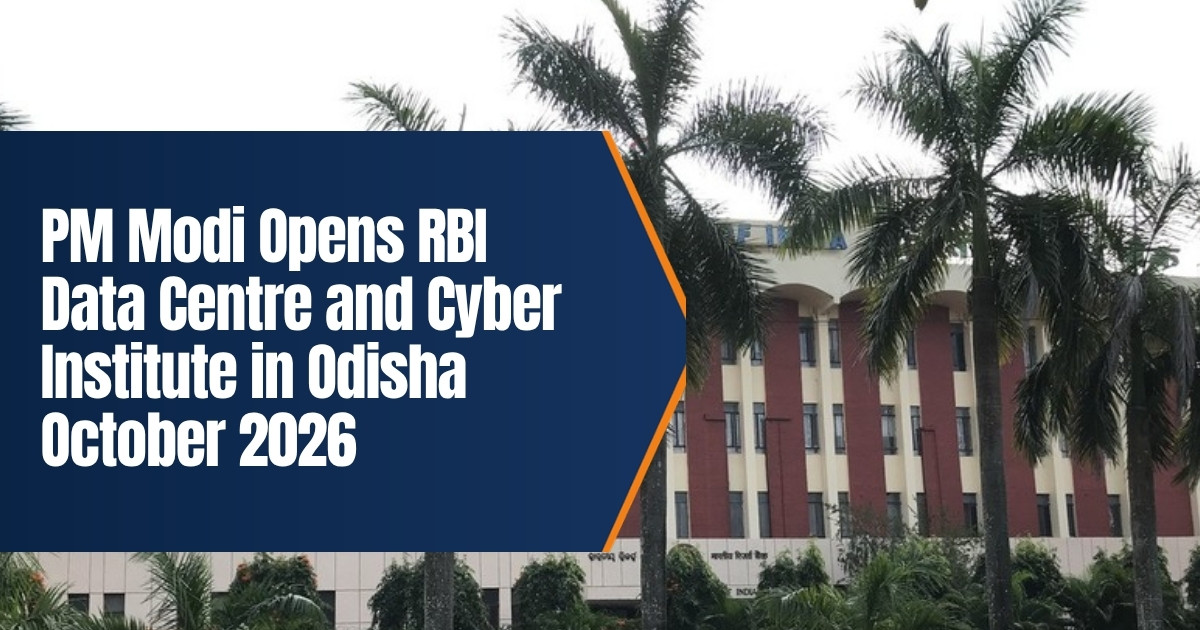
Featured image photo: Subhrasingh, CC BY SA 4.0, via Wikimedia Commons. The photo shows the Reserve Bank of India office building in Bhubaneswar, not the new data centre campus.
FAQ
Where is the new RBI data centre?
It is at Info Valley II in Jatni, near Bhubaneswar in Odisha, on an 18.55 acre campus shared with the Cybersecurity Training Institute.
Which systems will the data centre host?
Mission critical payment and settlement systems such as RTGS and NEFT, the e Kuber platform and applications used by regulated entities.
Who can train at the Cybersecurity Training Institute?
RBI staff as well as employees of banks and other financial sector organisations.
Sources
- Reserve Bank of India press release, 25 October 2026: inauguration and list of dignitaries.
- PM India, 25 October 2026: Prime Minister’s remarks.
- Hindustan Times, 25 October 2026: cost, site area, foundation stone and PMO statement.
- The New Indian Express, 25 October 2026: Finance Minister’s remarks and figures.
- ETBFSI, 26 October 2026: Governor’s remarks on systems, Tier IV rating, site choice and institute.