


India’s homegrown navigation system got a much needed lift late on Friday. The Indian Space Research Organisation (ISRO) launched the NVS 03 satellite on board its GSLV F18 rocket at 11:51 pm IST on 30 October 2026 from Sriharikota, and placed it in the planned orbit, The Times of India reported. The launch is meant to help restore NavIC, often called India’s own GPS, which has been unable to give users a standalone position fix since March because too few of its satellites are working, according to Hindustan Times.
The rocket lifted off from the second launch pad of the Satish Dhawan Space Centre (SDSC SHAR). It was the 20th flight of the Geosynchronous Satellite Launch Vehicle, The Times of India said.
Table of Contents
How the NVS 03 satellite launch unfolded
About 18 minutes after liftoff, the rocket released the satellite into a geosynchronous transfer orbit with an apogee of 37,023 km and a perigee of 170 km, The Times of India reported. That stretched oval is only a starting point. The satellite will use its own engine over the coming days to climb to its final working orbit.
“The GSLV F18 vehicle has successfully and precisely injected the NVS 03 satellite weighing 2250 kg in the intended elliptical orbit,†ISRO Chairman V Narayanan said after the launch, The Hindu reported in its live coverage. He thanked ISRO teams, industry partners and academia for what he called an outstanding accomplishment.
India Today, which followed the countdown live, described the flight as a picture perfect launch.
PM Modi congratulates ISRO
Prime Minister Narendra Modi congratulated the scientists and engineers in a post on X. “This mission marks an important step in strengthening NavIC, our indigenous satellite navigation system,†he wrote, adding that NVS 03 would further India’s pursuit of self reliance in critical technologies, The Times of India reported. “The dedication and ingenuity of our space scientists continue to make our nation proud,†he said.
Why NavIC needed this launch
NavIC, short for Navigation with Indian Constellation, is a regional system. Its main service area covers India and about 1,500 km beyond the country’s borders, according to Hindustan Times and India Today.
The system needs at least four working satellites to tell a user where they are. In a written reply to the Lok Sabha on 29 July, Minister of State Jitendra Singh said only three satellites, IRNSS 1B, IRNSS 1I and NVS 01, were providing signals, Hindustan Times reported. “To provide basic positioning service, minimum four operational satellites are required in orbit,†he said, while noting that the timing service still worked.
The minister also said there was “no vulnerability for the users†because NavIC is mostly used alongside other global systems, The Times of India reported.
Hindustan Times added that IRNSS 1B, one of the three working satellites, was launched in April 2014 with a 10 year mission life and is now in its 13th year. That makes fresh satellites all the more urgent.
The setback that came before
The previous satellite in the series, NVS 02, was launched on 29 January 2025 but never reached its intended orbit. An ISRO review found that an electrical signal failed to reach a pyro valve in the satellite’s oxidiser line, so its engine could not fire, Hindustan Times reported. The first of the new series, NVS 01, was launched in May 2023, The Times of India noted.
The Hindu noted that ISRO had recorded three failures in six missions launched from Indian soil between January 2025 and January 2026, which made Friday’s clean flight especially welcome for the agency.
What is new on board
NVS 03 is the third of the second generation NVS satellites. It carries an indigenously developed atomic clock alongside imported atomic clocks, The Times of India reported, a step towards reducing India’s reliance on foreign hardware for precise timing.
The satellite broadcasts navigation signals in the L1, L5 and S bands. According to The Times of India, the added L1 signal should improve compatibility with other satellite navigation systems and widen the use of NavIC in phones and other civilian devices. ISRO plans five second generation satellites in all, from NVS 01 to NVS 05.
Who uses NavIC
When four satellites were working, more than 10,400 railway locomotives, 40,000 fishing vessels and at least 60 mobile handset models used NavIC for tracking, emergency alerts and positioning, Hindustan Times reported. The newspaper said the government approved the programme in May 2006, and the system got its current name in April 2016.
Former Space Applications Centre director Nilesh M Desai stressed its strategic value before the launch. “For any country, its navigation system is considered its lifeline,†he told news agency ANI, as quoted by India Today. “It is used in the commercial and civilian domains, but it is also very important for strategic users.â€
What happens next
Over the next few days, ISRO will raise the satellite’s orbit step by step before it starts its tests. Once NVS 03 is checked and commissioned, NavIC should again have the four satellites it needs for standalone positioning. Jitendra Singh had told Parliament in July that NVS 04 and NVS 05 were in an advanced stage of realisation, Hindustan Times reported, so more launches are expected to follow.
For everyday users, the change may not be felt at once, because most phones mix signals from several systems. The bigger gain is strategic: a navigation service India controls fully, with a clock built at home.
Read more on Bharat Stories about how India built its space legacy, India’s journey from Chandrayaan to Gaganyaan, and how India is emerging as a leader in space exploration.
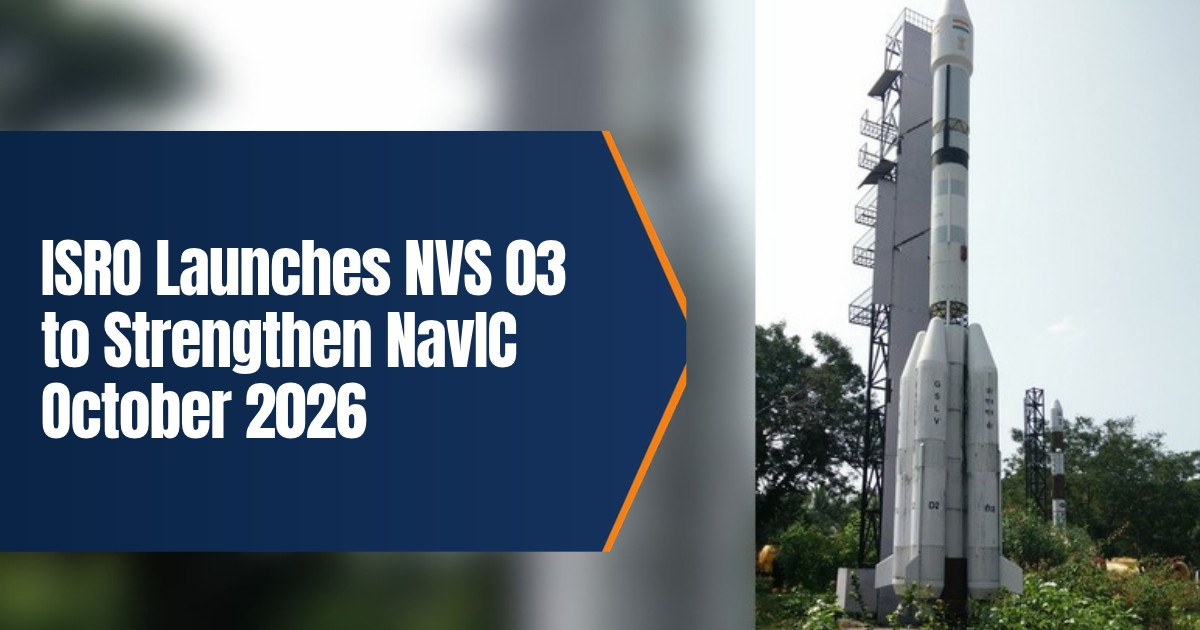
Featured image photo: à°°à°¹à±à°®à°¾à°¨à±à°¦à±à°¦à±€à°¨à± (Rahmanuddin), CC BY SA 4.0, via Wikimedia Commons. It shows a GSLV rocket model displayed at the Satish Dhawan Space Centre in Sriharikota in 2016, not the GSLV F18 launch itself.
FAQ
When was the NVS 03 satellite launched?
ISRO launched it on the GSLV F18 rocket at 11:51 pm IST on 30 October 2026 from the second launch pad at Sriharikota.
Why is NVS 03 important for NavIC?
NavIC needs at least four working satellites for standalone positioning, and only three were working. NVS 03 is expected to restore that minimum once it is commissioned.
What is special about NVS 03?
It carries an indigenously developed atomic clock along with imported clocks, and transmits signals in the L1, L5 and S bands.
Sources
- The Times of India, 30 and 31 October 2026: liftoff time, launch pad, 20th GSLV flight, orbit figures, atomic clock, L1 signal and minister’s remark.
- The Hindu live updates, 30 October 2026: ISRO Chairman V Narayanan’s statement and ISRO’s record of three failures in six missions.
- India Today live updates, 30 October 2026: launch coverage, coverage area and Nilesh M Desai’s remarks to ANI.
- Hindustan Times explainer, 30 October 2026: NavIC status since March, Lok Sabha reply, NVS 02 failure, user figures, programme history.
- The Times of India, 31 October 2026: Prime Minister Narendra Modi’s post on X.