

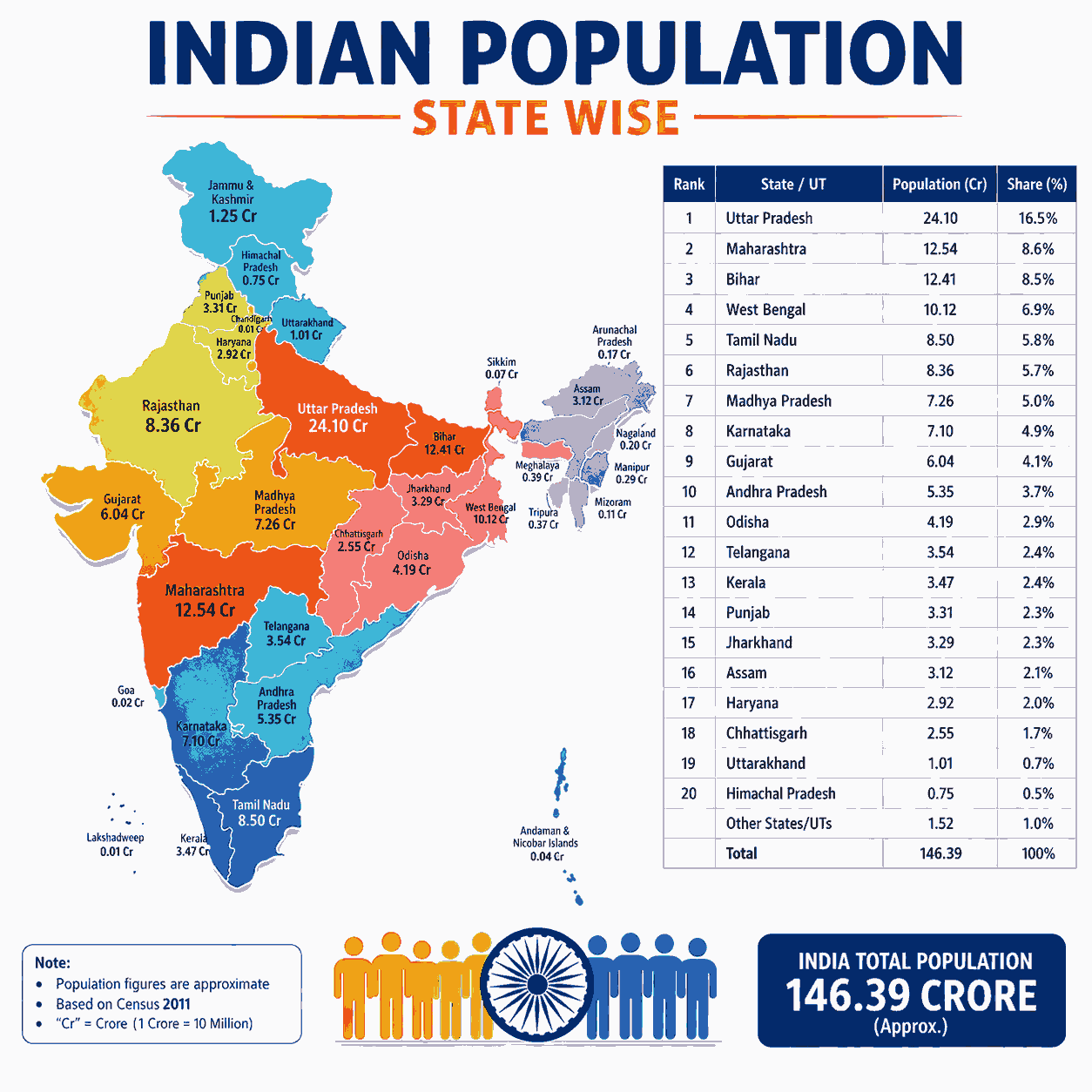
Indian Population – State Wise
India is a nation that hosts many people, and they are not evenly distributed across the country. India has very crowded areas. Knowing the population of each state in India lets us visualize how factors such as food, jobs, schools, and development are linked to population.
This article discusses the state-wise population India list, how people are distributed across the country, and what this implies for the country’s future. We shall concentrate on facts, easy-to-grasp concepts, and real-life illustrations to ensure readers can easily identify with the subject.
Table of Contents
Knowledge on the Population Structure of India.
The shape of India’s population state-wise depends on factors such as location, history, migration, employment, and cultural practices. However, when we look at the figures, we find that some states, such as Uttar Pradesh and Maharashtra, have high populations, whereas others, such as Sikkim and Goa, have lower populations.
Everything depends on the number of people in a place. It influences how cities develop, how the state organizes aspects such as roads and buildings, and how individuals acquire employment and education. This is why the population of Indian states should be taken into account.
India’s population state-wise
India has 28 states and 8 union territories. Each one has a different number of people. Based on the numbers, we can see that Uttar Pradesh has the most people in India. It has more than 200 million people, which is more than many countries. The reason for this is that many people are born in Uttar Pradesh and live in certain areas.
Maharashtra is the most populous state, with over 120 million people. This state has a city called Mumbai, one of the busiest in India. Many people move to Mumbai from parts of India to find jobs and start businesses.
Bihar is another state with over 100 million people. This state is smaller. Many people live in a small area. West Bengal has over 90 million people. Has a mix of people living in cities and rural areas. The city of Kolkata is a center for culture and trade.
Some states like Madhya Pradesh and Tamil Nadu have over 70 million people. While Madhya Pradesh has rural areas, Tamil Nadu has many cities and industries. Other states like Rajasthan, Karnataka, and Gujarat have between 60 and 70 million people. These states are growing because of job growth and urbanization. On the other hand, smaller states like Sikkim, Mizoram, Arunachal Pradesh, and Goa have fewer than 2 million people. These states have features like hills and forests, which make it hard for many people to live there.
Why Population Varies Across States
So why do some states have more people than others? The answer is that it is a mix of economic reasons. States with farming land, like Uttar Pradesh and Bihar, have always had more people. Over time, these places kept growing because families had children and stayed in rural areas.
In contrast, states with land like that in the northeast have smaller populations because it is hard to live there. Economic opportunities also play a role. States like Maharashtra, Karnataka, and Gujarat attract people from across India because of job opportunities in industries and businesses.
Education and awareness also affect the number of people in a place. States like Kerala and Tamil Nadu have lower birth rates because people are more educated and have better access to healthcare.
Urban vs Rural Population Distribution
Another important thing to consider is the Indian demographics statistics of people living in cities and those in rural areas. Many states still have people living in rural areas, especially in the north and central parts of India.
States like Bihar, Uttar Pradesh, and Madhya Pradesh have more people living in villages than in cities. Farming is a source of income in these areas. On the other hand, states like Maharashtra, Tamil Nadu, and Karnataka have more people living in cities. These cities offer jobs, education, and healthcare, which attract people from rural areas.
When people move from one area to another, it is called migration. This movement of people affects the population of each state in India.
Impact of Population on Development
The number of people in a state affects development. A large population can put pressure on resources such as water, housing, and healthcare. For example, in densely populated areas, schools and hospitals can become crowded. It can also be hard to find jobs if there are more workers than available positions.
At the time, a large population can also be good. It provides a workforce and a big market for businesses. States like Maharashtra and Tamil Nadu have used their population to build strong industries.
Smaller states may face pressure on resources, but they may also face challenges such as a small workforce and slow economic growth.
Population Density: A Key Factor
Population density is another factor to consider. It means the number of people living in an area. This gives a picture rather than just the total number of people.
For example, Bihar has a high population density because many people live in a small area. Rajasthan, on the other hand, has a lower density because it has a large desert area with fewer people.
Trends in Population Growth
Understanding density helps plan cities, transportation, and public services. It also helps manage issues such as pollution and land use.
India’s population growth has slowed down. It still varies from state to state. Northern states like Uttar Pradesh and Bihar are still growing rapidly due to high birth rates. Southern states like Kerala and Tamil Nadu are growing more slowly because families prefer to have children and have better access to education and healthcare.
Migration also affects growth. Many people move from rural areas to larger cities for jobs, increasing urban populations.
These trends are important when examining the population of each state in India, as they show how the country is changing over time.
Role of Government Policies
Government policies also influence population trends. Family planning, education, and healthcare programs are used to curb population growth.
States that have invested in women’s education have experienced lower birth rates. Healthcare services also assist families in making decisions about family size.
Infrastructure development, such as roads, schools, and industries, also influences people’s choice of residence. This alters the population structure in India with time.
Challenges Linked to Population Distribution
Given that each state has a different population, this poses challenges. Unemployment, crowding, and strain on available natural resources are common problems in densely populated states.
Growing cities might experience problems such as traffic congestion, pollution, and housing crises. Rural communities may face unemployment, which can contribute to migration.
On the other hand, states with smaller populations may find it hard to attract investment and build strong economies.
Balancing population growth and development remains a concern in India.
Future of India’s Population Distribution
The future of India’s population state-wise depends on education, economic growth, and government planning.
Urban areas are expected to grow as more people move to cities in search of better opportunities. Technology and remote work may also change migration patterns in the coming years.
States that focus on education, healthcare, and job creation are likely to manage their population and improve living standards.
Conclusion
In conclusion, the population of Indian states shows diversity across the country. Some states are densely populated and economically active, while others have smaller populations and unique geographical features.
Understanding the population of each state in India is not about numbers. It helps us see how resources are used, how cities grow, and how opportunities are created.
As India continues to grow, managing population distribution in India will remain important for development and a better quality of life.
S.No |
States |
Population (2011 Census) |
Density (per km²) |
Sex ratio |
|
1 |
Uttar Pradesh |
199,581,477 |
828 |
908 |
|
2 |
Maharashtra |
112,372,972 |
365 |
946 |
|
3 |
Bihar |
103,804,637 |
1102 |
916 |
|
4 |
West Bengal |
91,347,736 |
1029 |
947 |
|
5 |
Andhra Pradesh |
84,665,533 |
308 |
992 |
|
6 |
Madhya Pradesh |
72,597,565 |
236 |
930 |
|
7 |
Tamil Nadu |
72,138,958 |
555 |
995 |
|
8 |
Rajasthan |
68,621,012 |
201 |
926 |
|
9 |
Karnataka |
61,130,704 |
319 |
968 |
|
10 |
Gujarat |
60,383,628 |
308 |
918 |
|
11 |
Odisha |
41,947,358 |
269 |
978 |
|
12 |
Kerala |
33,387,677 |
859 |
1,084 |
|
13 |
Jharkhand |
32,966,238 |
414 |
947 |
|
14 |
Assam |
31,169,272 |
397 |
954 |
|
15 |
Punjab |
27,704,236 |
550 |
893 |
|
16 |
Haryana |
25,353,081 |
573 |
877 |
|
17 |
Chhattisgarh |
25,540,196 |
189 |
991 |
|
18 |
Jammu and Kashmir |
12,548,926 |
56 |
883 |
|
19 |
Uttarakhand |
10,116,752 |
189 |
963 |
|
20 |
Himachal Pradesh |
6,856,509 |
123 |
974 |
|
21 |
Tripura |
3,671,032 |
350 |
961 |
|
22 |
Meghalaya |
2,964,007 |
132 |
986 |
|
23 |
Manipur |
2,721,756 |
122 |
987 |
|
24 |
Nagaland |
1,980,602 |
119 |
931 |
|
25 |
Goa |
1,457,723 |
394 |
968 |
|
26 |
Arunachal Pradesh |
1,382,611 |
17 |
920 |
|
27 |
Mizoram |
1,091,014 |
52 |
975 |
|
28 |
Sikkim |
607,688 |
86 |
889 |
|
29 |
Delhi |
16,753,235 |
9,340 |
866 |
|
30 |
Puducherry |
1,244,464 |
2,598 |
1,038 |
|
31 |
Chandigarh |
1,054,686 |
9,252 |
818 |
|
32 |
Andaman and Nicobar Islands |
379,944 |
46 |
878 |
|
33 |
Dadra and Nagar Haveli |
342,853 |
698 |
775 |
|
34 |
Daman and Diu |
242,911 |
2,169 |
618 |
|
35 |
Lakshadweep |
64,429 |
2,013 |
946 |
FAQs
What is the most populous state in India?
Uttar Pradesh is the most populous state in India, with more than 200 million people.
Which state has the lowest population in India?
Sikkim has the lowest population among Indian states.
Why is the population across Indian states?
Population varies due to factors such as geography, opportunities, education, and access to healthcare.
How does population affect development?
A higher population can create pressure on resources while also providing a workforce for economic growth.
What is population density?
Population density is the number of people per square kilometer in a given area.
Which states have an urban population?
Maharashtra, Tamil Nadu, and Karnataka have higher urban populations due to strong industrial and job opportunities.