

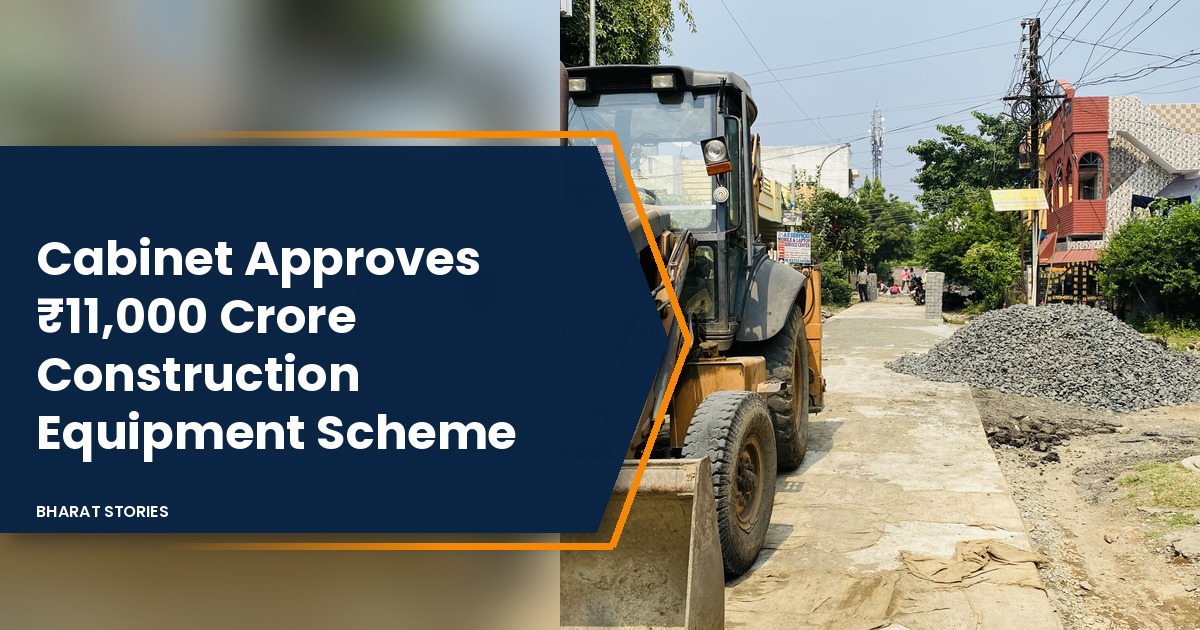

The Union Cabinet has approved a ₹11,000 crore scheme to build up domestic manufacturing of construction and infrastructure equipment (CIE) in India. The decision was taken on Wednesday, 25 November 2026, at a meeting chaired by Prime Minister Narendra Modi, according to the Press Information Bureau. The Ministry of Heavy Industries will run the scheme, which also funds a dedicated CIE testing facility inside the country.
Table of Contents
What does the construction equipment scheme offer manufacturers?
The scheme has two parts. The first is a sales linked incentive paid on the incremental sales value of eligible CIE equipment and components. It is open to two kinds of approved applicants, original equipment manufacturers (OEMs) and component makers, and the graded rates run from 13 per cent down to 8 per cent over a five year period, the PIB release says.
The second part is a grant of up to ₹375 crore, in the form of viability gap funding, to set up a dedicated testing facility. The Cabinet briefing says the money goes to the Automotive Research Association of India (ARAI), so that machines built in India can be tested and certified at home.
Which machines and parts are covered?
The scheme covers seven categories of equipment that are fully or largely imported today: tunnel boring machines, off highway trucks, excavators, cranes, loaders, piling rigs and drilling machines. Union Minister Ashwini Vaishnaw gave the same list while briefing the media, Akashvani News reported. The PIB release names ship to shore cranes and hydraulic excavators among the technologically advanced machines it wants made in India.
Five categories of components are included as well: engines, transmissions, hydraulic systems, undercarriages and drive systems. Including components means the incentive is not limited to makers of finished machines.
How long will the scheme run?
It lasts eight years from the 2026 27 financial year. The first two years are a gestation period for companies to set up factories. A five year incentive disbursement period follows, from 2028 29 to 2032 33, and the last year, 2033 34, is for settling incentives on the incremental sales of 2032 33. The Hindu reported the same timeline from the ministry statement.
Why does India want to make more of this equipment at home?
India’s CIE industry is the world’s third largest, after China and the United States, with a market of about ₹97,500 crore in 2024 25. The Cabinet briefing notes that about 45 per cent of that market depends on imports. The PIB release expects the industry to more than double, to around ₹2,28,100 crore by 2029 30, as roads, ports and housing keep growing.
The government expects the scheme to attract about ₹21,000 crore of investment and to replace imports worth about ₹22,500 crore over its life, according to the briefing. A Ministry of Heavy Industries statement quoted by The Hindu says that building local capability will ensure supply chain security and create more jobs.
This is not the only Cabinet decision on business support this month. On 11 November it extended Stand Up India and the Mudra credit guarantee fund to 2031, which we covered in our report on the Stand Up India and Mudra extension. In electronics, the government has also been approving factory projects under the Electronics Components Manufacturing Scheme, as in our story on the Semicon 2.0 portal and 12 ECMS projects.
What else did the Cabinet approve on 25 November?
The briefing lists five decisions with a combined outlay of ₹19,934 crore. After the equipment scheme, the largest is a second container terminal at Kamarajar Port in Tamil Nadu, to be built on a design, build, finance, operate and transfer basis under a public private partnership at an estimated ₹4,288 crore. The concession runs for 40 years on a 111 acre site, with a design capacity of 2 million TEUs a year, a 900 metre long berth and an 18 metre draft. It will be able to take vessels of up to 24,346 TEUs.
The Cabinet also cleared a greenfield airport at Doloo, Silchar, in Assam at an estimated ₹2,014 crore, funded entirely from the Airports Authority of India’s own resources. The existing airport is owned by the Indian Air Force, with a civil enclave of 70 acres that can handle only A320 and Boeing 737 800 type aircraft, and the briefing says terminal traffic already exceeds capacity. The new airport plans a 12,351 square metre terminal, a 2,705 metre runway and capacity for 800 passengers at peak hour, or 1.01 million a year. For other airports across the country, see our list of domestic and international airports in India.
The remaining two decisions are for the Department of Posts: the Postal Operations Scheme, with an outlay of ₹1,141 crore over five years from 2026 27, and the Estates Management Scheme, with ₹1,491 crore for building and renovating post offices, staff colonies and heritage postal buildings.
What is still unclear?
None of the official material says when applications will open, how many manufacturers are expected to qualify, or what the final eligibility rules will be. Those details will matter for companies deciding whether to build new plants during the two year gestation period.
Sources
- PIB: Cabinet approves Rs 11,000 crore Scheme for Enhancement of CIE Manufacturing Ecosystem, 25 November 2026
- PIB: Cabinet briefing, 25 November 2026 (PDF)
- The Hindu: Cabinet approves ₹11,000 crore scheme for domestic manufacturing of construction equipment, 25 November 2026
- Akashvani News: Union Cabinet approves ₹11,000 crore scheme to boost domestic construction equipment manufacturing, 25 November 2026