

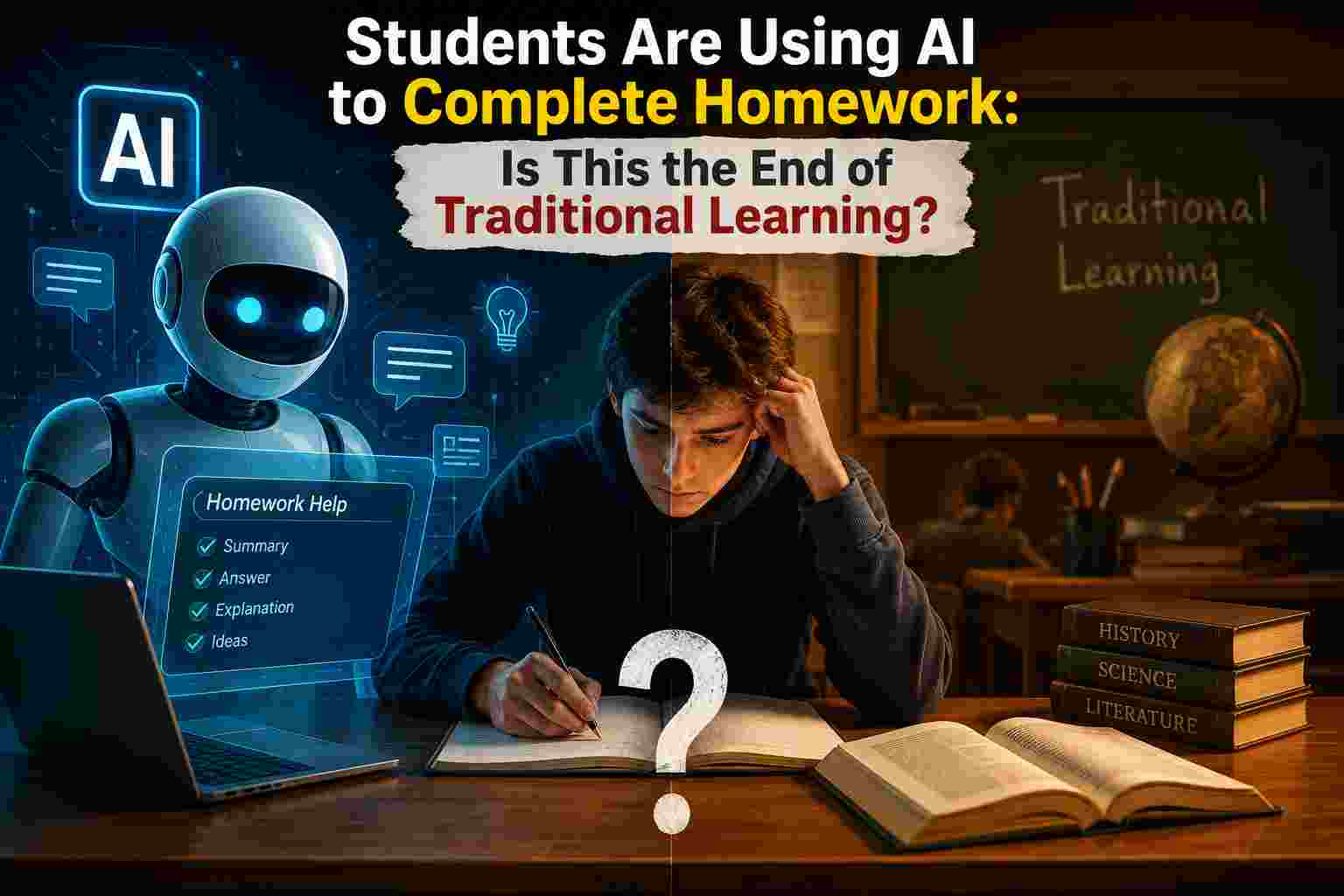
Students Are Using AI to Complete Homework: Is This the End of Traditional Learning?
Walk into any school staffroom today and you’ll hear teachers debating the same thing. Students are using AI for homework. Essays are coming in polished. Answers are suspiciously complete. ChatGPT homework is no longer a rare exception — it’s a pattern teachers everywhere are dealing with.
It takes an honest look at what’s actually happening — not to blame anyone, but to understand it clearly.
Table of Contents
What’s Actually Going On in Classrooms
By early 2023, students around the world were using it for assignments. This wasn’t a slow drift. It happened fast.
A survey by the Stanford Internet Observatory found close to 60% of US high school students had used ChatGPT for homework. Indian students followed a similar pattern, particularly those in urban schools with smartphone access. ChatGPT homework became normal within months, not years.
Students aren’t doing this secretly because they’re lazy. Many do it openly because it works. Ask a question, get an answer. Paste it in. Submit. The temptation is obvious.
But here’s what doesn’t get said enough: many students also use AI for students in genuinely productive ways — to understand concepts they missed in class, to get feedback on drafts, to check their reasoning before submitting. The picture is more complicated than “students are cheating.”
Why This Is Happening Now
The timing isn’t coincidental. Several things came together at once.
Smartphones became nearly universal among school students in India by 2022. Internet access improved significantly in smaller cities. AI tools became free and easy to use. And the pandemic had already disrupted traditional learning for two full years. Students came back to classrooms already detached from old routines.
Into that environment came ChatGPT. It was conversational, fast, and didn’t judge. A student who struggled to write three paragraphs could get three polished pages in seconds. A student who didn’t understand a maths concept got a step-by-step explanation clearer than the textbook.
Education technology had promised to personalise learning for decades. AI actually delivered something that felt personal — even when it wasn’t perfect.
What Teachers Are Dealing With
Teachers are caught in a genuinely difficult position. They can’t ban smartphones. They can’t ban the internet. And AI detection tools — like Turnitin’s AI detector — are imperfect. AI-generated text that a student edits slightly often slips through.
Some teachers have responded by moving away from take-home essays entirely. They’re giving in-class writing assignments, oral presentations, and hands-on projects where AI can’t substitute for the student’s own presence and thinking.
Others have accepted that AI is here and are trying to teach students how to use AI learning tools responsibly rather than covertly. This approach treats ChatGPT the way earlier generations treated calculators: not banned, but not a replacement for understanding the underlying skill either.
Both approaches have merit. Neither is fully winning yet.
Is Traditional Learning Actually Ending?
This is the question everyone keeps asking. The honest answer is: parts of traditional learning are already gone, and they probably aren’t coming back.
Rote memorisation of facts was already less useful once search engines became ubiquitous. Now, the ability to produce a generic five-paragraph essay on a set topic is similarly losing value. If any student can generate a competent essay on the causes of the First World War in 30 seconds, the essay itself stops measuring anything meaningful.
But this doesn’t mean learning is ending. It means what learning needs to do is shifting.
The skills that AI cannot replicate well are the skills that matter more now:
- Critical thinking — evaluating whether an argument holds up, not just whether it sounds good
- Original synthesis — connecting ideas across domains in ways that aren’t prompted
- Ethical reasoning — making judgements that require context and human experience
- Creative risk-taking — making choices that reflect a genuine point of view, not a statistical average of existing content
- Interpersonal skills — collaborating, debating, persuading other human beings
These are the skills that the future of education needs to be building. The schools that will serve students best are the ones that recognise this shift and respond to it — not by banning AI, but by redesigning what they’re trying to measure and teach.
The AI Learning Debate: Where Experts Stand
Educators are genuinely divided. Some see AI as an opportunity. Others see it as a threat to academic integrity.
Dr. Ethan Mollick at Wharton has argued that AI tools will become as foundational as the internet, and that universities need to teach students to use them well. His research suggests students who use AI learning tools effectively can produce genuinely better work — if they use AI to extend their thinking rather than replace it.
On the other side, many educators argue that the struggle of producing work — not knowing how to start, wrestling with an argument until it clicks — is where learning actually happens. Remove that struggle and you remove the learning.
Both points can be true at once. AI can help and hinder learning depending entirely on how a student uses it.
What Parents Should Actually Be Thinking About
If your child is using AI for homework, the first question isn’t “is this cheating?” It’s “are they learning anything?”
A student who generates an essay and submits it unchanged has learned nothing. A student who uses ChatGPT to get a draft, then rewrites it in their own voice while checking facts and sharpening arguments, has actually done real work — just different work.
AI for students is a tool. A hammer doesn’t build a house — the person using it does. The same logic applies here.
Parents can test this simply. Ask your child to explain what they submitted. If they can walk you through it, they understand it. If they can’t, the AI did the learning and they didn’t.
The Future of Education With AI in the Room
The future of education isn’t AI replacing teachers. It’s teachers and students working out what AI is for and what it isn’t — a hard conversation happening in real time right now.
Some changes are already clear. Tests that any AI can answer need to be redesigned. In-class writing, oral assessments, project portfolios, and problem-solving tasks are gaining ground because they’re harder to fake.
Curriculum needs to include AI literacy — teaching students to evaluate AI output, spot errors, and understand its limits. The future of education means treating that as a skill, not just a warning.
And strong human teaching matters more now, not less. Research consistently shows the teacher-student relationship is one of the strongest predictors of learning outcomes. AI doesn’t change that. Students still need someone to help them make sense of everything they’re encountering. The schools that see education technology not as a threat but as a new set of constraints to design around will serve students well over the next decade.
Frequently Asked Questions
-
Is using ChatGPT for homework considered cheating?
It depends on how it’s used and what the school’s policy says. Using ChatGPT to generate work and submit it unchanged is widely considered academic dishonesty. Using it to understand a concept better or get feedback on your own draft is closer to how students have always used tutors and reference books. The key question is whether the student did the thinking.
-
Can teachers detect AI-generated homework?
Sometimes. Tools like Turnitin have built AI detection, but they aren’t perfect. AI-written text that’s been edited or paraphrased often slips through. Many teachers are now moving toward in-class assessments and oral reviews, which are harder to fake.
-
How should students use AI for students responsibly?
Use AI learning tools to understand concepts, check reasoning, and get feedback on your own drafts. Don’t submit AI-generated content as your own work. The goal of school is to build skills — AI can support that or undermine it depending on how you use it.
-
Will AI replace teachers?
No. Research consistently shows that the teacher-student relationship is one of the most powerful factors in learning. What AI will likely do is change what teachers spend their time on — less on delivering information that students can find elsewhere, more on critical thinking, discussion, and individual support.
-
What does the future of education look like with AI?
More emphasis on skills that AI can’t replicate — critical thinking, original synthesis, creative judgment, ethical reasoning. Assessment will move away from essays and fact-recall tests toward projects, presentations, and problem-solving. AI literacy — knowing how to use and evaluate AI tools — will become part of the standard curriculum.