

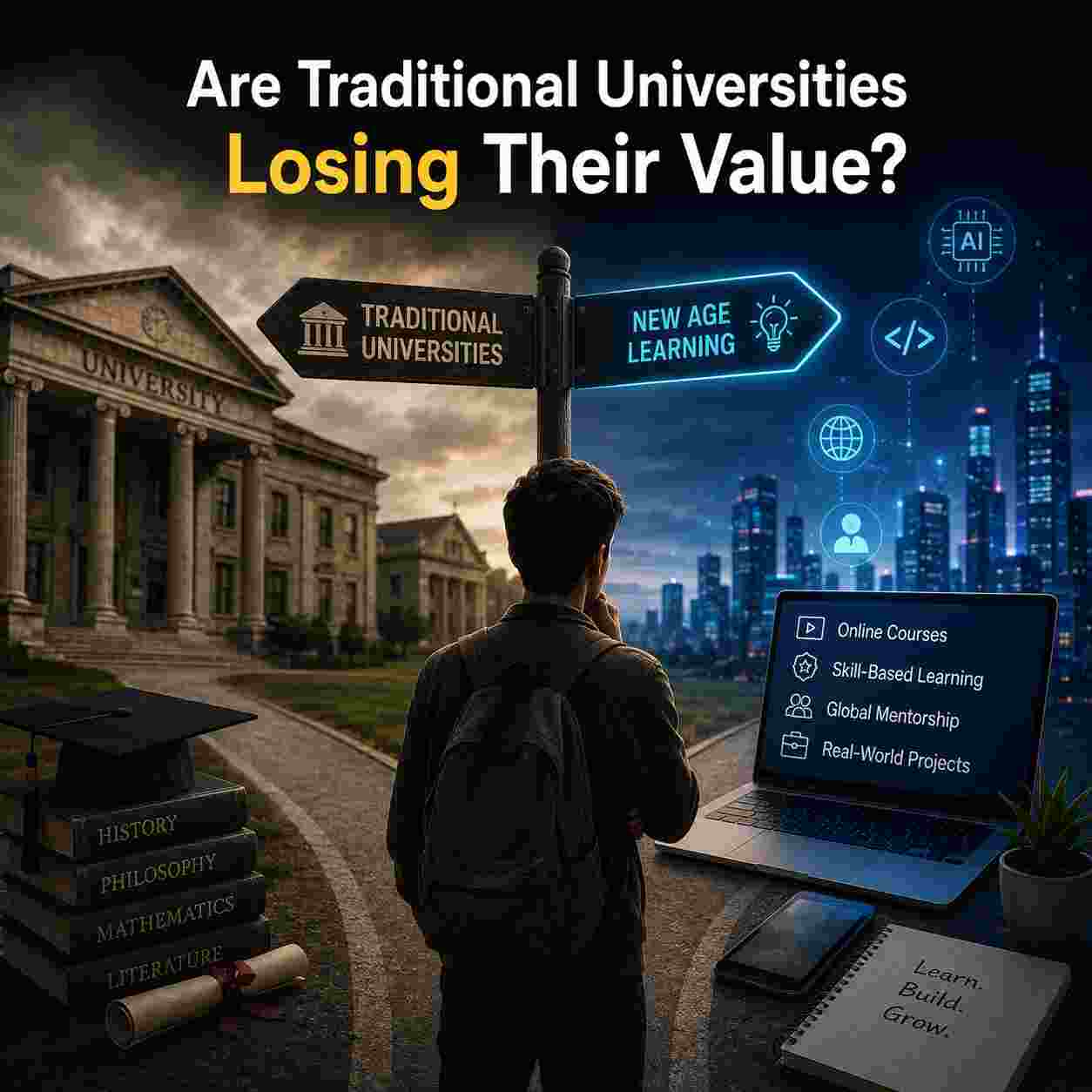
Are Traditional Universities Losing Their Value?
Ten years ago, this question would have sounded almost offensive to most educators. A university degree was the path. Full stop. Today, the question comes up in board meetings, career counselling sessions, and family dinners, and fewer people are dismissing it than before.
That doesn’t mean universities are done. But something has clearly shifted. Higher education trends over the last decade point to a growing gap between what traditional institutions offer and what students, employers, and the working world actually need. That gap is worth taking seriously.
Table of Contents
What’s Actually Changing
The numbers tell one part of the story. Enrolment at traditional universities in several Western countries has been declining steadily. In the US, college enrollment dropped by nearly four million students between 2010 and 2022. India’s higher education sector is growing in total numbers, but the frustration with degree relevance and graduate unemployment is loudly present here too.
At the same time, higher education trends are pointing sharply toward online learning platforms, short-term certification courses, and self-directed skill building. These aren’t fringe choices anymore. Tens of millions of people are completing courses on platforms like Coursera, LinkedIn Learning, and Udemy every year, and a growing number of employers are starting to treat those credentials with real respect.
The Case Against Traditional Universities Right Now
Let’s be honest about what’s frustrating people. Cost is the most obvious issue. A four-year college degree in the US can run anywhere from 50,000 to well over 200,000. Graduates often spend years repaying student debt while working in jobs that didn’t strictly require the degree they borrowed money to get.
Beyond cost, there’s the time factor. Four years is a long commitment in a job market that changes fast. A lot of what gets taught in the first two years covers foundational material with little direct connection to what a job actually requires.
The classroom experience is also being questioned. Sitting in a lecture hall with three hundred students doesn’t give anyone much personal attention or mentorship. Online learning, ironically, often does better on that front — with personalised feedback, self-paced progress, and direct access to working professionals through courses.
What Online Learning Has Actually Changed
Online learning didn’t just make education cheaper or more convenient. It fundamentally changed who gets to learn, from where, and on what timeline.
A first-generation student in a small town now has access to courses taught by professors from universities they’d never be able to attend physically. A professional in their thirties can pick up a new skill in the evenings without leaving a job. A high school student can access university-level content years before applying.
This access shift is significant. It’s also why the conversation about college degrees has changed. When someone can learn data science from a working practitioner online, get a portfolio of real projects, and then apply for a job, the four-year degree starts to look like one option among several, not the only viable option.
Where AI Education Fits Into This
AI education is making things more interesting — and more complicated — at the same time. AI-powered learning tools can now adapt content to how a specific person learns, track gaps in understanding, and suggest the next step. That’s something a fixed university curriculum simply cannot do.
AI education platforms are also creating new categories of skills that didn’t exist five years ago, and universities are often slow to fold these into degree programmes. By the time a course on prompt engineering or machine learning gets formally accredited, the field has moved on.
That said, AI education comes with its own limits. It’s strong on technical content and weak on the kind of structured thinking, debate, and peer interaction that a good university still does well. The two aren’t opposites so much as they’re filling different gaps.
What the Future of Universities Actually Looks Like
The future of universities almost certainly isn’t extinction. It’s more likely to be a serious narrowing of purpose and a harder push to prove value in ways that were easy to take for granted before.
Some things that make physical university attendance hard to replace:
- Research infrastructure and access to labs, equipment, and specialised resources
- Professional networking that happens organically over years of shared physical space
- Structured intellectual challenge across multiple disciplines, not just one skill
- Credentials that still carry strong weight in specific fields like medicine, law, and engineering
- Campus experiences, personal development, and exposure to different people and ideas
For these reasons, the future of universities isn’t a blank page. But universities that rely on name recognition and old reputation alone, without updating how they teach and what they teach, are going to find the ground shifting beneath them faster than expected.
What Employers Are Actually Looking For
Employer attitudes have been shifting in ways that are quietly reshaping higher education trends. Google, Apple, IBM, and a growing list of other major companies have dropped the requirement for a college degree for a significant number of positions. They’re hiring based on demonstrated skill, portfolio work, and problem-solving ability.
This matters because universities have historically justified their cost partly on employment outcomes. When the employer no longer requires the degree, that justification gets weaker in direct proportion.
That said, many employers in finance, healthcare, law, and research still treat college degrees as a basic requirement. The shift isn’t uniform — it’s sector-specific, and students choosing their path need to understand which sector they’re heading into.
What Students Should Actually Be Thinking About
For someone deciding right now whether to pursue a traditional university, online learning, or some combination, a few honest things are worth sitting with.
A degree from a well-regarded institution still carries weight, especially early in a career before a track record has built up. The network from a physical university — professors, classmates, alumni connections — is genuinely difficult to replicate online.
At the same time, college degrees aren’t the only way to build that network, and they’re definitely not the only path to skills. Many people now combine a shorter, focused university programme with online courses and internships to build something more practical and less expensive than a traditional four-year route.
Final Thought
Nobody serious is arguing that universities should disappear. What’s being argued, and fairly, is that the automatic assumption of their value is no longer justified. Higher education trends are forcing institutions to answer questions they’ve avoided for decades: What exactly do students get for this cost? Could they get it another way? Does the credential still mean what it used to?
The answer differs depending on the person, the field, and the country. Online learning and AI education aren’t replacing universities — they’re creating real competition for the first time. And competition, for better or worse, tends to force things to get better.
Frequently Asked Questions
-
Are college degrees still worth pursuing in 2025?
It depends heavily on the field. Medicine, law, engineering, and academic research still require formal degrees as a legal or professional standard. In technology, design, and creative fields, demonstrated skill and portfolio work are increasingly accepted as alternatives. The blanket assumption that a degree is always necessary no longer holds across every sector.
-
How are higher education trends changing what universities teach?
There’s growing pressure to include more applied, practical content alongside theoretical foundations. Many universities are adding short-term certificate programmes, online modules, and industry partnerships to stay relevant. The pace of change varies significantly between institutions.
-
Is online learning as respected as a university degree by employers?
It depends on the employer and the role. In tech companies especially, online certifications and demonstrated skills are increasingly taken seriously. In more traditional industries, a formal degree still carries more weight. The gap is narrowing, but it hasn’t closed completely.
-
What role does AI education play in higher learning today?
AI education tools are being used inside and outside universities to personalise learning paths, provide instant feedback, and cover skills that traditional programmes haven’t caught up with yet. Universities are beginning to integrate AI tools into coursework, though many are still working out the right approach.
-
What does the future of universities look like over the next decade?
The future of universities is likely to involve a stronger focus on what physical attendance genuinely offers — research, community, peer learning, and accredited credentials in regulated fields — while shedding the parts that online learning does better at a fraction of the cost. Universities that adapt quickly will do fine. Those that don’t will find the next decade difficult.