

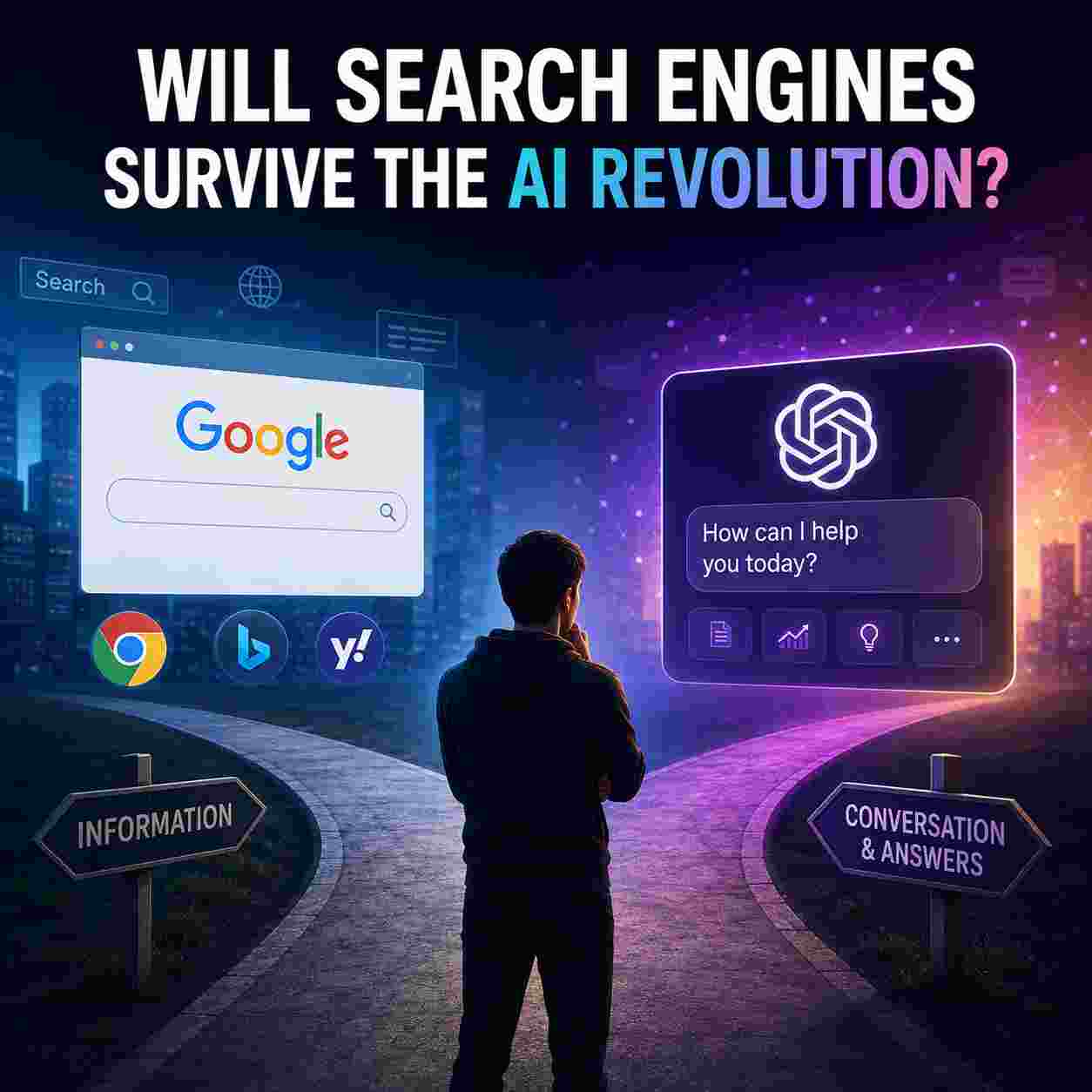
Will Search Engines Survive the AI Revolution
Remember when “googling something” just meant typing a phrase and scrolling through a list of links? That’s still how a lot of people search, but it’s not the whole picture anymore. Tools like ChatGPT search and Google AI now jump in with answers before you even click anything. So naturally, people are starting to wonder: are search engines on their way out?
This article gets into what’s actually changing, why it matters, and what the future of search engines might realistically look like for the people using it every day.
Table of Contents
The Old Way of Searching
For most of the internet’s history, search worked in a pretty simple way. You typed something in, got a wall of blue links, and clicked around until you found what you needed. It wasn’t fancy, but it worked, and most people never really questioned it.
The catch was that all the digging fell on the user. Want to compare three products? Open three tabs. Need a quick fact buried somewhere in an article? Skim through paragraphs to find it.
AI search flips that around. Instead of links, you get an actual answer, written out, summarized, and ready to use. ChatGPT search can pull information from multiple sources and hand it over in one response. Once someone experiences that a few times, going back to ten open tabs starts to feel like a step backward. That’s really the heart of why this shift is happening so quickly.
What’s Going On With Google AI
Google clearly noticed this trend too, and it hasn’t been sitting on the sidelines. The company has started placing AI-written summaries right at the top of search results, so people sometimes get their answer before scrolling past anything else.
A few things you might’ve already noticed:
- AI summaries showing up above the usual list of links
- Being able to ask a follow-up question without leaving the page
- Some searches not really needing a click-through to a website anymore
- Certain websites getting noticeably less traffic for basic, common questions
It’s pretty clear what Google AI is going for here. Keep people on the platform, answer questions directly, and reduce the need to bounce off to other sites. That’s a big shift from the “here are some links, good luck” approach search engines used for years.
Why AI Search Has Caught On So Fast
AI search saves time, and people notice that pretty quickly.
AI technology can scan through a huge amount of information and hand back a clean answer in seconds. No tab-hopping, no skimming five articles just to piece together one paragraph’s worth of useful info.
But here’s something worth keeping in mind: AI answers aren’t always right. They can be outdated, especially for anything that changes often, like prices, news, or recent updates. And unlike a regular search result, there isn’t always a clear sense of where the information came from or how recent it actually is.
So yes, it’s faster. Just maybe don’t rely on it completely for anything important without a quick double-check.
Are Search Engines Actually Going Away?
Short answer: Probably not, at least not in the way a lot of people picture it. AI tools still need somewhere to pull information from, and that “somewhere” is largely the same web that search engines have been organizing for years. ChatGPT search and similar tools are often working with search infrastructure underneath, not replacing it from the ground up.
Think of it less like AI knocking out search engines, and more like AI sitting on top of them, using what’s already there but presenting it in a different way.What is changing is how people use search. Instead of typing out careful keyword phrases, more people are simply asking questions the way they’d ask another person. And instead of clicking through five results, many are satisfied with one solid answer.
Search engines aren’t disappearing here. They’re becoming more of a backstage operation, less visible, but still doing a lot of the heavy lifting behind the scenes.
What Does the Future of Search Engines Actually Look Like?
Honestly, it looks like a mix of both. This combo is already visible: AI answers up top, regular search results below. That setup seems likely to stick around for a while. For website owners, this raises a real concern. If someone gets their answer from an AI summary, they might never click through to the original article, even if that article is where the AI pulled its information from in the first place.
This is already changing how businesses think about their content and how they get found online. For everyday users, this mostly means faster answers, with one small tradeoff: people might need to double-check things a bit more often than they used to.
A few patterns seem likely to continue:
- AI features keep getting added to search, rather than search results disappearing
- People use AI tools for quick answers and regular search for deeper digging
- Solid, original websites still matter, since that’s often where AI tools pull their information from
- Conversational and voice search keep growing alongside typed searches
What Should You Actually Do With All This?
Honestly, just use whatever fits the moment. If you want a quick answer or a starting point on something, AI search works great for that. If you’re researching something important, comparing options, or want to read the original source directly, regular search engines still do that job well.
Most people have probably already been doing this without giving it a label. Asked Google AI a quick question? That’s AI search. Clicked through afterward to read a full article? That’s traditional search, still doing its job. There’s no real need to pick a side here. The smarter approach is just using whichever tool fits what someone is trying to do at that moment.
Does AI Technology Make Things More Accurate?
Not automatically, no. AI technology is excellent at summarizing and organizing information quickly, but it’s only as good as what it’s pulling from. If the source material is outdated or incorrect, the AI’s answer will carry that same issue.
This is actually a good reason why search engines still matter. They’re the ones doing the sorting and ranking of all that source material in the first place. AI tools depend on that structure, whether people realize it or not.
So really, AI search and traditional search aren’t competing as much as they’re tangled together. One often depends on the other more than it first appears.
Bottom Line
The future of search engines aren’t like they’re going extinct anytime soon, but they are definitely evolving. The gap between a “search engine” and an “AI assistant” keeps shrinking, and for most people, that’s actually a useful shift rather than a worrying one.
The real skill now is knowing which tool fits which job. Need a quick answer? Google AI or ChatGPT search has that covered. Need deeper research or source-checking? Regular search engines are still the better bet. Both have their place, and that’s likely how things will stay for a while yet.
Frequently Asked Questions
Will Google AI completely replace regular search results?
Doesn’t seem likely. Google AI adds a summary near the top of the page, but regular results are still right there underneath for anyone who wants to dig deeper.
Is ChatGPT search better than Google for finding information?
It depends on the task. For quick answers and back-and-forth questions, ChatGPT search is handy. For finding specific websites or comparing detailed information, regular search often works better.
Can AI search tools get things wrong?
Yes, this happens sometimes. Especially with anything time-sensitive or recently updated. It’s worth double-checking if the information actually matters.
What’s the biggest change AI technology has brought to search?
Probably the shift from “here are some links” to “here’s your answer directly.” It’s convenient, but it also means fewer people clicking through to the original sources.
Should people just use AI tools and skip search engines entirely?
Probably not. Most people end up using both, AI tools for quick stuff, and search engines for anything that needs more depth, comparison, or verification.