

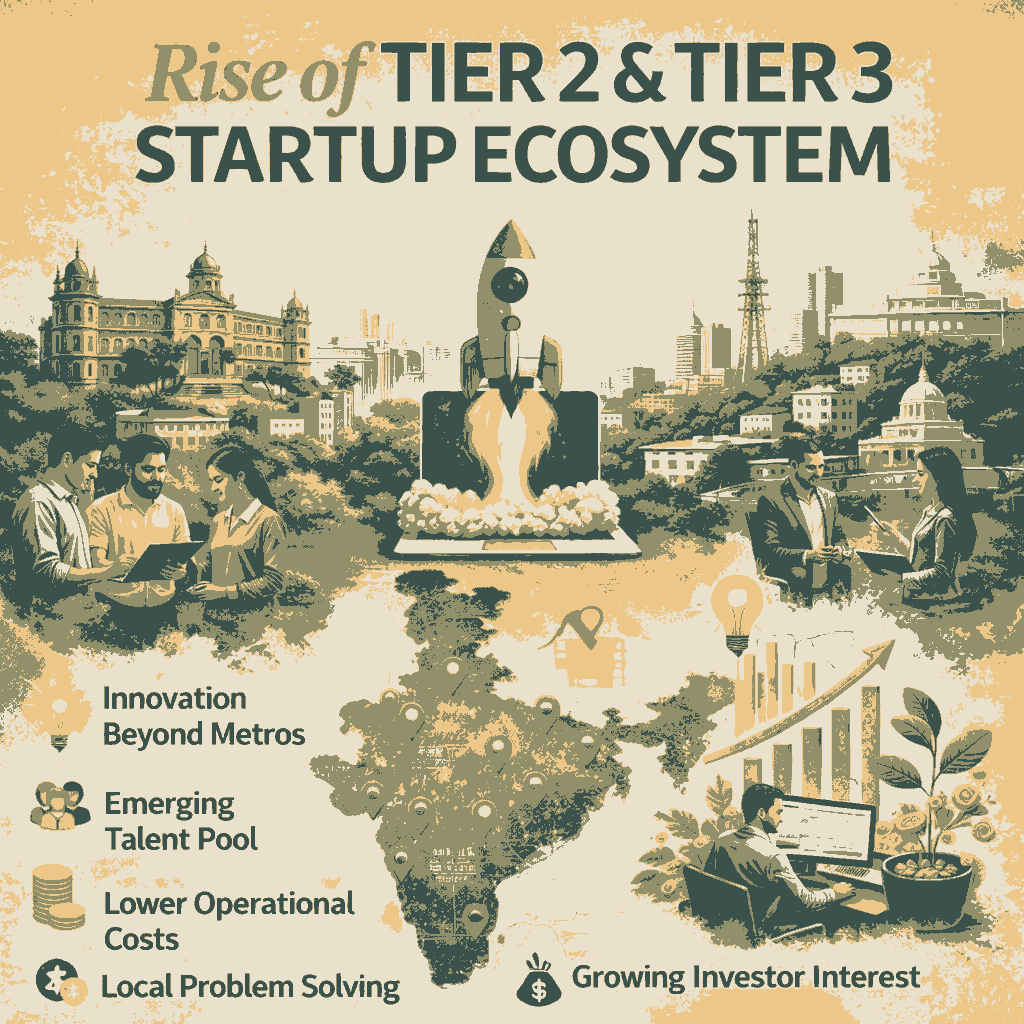
Rise of Tier 2 & Tier 3 Startup Ecosystem
India’s startup story is no longer limited to metro cities. Over the past decade, business ideas have begun to grow from smaller cities, where ambition meets local insight. This shift is changing how people look at entrepreneurship, jobs, and growth. For readers, founders, and investors, this change signals a broader and more inclusive future.
Tier 2 startups in India are currently demonstrating that good ideas do not require a big-city speech. As access to the internet improves and local talent grows, with increasing support, founders are starting companies that address real needs and grow at an accelerated pace. This paper defines the movement’s origins, its motive, and its implications for the nation.
Table of Contents
Knowledge of the Startup Shift Beyond Metros.
Over the years, most startups have been based in cities such as Bengaluru, Delhi, and Mumbai. These locations possessed investors, mentors, and early users. That picture is now changing.
The number of founders in smaller cities is on the rise since they know their local markets better than anyone. They are constructing educational, financial, health, and daily services products. This has gradually expanded the Indian startup ecosystem and made it more balanced and people-oriented.
This growth is not sudden. It is a result of decades of policy shifts, online connectivity, and a shift in attitude that makes starting a business a viable career choice.
The reasons why Tier 2 and Tier 3 Cities are walking forward.
There are several practical reasons why founders are selecting smaller cities today.
Reduced Price and Increased Runway.
Rent, salaries, and day-to-day expenditure are significantly lower than in metros. This enables founders to run their startups for longer with less capital. Tier 2 startups in India can handle early-stage funding without the pressure to raise large sums.
Local Iss, Straussforward Solutions.
Founders of smaller towns are aware of the pain points in their areas. It is either access to credit or superior learning tools, but in either case, they tailor their products to meet local demand. This will make them loyal users at the beginning.
Local Talent That Wants to Remain Local.
Most talented individuals like to work near their families. Remote work has enabled them to participate in startups without relocating. This has empowered the Indian startup ecosystem at both the city and district levels.
Policy Support and Role of Government.
Government programs have remained consistent in helping founders outside large cities. Digital platforms, state-level incubation centers, and Startup India have lowered barriers to entry.
Some states currently operate startup hubs in previously ignored cities. These centers provide basic funding assistance, legal advice, and workspace assistance. This assistance builds confidence among small city entrepreneurs in India who might not be industry-related.
Incorporating incubators with local colleges is also a way to enable students to experiment with ideas at an early stage. It is a vicious circle in that education and startups enhance one another.
How Technology Is Leveling the Field.
Technology has narrowed the gap between metro and non-metro founders.
Low-cost smartphones, web-based payments, and cloud services enable startups to reach Indian customers. Social media helps founders sell goods without a huge budget. It becomes easier to get to know investors and mentors through video calls.
Because of this access, startup success stories in India now include founders from cities like Indore, Jaipur, Surat, and Kochi. These stories inspire others who once thought startups were only for big cities.
Changing Investor Mindset
Previously, many investors were only concerned with companies operating in the metros. This perception is evolving as returns from smaller-city startups are emerging.
Investors now look at:
- Strong local demand
- Clear revenue plans
- Deeply market-savvy founders.
This has led to increased investment inflows into tier 2 startups in India, particularly in fintech, agritech, and logistics. There are also smaller regions where Angel networks and micro funds are active.
Effects on the Local Economies and Jobs.
Startups in smaller cities generate new jobs that did not previously exist. They employ young people in the area, educate them, and reduce the flow to metros.
As a startup gains relevance in a small city, other businesses there do too. All service providers, transport workers, and vendors are in demand. This enhances the local economy and, in the long run, enriches the ecosystem of startups in India.
The change in the family perceptions towards entrepreneurship is also affected by this growth. Starting a company is no longer seen as risky or unrealistic.
Big Brands to Small Cities.
The non-metro founders have created companies competing nationally. Some have also made it onto the list of Indian unicorn startups, demonstrating that scale is everywhere.
These companies began by finding a simple solution but expanded their operations by focusing on performance and customer loyalty. Their trip reveals that location is no longer the constraint.
As more startup success stories in India come from smaller towns, they challenge old ideas about where innovation comes from.
Challenges Still Exist
In smaller cities, founders face obstacles despite the changes.
Compared to metros, there is still limited access to early funding. Mentorship networks are becoming disproportionate. Some areas are still characterised by low levels of compliance and scaling awareness.
Nonetheless, due to the presence of numerous low-scale metropolitan entrepreneurs in India, these problems can be addressed through internet-based education, the development of peer networks, and the use of country-wide platforms. As time goes on, such gaps are becoming narrower.
Role of Education and Community Support
Colleges, local groups, and co-working spaces play an important role in startup growth. Workshops, meetups, and demo days help founders learn from each other. These activities give practical exposure that books alone cannot provide.
Many colleges in smaller cities are now encouraging students to work on real business ideas. Hackathons, startup clubs, and project-based learning help students think beyond regular jobs. This early exposure builds confidence and prepares them for real challenges. It also strengthens the startup ecosystem India at the grassroots level.
Local communities play an equally important role. Founder groups, alumni networks, and city-based startup circles allow people to share honest experiences. Communities create a safe space to talk about failures, funding issues, and customer problems. This peer learning supports growth in a way that top-down support cannot.
Co-working spaces in smaller cities have become meeting points for ideas. They help solo founders feel less isolated and give small city entrepreneurs access to shared resources and guidance. Many tier 2 startups India found their first partners or early team members in such spaces.
Families also matter. As more people see real income and jobs coming from startups, support at home increases. Emotional backing from family helps founders stay focused during uncertain early stages.
Future Outlook for Tier 2 and Tier 3 Startups.
The future is stable for founders, not in metros. More small towns will be sources of ideas as access to digital technology expands and investor confidence increases.
Industries that are possible to do well in are:
- Local commerce
- Health services
- Education tools
- Affordability to underserved customers.
These startups can form part of the next generation of Indian unicorns, with others continuing to be profitable regional players. The two results are important to the economy.
What This Means for You as a Reader
Your city is no longer a weakness if you plan to start a business. The rise of tier 2 startups in India shows that strong ideas and clear execution matter more than location.
As an investor or professional, there are new opportunities to work with founders who have experience with what is really wrong. And if you are a student, these developments demonstrate that you can start being innovative near home.
Frequently Asked Questions (FAQs).
What are the Indian Tier 2 start-ups?
These are urban startups in out-of-metropole cities. They usually specialize in local or regional issues, and their operating costs are lower.
Why do small cities experience an emergence of startup hubs?
Reduced costs, online products, and proximity to the local market are among the advantages that allow founders to create sustainable businesses in small cities.
Do investors take an interest in start-ups in small cities?
Yes. There is now a rush by many investors to get good ideas in non-metro regions, particularly in practical fields.
Is it possible to make a startup in a small city a unicorn?
Yes. Major metros are not the only places where several Indian unicorn startups have their origins, indicating that scale is possible.
What is the benefit of this trend to the economy?
It generates employment in the country, reduces migration, and enhances the overall startup ecosystem in India.
The emergence of start-ups in small cities also marks a new chapter in India’s business story. In that way, with a supportive atmosphere, real-world thinking, and local confidence, small city entrepreneurs in India are creating businesses that count, both to their communities and to the nation.