

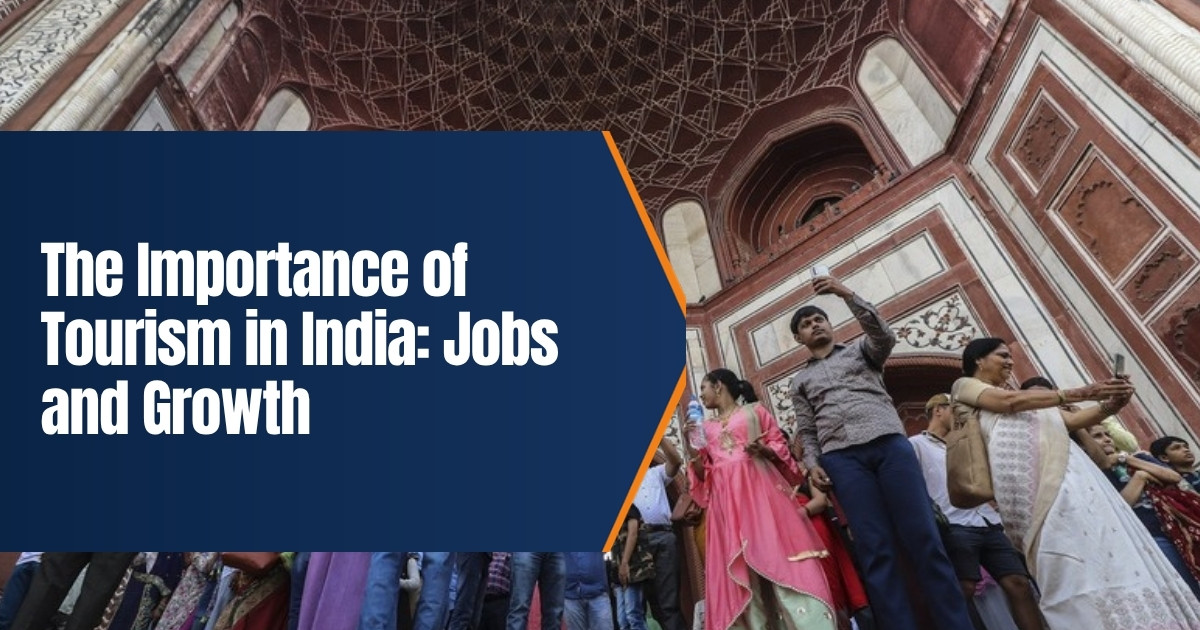
The Importance of Tourism in India: Jobs and Growth
Ask a boatman on the ghats of Varanasi what tourism means and he will probably not quote GDP. He will talk about the wedding season, the winter crowds from Europe and the long, slow months of the monsoon. That is the honest picture of tourism in India. It is a huge industry on paper, but it lives in small places, in the daily earnings of people who ferry, cook, guide, weave and host.
The numbers behind it are large. They are also worth reading carefully, because they tell us where India is strong and where it still lags.
Table of Contents
How Big Is Tourism in India?
India measures tourism through a Tourism Satellite Account, an accounting method that tracks spending by travellers across hotels, transport, food and shopping. According to the Ministry of Tourism, as reported by PIB, tourism made up 5.22 percent of India’s GDP in 2023 to 24 (provisional). That works out to roughly ₹15.73 lakh crore. The direct share alone was 2.72 percent. The rest comes from the ripple effect on suppliers and the wider economy.
The World Travel and Tourism Council uses a different, broader method, so its figures run higher. In its latest research, WTTC estimates that travel and tourism generated about $263.6 billion for India in 2025, close to 6.6 percent of GDP. It also found the sector grew 7.3 percent that year, well ahead of the global average of 4.1 percent.
Two sources, two methods. Both point the same way.
Jobs: The Strongest Case for Tourism
If there is one reason governments keep returning to tourism, it is employment. Building a factory takes years and heavy capital. A homestay in Spiti can open with a few spare rooms and a good cook.
Official data from the Periodic Labour Force Survey shows tourism supported 84.63 million jobs in 2023 to 24, or about 8.46 crore people. Of these, 36.90 million were direct jobs and 47.72 million were indirect. Together they accounted for 13.34 percent of all employment in the country. Just a year earlier, in 2022 to 23, the figure stood at 76.17 million. Go back to 2019 to 20 and it was 6.94 crore.
WTTC counts more narrowly and arrives at around 46.2 million jobs for 2025, which it describes as more than one in every ten jobs in India. Whatever the method, the scale is hard to ignore.
Who Actually Gets These Jobs
Much of this work sits outside big cities. Think of jeep drivers in Ladakh, pony handlers on the Kedarnath route, shikara owners on Dal Lake and the families who run dhabas on highway stretches between pilgrimage towns. Women run a large share of rural homestays and craft businesses. Plenty of these roles need skills and local knowledge rather than a degree, which makes tourism one of the few sectors that can absorb young workers in remote districts.
There is a catch. A lot of this work is seasonal and informal. When a landslide closes a road, or a bad monsoon cuts the season short, income can vanish overnight.
Domestic Travel Carries the Load
Foreign visitors get the headlines, but Indians travelling within India drive the sector. The Ministry of Tourism recorded about 250.96 crore domestic tourist visits in 2023, up sharply from 173.1 crore in 2022. The pace kept rising. By August 2025, the count for that year had already crossed 303 crore, according to a PIB backgrounder for World Tourism Day 2025.
WTTC’s data tells a similar story in money terms. Domestic visitors spent about $203 billion in 2025, roughly 86 percent of all tourism spending in the country. Pilgrimages, family weddings, school holiday trips and long weekends add up. A single Kumbh or a busy Char Dham season can move crores of people, and every one of them pays for a bus seat, a meal or a bed.
Foreign Visitors and Foreign Exchange
Inbound tourism matters for a different reason. Overseas visitors pay in foreign currency, which helps India’s balance of payments.
Here the recent trend is mixed. India welcomed 9.95 million foreign tourists in 2024. In 2025, provisional figures in the Ministry of Tourism’s Annual Report 2025 to 26 put foreign tourist arrivals at about 9.02 million, a fall of around 9 percent. Foreign exchange earnings also slipped, from a revised ₹2,93,033 crore in 2024 to about ₹2,73,638 crore in 2025. For context, the pre-pandemic peak was 10.93 million foreign arrivals in 2019.
India’s share of the global pie is still small. The India Tourism Data Compendium 2025 notes that the country accounted for 1.40 percent of international arrivals worldwide and 2.02 percent of global tourism receipts in 2024. For a country with this much history and geography, that gap is an opportunity rather than a ceiling.
What Holds Inbound Numbers Back
WTTC has repeatedly flagged visa friction, especially reciprocal delays with some major source markets, along with cuts to overseas promotion budgets. Safety perceptions, particularly among solo women travellers, and uneven cleanliness at major sites also shape reviews that future visitors read before booking.
Heritage, Culture and the Money to Protect Them
India has 44 properties on the UNESCO World Heritage List. The most recent additions were the Moidams of Assam in 2024 and the Maratha Military Landscapes in 2025. Ticket revenue and visitor interest give these places a budget line and a political constituency. A monument nobody visits rarely gets restored on time.
Living culture benefits too. A visitor who buys a Pochampally ikat from the weaver, or pays for a Kathakali performance in Kochi, keeps that tradition commercially alive for another season. Kerala’s Muziris Heritage Project, which won a PATA Gold Award, shows how an old port history can become a source of local pride and income at the same time.
Roads, Airports and Spillover Benefits
Infrastructure built for visitors rarely serves only visitors. The Data Compendium 2025 cites 517 new air routes under the UDAN regional connectivity scheme and 157 operational airports. A new airport near a pilgrimage town also helps a farmer’s son fly to a job interview or a patient reach a city hospital.
Government schemes target destinations directly. Swadesh Darshan 2.0 funds themed tourism circuits, while PRASHAD focuses on pilgrimage sites. The results vary by state, but the idea is sound: improve water, toilets, parking and signage, and both residents and tourists gain.
The Costs Nobody Should Ignore
Tourism is not free of damage. Shimla has faced severe water shortages during peak summers. Manali and Mussoorie choke on traffic during long weekends. In Joshimath, land subsidence in early 2023 forced families out of cracked homes and renewed questions about unchecked construction in fragile Himalayan towns.
Rents rise in popular spots, pushing locals out of old neighbourhoods. Waste piles up on trekking trails. Coral reefs and mangroves suffer when boat traffic grows faster than rules. Growth without planning simply moves the bill to someone else.
Better, Not Just Bigger
Some fixes are already in use. Sikkim and parts of Ladakh require permits for sensitive zones. Several hill states have banned single use plastic at tourist spots. Community homestay networks in Meghalaya and Uttarakhand keep more money inside the village. Pushing travellers towards the off season and towards lesser known places eases pressure on the famous few. If you want ideas, our list of hidden travel destinations in India is a good place to start.
What Travellers Can Do
Individual choices matter more than they seem. Carry a refillable bottle. Bring your trash back down the mountain. Hire a licensed local guide instead of the first tout at the gate, and pay fair rates. Eat where locals eat. Dress modestly at temples and dargahs. And if you can travel in February rather than during the Diwali rush, you will likely pay less and leave a lighter footprint.
Why It Matters
The importance of tourism in India goes beyond any single statistic. It supports more than eight crore livelihoods, pays for heritage upkeep, and links a Tamil family to a Ladakhi village in a way no textbook can. The task now is to grow it without wearing out the places that make India worth visiting. Read more about how one state built its economy around visitors in our guide to Goa’s history, tourism and economy.
Frequently Asked Questions
What share of India’s GDP comes from tourism?
About 5.22 percent in 2023 to 24, according to provisional Tourism Satellite Account estimates from the Ministry of Tourism. WTTC, using its own method, puts it near 6.6 percent for 2025.
How many people work in tourism in India?
Around 84.63 million direct and indirect jobs in 2023 to 24, which is 13.34 percent of total employment.
How many foreign tourists came to India in 2025?
About 9.02 million, based on provisional Ministry of Tourism figures, down from 9.95 million in 2024.