


New Delhi: The Supreme Court has widened its long running wetland demarcation case to cover all water bodies in the country, not only the sites formally listed as wetlands, and has told every state to report back within four weeks on how far the ground work has gone, Hindustan Times reported. The court tied the order to drinking water and the right to life under Article 21 of the Constitution.
The directions came from a Bench of Justices Aravind Kumar and Vipul M Pancholi in an order dated 12 October 2026, which was reported on Friday, 23 October, according to LawBeat. The case was brought by petitioners including birder and environmentalist Anand Arya, who told the court that states and Union Territories had not finished marking out their wetlands.
Table of Contents
What the wetland demarcation order covers
Wetland demarcation means two things in this case. The first is ground truthing, where officials visit a site picked up by satellite mapping and confirm on the spot that it is a wetland. The second is physical demarcation, where the boundary of that wetland is marked so that it can be protected from filling, dumping and construction.
The Bench made clear that the job is not limited to designated wetlands. LawBeat reported that it would cover every water body named in the existing atlases, including those smaller than 2.25 hectares. In August 2025 the court had noted that the 2021 Wetlands Atlas prepared by the Space Applications Centre, part of ISRO, identified about 555,557 wetlands of less than 2.25 hectares and asked states what they were doing to protect them, Hindustan Times said.
The legal basis is Rule 7(1)(a) of the Wetlands (Conservation and Management) Rules, 2017. Under that rule, the state department or Union Territory administration concerned was meant to prepare, within one year of the Rules being published, a brief document for each wetland identified for notification, LawBeat reported. The Bench said boundary marking must be carried out by state and Union Territory authorities in coordination with the nodal departments.
Why the court linked water bodies to the right to life
The strongest words in the order were about drinking water. According to Hindustan Times, the Bench said water bodies are a precious source of drinking water and come within the right to life guaranteed by Article 21. It added that the court “cannot remain as a mere spectator” while such water bodies stay unprotected, LawBeat reported.
The court also voiced frustration at the pace of work. It recorded that earlier directions had been issued on 11 December 2024, 19 August 2025, 7 October 2025, 28 October 2025 and 28 July 2026, yet the exercise was still not complete “even after nine years” from the date the Rules were published, LawBeat said. In December 2024 the court had asked states and Union Territories to finish ground truthing and demarcation of the atlas wetlands within three months.
The petitioners told the Bench that some states had argued certain sites did not need protection because they fell outside the definition of a wetland under the 2017 Rules, Hindustan Times reported. Widening the order to all water bodies takes much of the force out of that argument.
Tamil Nadu held up as the model state
The court described Tamil Nadu as a model for the rest of the country because it has carried out the work in four stages in what the Bench called a systematic and scientific way. Tamil Nadu has 28,898 wetlands and has demarcated 2,614 of them so far, according to Bombay Samachar.
The state had asked for six months to finish the remaining sites. As an exception, the court allowed Tamil Nadu four months to complete demarcation of all its identified wetlands, Hindustan Times reported. All other states and wetland authorities were told to follow the same or a similar method, if they had not already done so, and to explain the mode and method they used in their affidavits.
The court also took on record a compliance affidavit from Karnataka, which said the state has 14,936 wetlands, of which 14,355 have been ground truthed and demarcated, LawBeat reported. The Bench asked Karnataka to file supporting documents within four weeks, including details of the method used and proof of how the boundaries were drawn.
Plea on Vrindavan kunds turned down
In the same hearing, the Bench rejected an application that asked for a valuer to be appointed to assess the cost of restoring old temple tanks. The applicant said Vrindavan alone has more than 100 kunds, or large water tanks, and that around 80 per cent of them are in a dilapidated condition, according to LawBeat.
The court noted that it had earlier turned down a separate plea asking the Union government to pay Rs 80 crore to restore those tanks. It said there was no question of appointing a valuer at this stage, LawBeat reported.
What states must do next
Every state now has an outer limit of four weeks from the date of the order to file an affidavit on the status of ground truthing, covering both listed wetlands and other water bodies, Bombay Samachar and Hindustan Times reported. The matter is listed for its next hearing on 16 November 2026.
Reports differ slightly on one detail. LawBeat described the four month window as applying to the states in general, while Hindustan Times and Bombay Samachar said the four months was an exception granted to Tamil Nadu. Bharat Stories has followed the second reading, which is supported by the text of the order quoted in those reports.
For residents, the practical effect could be large. A pond or lake that was never formally notified could still come under the court’s order if it appears in a state atlas, which may make it harder to fill such sites for housing, roads or other projects.
Bharat Stories has more on India’s lakes and rivers. Read about why World Environment Day matters, the birdlife of Bihar’s Kanwar Lake Bird Sanctuary, and the country’s major rivers of India.
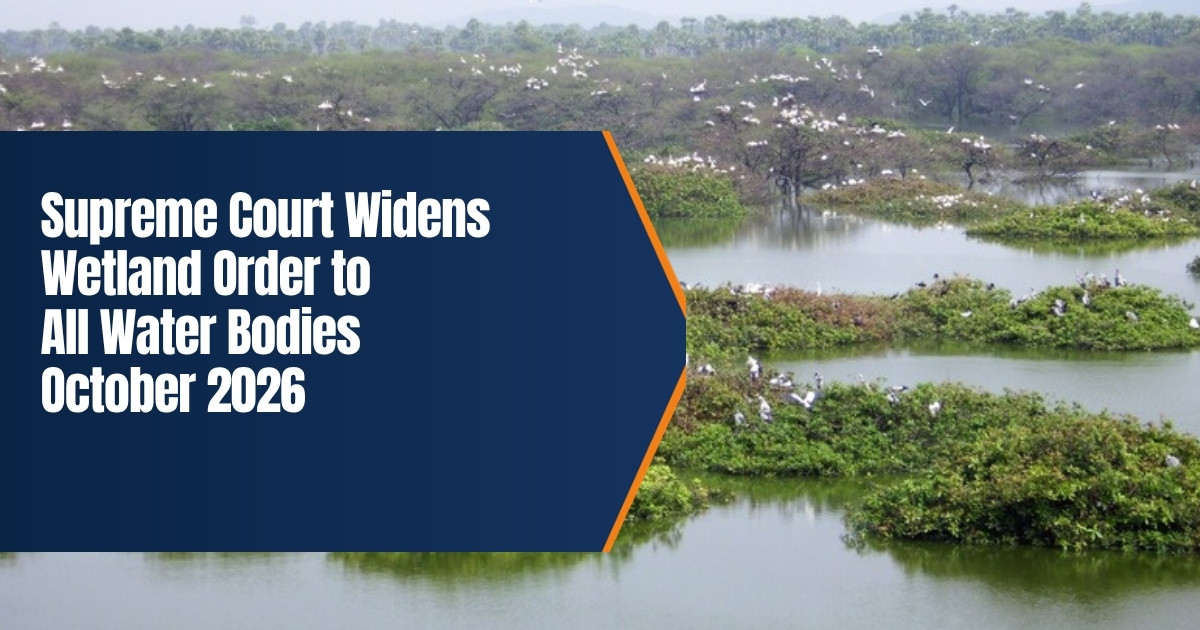
Featured image photo: Phoenix bangalore, public domain, via Wikimedia Commons (Vedanthangal lake, Tamil Nadu).
FAQ
What did the Supreme Court order on wetland demarcation?
It extended wetland demarcation to all water bodies listed in existing atlases, including those under 2.25 hectares, and told every state to file a status affidavit within four weeks.
When is the next hearing?
The case is listed on 16 November 2026.
Sources
- Hindustan Times, 23 October 2026: scope of the order, Article 21 remarks, Tamil Nadu figures and the four week deadline.
- LawBeat, 23 October 2026: Bench, Rule 7(1)(a), earlier orders, Karnataka affidavit and the Vrindavan plea.
- Bombay Samachar, 23 October 2026: Tamil Nadu demarcation figures and next hearing date.