

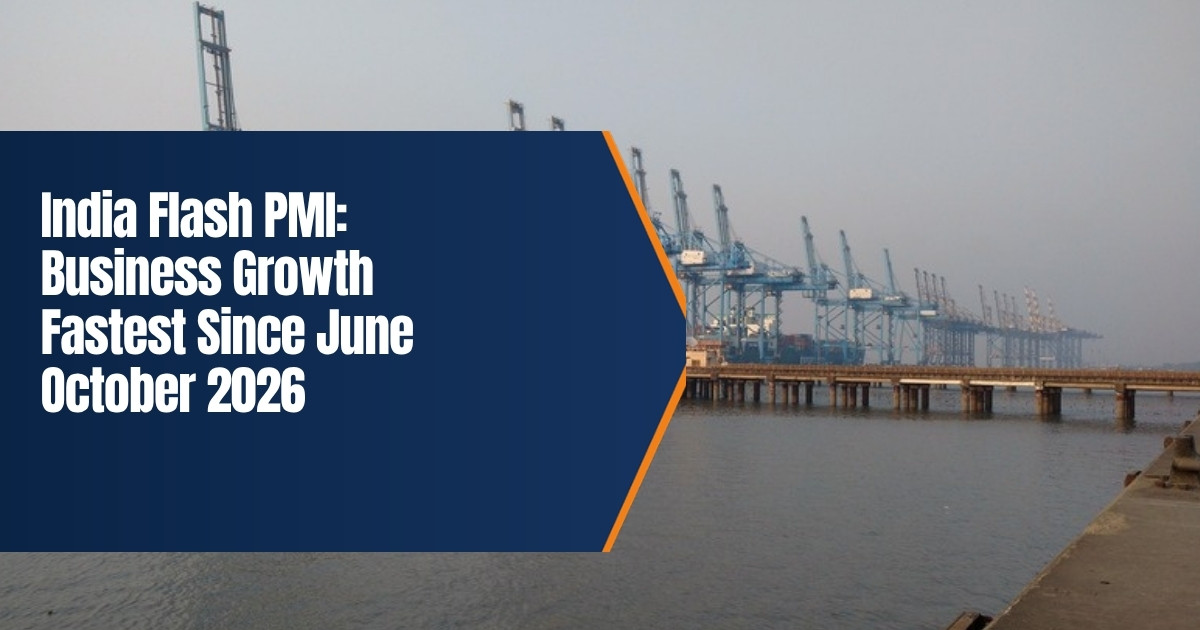

Mumbai: India’s private sector grew at its fastest pace in four months in October, the HSBC India flash PMI showed on Friday, 23 October, as stronger orders at home and abroad lifted output in both factories and services. The flash composite output index rose to 56.7 from 55.9 in September, according to the S&P Global release. It beat the 56.1 median forecast in a Reuters poll.
The rise came with a catch. Companies were cautious about adding workers, and job creation slowed to the weakest pace so far this year, while price pressures eased further. A separate survey released the same day by the National Council of Applied Economic Research (NCAER) also showed business confidence recovering, though still well short of last year’s level.
Table of Contents
India flash PMI numbers at a glance
The flash data were collected between 9 and 20 October from panels of roughly 400 manufacturers and 400 service providers, S&P Global said. Any reading above 50 signals growth over the previous month.
- Composite output index: 56.7, up from 55.9 in September and the fastest since June.
- Services business activity index: 56.2, up from 55.2.
- Manufacturing output index: 57.6, against 57.5 in September.
- Manufacturing PMI: 54.9, slightly lower than 55.1.
The composite index has now stayed above the 50 mark for 63 months in a row, Business Standard reported. Even so, S&P Global noted that October’s pace of growth remained below the average seen across 2026 so far.
Export orders lead the gains
Firms said better market conditions and a pickup in new orders drove output higher. Total new business rose faster than in September, helped by the quickest increase in orders from abroad in six months. Companies named the US, the UK, the Middle East and Bangladesh as sources of fresh demand, according to S&P Global.
Pranjul Bhandari, chief India economist at HSBC, said the steady growth in overall orders “masks the fastest increase in new export orders since June 2025” for manufacturers. She added that factories responded by building up their stocks of inputs and finished goods.
That stockbuilding was striking. The rise in finished goods inventories was the sharpest in the history of the survey, while stocks of purchases grew at the fastest rate in eight months as supplier delivery times shortened, the release said. Purchasing activity itself, however, grew at its slowest pace in the current run of expansion that began in July 2021.
Hiring stalls as backlogs shrink
The weakest part of the report was jobs. Overall employment rose only marginally. Services companies kept staff numbers unchanged, ending nine straight months of job creation, while manufacturers added workers only slightly, Moneycontrol reported. Firms told surveyors their existing staff could handle the current workload.
That spare capacity showed up in backlogs. Outstanding work fell for the third time in four months, and the rate of decline matched August 2021 as the strongest in six and a half years, S&P Global said. A falling backlog can be a sign that companies do not feel pressure to hire, which may explain the pause in recruitment.
Price pressures keep easing
For households and policymakers, the inflation numbers in the survey were encouraging. Input cost inflation slowed for a seventh month in a row to its lowest level in almost a year. Where costs did rise, firms pointed to steel and transport, Mint reported.
Selling price inflation eased to its slowest pace since March 2025, and the rise in factory gate charges was the softest in almost four years, according to the release. That comes after retail inflation for September and the recent policy rate decision, which Bharat Stories covered in its reports on September retail inflation at 5.54 per cent and the RBI repo rate increase to 5.50 per cent.
Business confidence about the year ahead improved to its highest level since May, though it stayed below the 2026 average, S&P Global said. Optimism rose in both manufacturing and services.
NCAER survey points the same way
NCAER’s Business Confidence Index rose to 107.8 in the July to September quarter from 99.8 in the April to June quarter, ending four straight quarters of decline, the Economic Times reported. The index remained well below the 142.6 recorded in the same quarter a year earlier.
The survey, carried out in September, covered 502 firms across Delhi NCR, Bengaluru, Chennai, Kolkata, Mumbai and Pune, The Times of India reported. The index for small and medium businesses rose to 100 from 93, while that for large firms climbed to 120.3 from 111.6. NCAER professor Bornali Bhandari, who led the survey, said the data pointed to a broad based recovery in sentiment across both groups.
Half of the firms surveyed expected economic conditions to improve over the next six months, up from 43 per cent, and most expected no change in staff numbers, according to TOI and All India Radio. That matches the cautious hiring picture in the flash PMI.
What comes next
Flash readings are early estimates. S&P Global publishes final manufacturing and services PMI figures for the month in early November, and the numbers can be revised from the flash estimate. Export demand will be watched closely as trade deals bed in, including the India New Zealand free trade agreement that took effect this month.
Featured image photo: Ccmarathe, CC BY SA 4.0, via Wikimedia Commons (container handling at JNPT port, Navi Mumbai).
FAQ
What did the India flash PMI show for October 2026?
The flash composite index rose to 56.7 from 55.9, the fastest growth since June, with services at 56.2 and the manufacturing PMI at 54.9.
Why did hiring slow?
Firms said current staff could handle workloads, and backlogs of work fell at the joint strongest pace since August 2021.
Sources
- S&P Global, HSBC Flash India PMI release, 23 October 2026: all index readings, survey panel, export, hiring, stocks and price details.
- Reuters, 23 October 2026: poll median forecast of 56.1.
- Business Standard, 23 October 2026: 63 months above 50, HSBC comment.
- Moneycontrol, 23 October 2026: hiring and services staffing details.
- Mint, 23 October 2026: input cost drivers.
- Economic Times, 23 October 2026: NCAER Business Confidence Index.
- The Times of India, 23 October 2026: NCAER cities, segment indices, quote.
- All India Radio, 23 October 2026: NCAER survey indicators.