

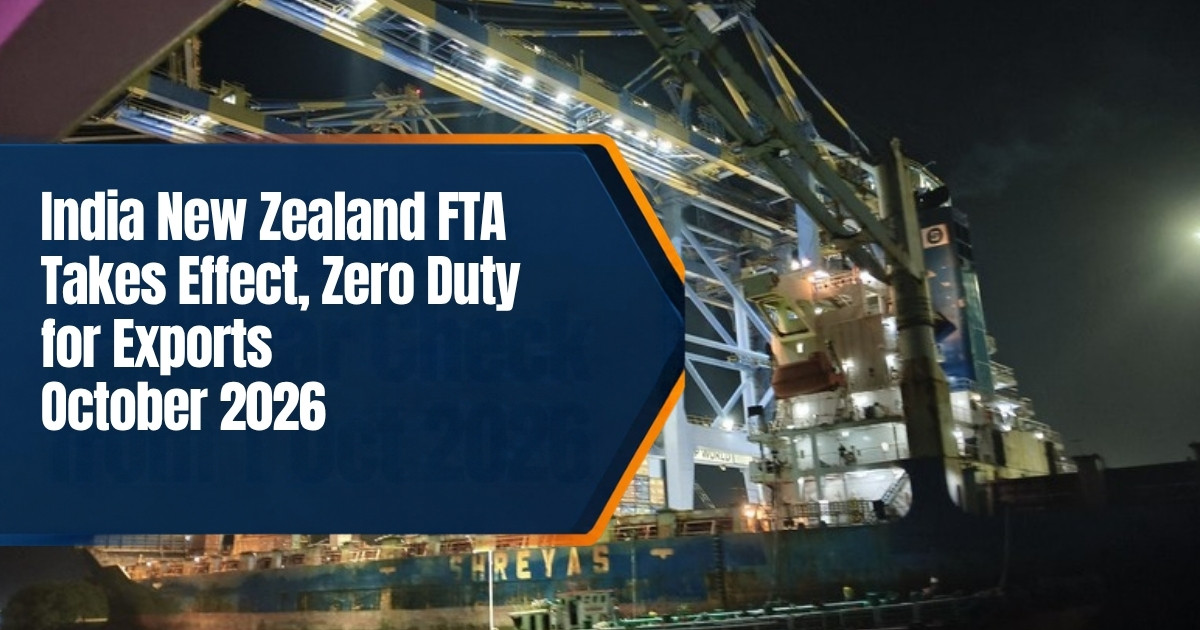

New Delhi: The India New Zealand FTA came into force on Tuesday, 20 October 2026, and from today every Indian product shipped to New Zealand enters that market without customs duty. Commerce and Industry Minister Piyush Goyal marked the start at an entry into force ceremony in New Delhi on Monday, where he also flagged off the first export consignment sent under the pact.
“We will start tomorrow on the auspicious day of Dussehra,” Goyal said, according to the Hindustan Times. Commerce Secretary Rajesh Agrawal called it the seventh free trade agreement India has put into operation in five years.
Table of Contents
What the India New Zealand FTA changes for Indian exporters
The headline promise is simple. “Starting tomorrow, 100% of the goods from every sector in India going to New Zealand will go there with zero duty,” Goyal said, as quoted by The Indian Express. India, in turn, has opened up a smaller share of its own market.
Sampath Kumar, Additional Director General of Foreign Trade, explained the change to ANI, as carried by The Hindu BusinessLine and Mint. Indian textiles and clothing, leather and footwear had faced duties of up to 10 per cent in New Zealand, and these now fall to zero. Duties of up to 5 per cent on pharmaceuticals, farm and marine products, plastics, chemicals and electrical goods have also gone. SBI Research, cited by Deccan Herald, estimates the deal could open up a market worth about $6 billion for Indian exporters.
First shipment: a JCB excavator made in Pune
The first consignment under the agreement was a JCB 18Z mini excavator built in Pune, Maharashtra, which Goyal flagged off at Vanijya Bhawan in New Delhi, Business Standard and Deccan Herald reported. All India Radio said further flag offs were planned for Tuesday across agriculture, gems and jewellery, engineering, sporting goods, footwear and leather.
New Zealand’s Minister for Trade and Investment, Todd McClay, joined the ceremony online and stressed that signing a deal is only the start. “The success of the agreement will ultimately be measured by the opportunities it creates and the extent to which businesses use them,” he said.
What India opens up, and what stays protected
India has offered tariff cuts on around 70 per cent of its tariff lines, which Business Standard said cover 95 per cent of the value of New Zealand’s exports to India. New Zealand goods that will see lower Indian tariffs include wine, medicines, polymers, aluminium and iron and steel articles, The Indian Express reported. The New Zealand government said wine duties will fall from 150 per cent to either 25 or 50 per cent over ten years, depending on the product’s value.
Some farm items are kept out entirely, and a few enter at lower duty only up to a fixed quantity, known as a tariff rate quota:
- Excluded: dairy products such as milk, cream, whey, yoghurt and cheese, along with onions, chickpeas, peas, corn, almonds, artificial honey and sugar.
- Allowed under a quota: apples, kiwifruit, albumins including milk albumin, and Manuka honey.
- New Zealand gains: tariffs removed on sheep meat, wool and coal, and better access for more than 95 per cent of its forestry and wood exports.
“Sensitive sectors, including dairy, remain protected, keeping farmers’ welfare at the heart of our approach,” Goyal wrote on X, as reported by Deccan Herald. He also said Centres of Excellence would be set up for apples, kiwifruit and honey.
For New Zealand, McClay said 57 per cent of its exports to India are tariff free from the first day. Reuters, in a report carried by The Economic Times, said this share will rise to 82 per cent over time.
Jobs, students and a $20 billion investment pledge
The pact also creates a Temporary Employment Entry visa for skilled Indian professionals, with a quota of 5,000 visas at any one time and stays of up to three years, the Commerce and Industry Ministry said. The route covers AYUSH practitioners, yoga instructors, Indian chefs and music teachers, as well as IT, engineering, healthcare, education and construction.
Indian students get no numerical caps, at least 20 hours of work a week during study, and post study work rights of up to three years for STEM graduates and up to four years for doctorate holders, according to the ministry.
New Zealand has committed to facilitate $20 billion of investment in India over the next 15 years. Goyal said the pledge holds “immense potential to strengthen manufacturing, infrastructure, services and innovation” in India.
The trade numbers behind the deal
Bilateral merchandise trade reached $1.3 billion in 2024/25, up 49 per cent on the previous year, according to the Ministry of Commerce and Industry. India exported goods worth $711 million and imported goods worth about $587 million, The Indian Express reported, putting trade in goods and services together at about $2.4 billion.
Both sides now aim to double bilateral trade to NZ$7 billion, or roughly Rs 35,000 crore, by 2030. Talks ran from 16 March to 22 December 2025. Goyal and McClay signed the agreement in New Delhi on 27 April 2026, and both countries completed ratification on 21 September.
What it means for small businesses and farmers
Goyal said his ministry would work with State governments to tell farmers and businesses about the new openings. Small manufacturers eyeing New Zealand can read our explainer on Udyog Aadhaar MSME registration.
The deal also arrives as India pursues other trade talks; last week we reported that Canada aims for a trade deal with India by year end. And with the agreement starting on Vijayadashami, readers can learn more about Dussehra, one of India’s most prominent Hindu festivals.
What happens next
Exporters can ship at zero duty straight away, and the commerce ministry has notified how the quotas for apples, kiwifruit, albumin and Manuka honey will be allocated. In New Zealand, McClay is presenting the deal as part of a push to double exports by 2034, ahead of a general election on 7 November, Reuters reported.
FAQ
When did the India New Zealand FTA come into force?
It came into force on Tuesday, 20 October 2026, the day of Dussehra.
Which Indian goods benefit?
All of them now enter New Zealand at zero duty; textiles, clothing, leather and footwear had faced the highest duties, up to 10 per cent.
Is Indian dairy affected?
No. Dairy, along with onions, chickpeas, peas, corn, almonds, artificial honey and sugar, has been kept out of the agreement.
Sources
- Hindustan Times, 20 October 2026: Goyal and Dussehra quote; seventh FTA in five years (Rajesh Agrawal); 57 per cent of New Zealand exports tariff free; wine duty cuts; $20 billion investment; NZ$7 billion target; negotiation dates; excluded items.
- The Indian Express, 19 October 2026: zero duty quote; excluded items and quota goods; Centres of Excellence; trade figures; visa and student mobility details; ratification on 21 September.
- The Hindu BusinessLine (ANI), 20 October 2026: Sampath Kumar on duties of up to 10 and 5 per cent; 70 per cent of Indian tariff lines; 2024/25 trade data; signing on 27 April.
- Business Standard, 19 October 2026: first consignment, a JCB mini excavator; McClay quote; 70 per cent of tariff lines covering 95 per cent of export value.
- Deccan Herald, 19 October 2026: ceremony at Vanijya Bhawan; Goyal post on X; SBI Research estimate; investment quote.
- All India Radio News, 20 October 2026: entry into force on Vijayadashami; planned flag offs across sectors.
- The Economic Times (Reuters), 20 October 2026: New Zealand tariff free share rising to 82 per cent; sheep meat, wool and coal; export target and 7 November election.
- Mint (ANI), 19 October 2026: cross check of DGFT duty details.