

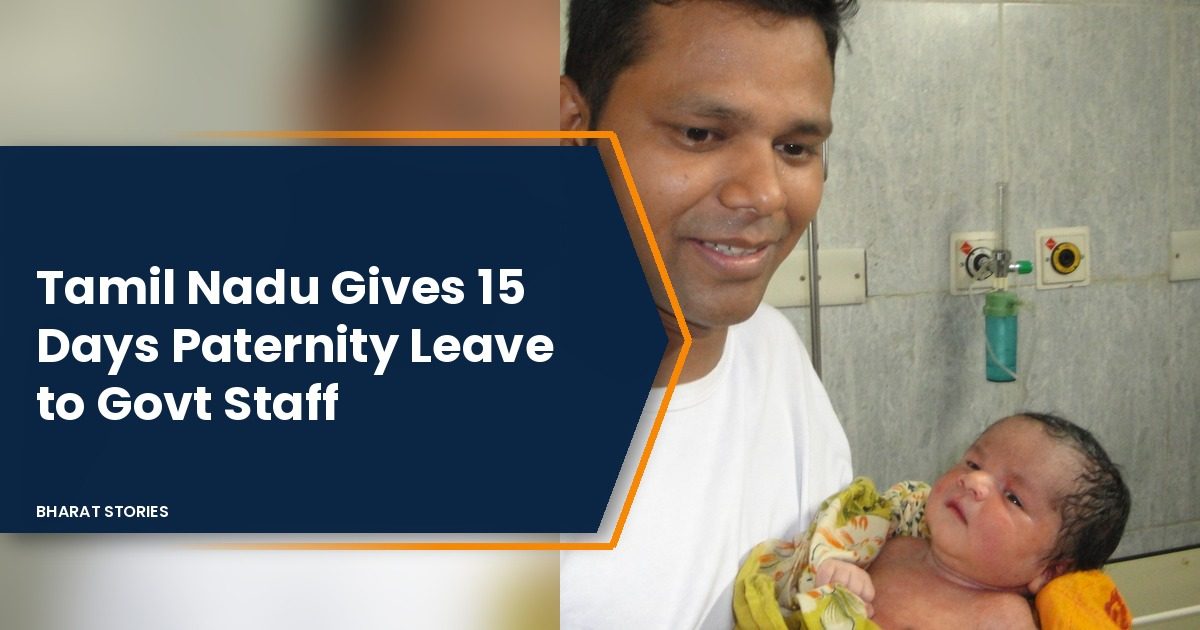

Married men working for the Tamil Nadu government can now take 15 days of paternity leave on full pay, the first time the state has offered such leave to fathers in its workforce. Chief Minister C. Joseph Vijay announced the decision in Chennai on Thursday, 26 November 2026, through a press release from the state’s Department of Information and Public Relations, and the government has issued an order to put it into effect.
Women in state service already get 365 days of maternity leave. The new rule gives fathers a short, separate entitlement of their own for the first time.
Table of Contents
Who is eligible for paternity leave in Tamil Nadu?
The leave is for married male government employees. The order sets one more condition. “The govt, after careful examination, have decided to grant paternity leave on full pay for a period of 15 days to the married men govt employees with less than three surviving children during the confinement of their wife for childbirth,” C. Samayamoorthy, Principal Secretary of the Human Resources Management Department, said in the order, as quoted by The Times of India.
So an employee with fewer than three surviving children qualifies. The release itself does not spell out how the leave applies to adoption or surrogacy, or whether it can be clubbed with other leave. Employees will need the full order for those details.
When can the 15 days be taken?
There are two windows. A father can start the leave up to 15 days before the expected date of delivery, or take it any time within six months of the child’s birth, The Hindu reported from the official release. In other words, a father does not have to take it in the first days after the birth; he can pick a later stretch within those six months.
Why did the government bring it in now?
The release says employees had asked for it. It describes the period around childbirth as very important for both mother and child, a time when the mother needs physical and emotional support and the father has a part to play in looking after the baby. The state’s 365 days of maternity leave, it says, shows the weight it gives to motherhood and child welfare; paternity leave should help fathers share family duties and take part in raising the child.
Employees had long asked for it, The Times of India noted. R. Arulraj, State president of the Tamil Nadu Village Administrative Officers’ Association, told The Hindu that representations had gone to the government on several occasions, and that the leave would help employees who work away from their families. Anna Kuberan, State president of the Tamil Nadu Government Employees’ Association, also welcomed it.
What did doctors say?
Doctors in Chennai who spoke to The Hindu backed the move, and one wanted it to be longer. A. Jaishree Gajaraj, Head of Obstetrics and Gynaecology at MGM Healthcare, said the leave carries a father’s involvement in pregnancy, labour and delivery into the weeks after birth, and suggested it be extended to a month. Pavithra Ramakrishnan of Apollo Speciality Hospitals said a father’s support lets the mother rest while she recovers, and can help with emotional difficulties, including post partum depression.
How does this compare with maternity leave in the state?
The gap is large: 15 days for fathers against 365 for mothers. Tamil Nadu has raised maternity leave in steps. It went from 90 days to six months in 2011, to nine months in 2016 and to one year in July 2021, Hindustan Times reported. The 365 day benefit applies to regular women employees with fewer than two surviving children, while those with two or more get 12 weeks on full pay, the paper said, citing PTI.
Rules linked to how many children a person has are being questioned elsewhere too. Earlier this month the Supreme Court said two child norms have lost their relevance, as we reported in our story on the two child norm and the larger bench reference.
How does it compare with central government rules?
The basic design matches the Centre’s. Under Rule 43A of the Central Civil Services (Leave) Rules, 1972, a male central government servant with fewer than two surviving children can get 15 days of paternity leave, from up to 15 days before delivery to six months after it. The leave is paid at his last pay, is not deducted from his leave account and can be combined with other kinds of leave. It lapses if not used in that window, and the rules say it should not normally be refused.
The visible difference lies in the child limit. As reported, Tamil Nadu’s order allows the leave to employees with fewer than three surviving children, one more than the central rule. With this decision, the state joins Kerala, Sikkim and Haryana in giving paternity leave to government staff, according to The Times of India.
What should employees do next?
The release does not say how to apply, so staff should check with their department or the order itself. State staff who check pay and service records online can find help in our IFHRMS login guide. New parents will also need to register the birth; our guide on how to get a birth certificate online explains the steps.
Sources
- Tamil Nadu DIPR: Press release No. 1124 on paternity leave for male government employees (PDF, Tamil), 26 November 2026
- The Hindu: Tamil Nadu introduces 15 days of paternity leave for married government employees, 26 November 2026
- The Times of India: Tamil Nadu govt employees to get 15 days of paternity leave, 26 November 2026
- Hindustan Times: In a first, Tamil Nadu govt approves 15 day paternity leave for govt staff, 26 November 2026
- Central Civil Services (Leave) Rules, 1972, updated to 24 September 2024 (PDF)