

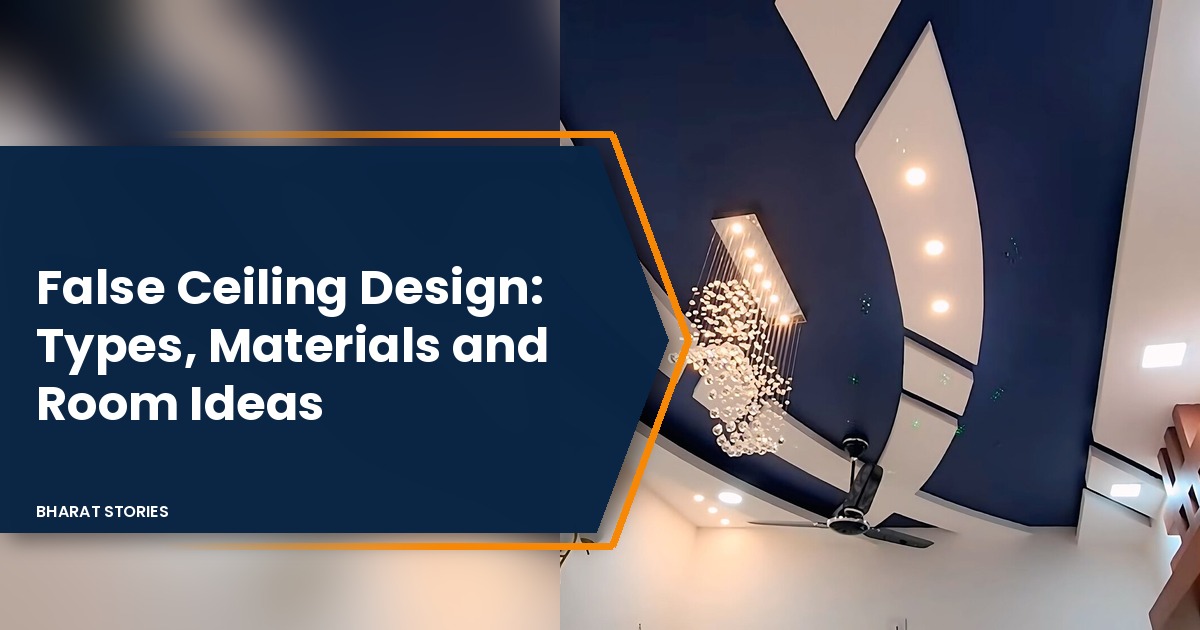
False Ceiling Design: Types, Materials and Room Ideas
A false ceiling is a second ceiling hung a few inches below the concrete slab, and in Indian homes it has gone from a hotel lobby feature to something people ask for in a two bedroom flat. It hides wires and AC pipes, gives lights somewhere to sit, and can make a plain room look finished. It can also look dated in five years, sag in a damp bathroom, or eat too much height. This guide covers the materials, the designs that work room by room, and the questions worth asking before the contractor starts cutting channels.
Table of Contents
What is a false ceiling?
It is a secondary ceiling suspended below the main structural ceiling, usually on a metal frame, leaving a gap that can hold wiring, ducts and light fittings. You may also hear it called a dropped ceiling, suspended ceiling or grid ceiling, all names listed on the Wikipedia entry for dropped ceilings.
The idea is old. That same entry notes that dropped ceilings were used in Japan for looks as early as the Muromachi period, and that London’s Blackfriars Theatre, built in 1596, had one to help the acoustics. In modern buildings the main job was practical: hide pipes and ducts but keep them reachable for repairs.
Why do people install a false ceiling?
Mostly for looks and lighting, but also to hide services, improve insulation and soften sound. In a typical Indian apartment the real reasons are concealed AC piping, cove lighting, and covering beams that cut across the room.
- Lighting: recessed downlights and hidden LED strips need a cavity, and a false ceiling gives them one.
- Hiding services: wiring, AC drain pipes and duct lines vanish above the board.
- Heat: the trapped layer of air between the slab and the board works as insulation. Gyproc notes this can help an air conditioner do its job, which matters on a top floor flat under a sunbaked roof.
- Proportion: a well placed drop can make a very tall room feel cosier or frame a dining area.
What are the main types of false ceiling?
Gypsum board, POP, PVC, wood, metal and mineral fibre tiles are the materials you will be offered most often in India. Each has a sweet spot, and the right choice depends on the room more than on the design catalogue.
| Material | Best for | Watch out for |
|---|---|---|
| Gypsum board | Living rooms, bedrooms, clean flat or layered designs | Standard board dislikes water; use moisture resistant board in wet areas |
| POP (plaster of Paris) | Curves, mouldings and detailed shapes made on site | Messy, slower work; finish depends heavily on the skill of the worker |
| PVC panels | Bathrooms, balconies, utility areas | Can look plasticky in living spaces; behaves poorly in a fire |
| Wood or wooden veneer | Accent panels, warm study or bedroom ceilings | Cost, termites and humidity |
| Metal (aluminium or GI) and mineral fibre tiles | Offices, corridors, rooms needing access above | Grid look feels commercial in most homes |
Gypsum or POP: which is better?
For most flats, gypsum board is the safer default because it is factory made, quick to fix and gives an even finish; POP wins when you want free flowing curves or ornate mouldings. The two are chemically related. Gypsum is calcium sulphate dihydrate, while plaster of Paris is calcium sulphate hemihydrate made from gypsum, as the Wikipedia article on plaster explains. Board arrives ready; POP is mixed with water and shaped on site, which takes longer and leaves more dust.
Gyproc, the gypsum maker, says its boards are lighter than cement plaster and POP and that a well built gypsum ceiling can last 20 years or more. That is a manufacturer’s claim, but it matches what most interior contractors will tell you about board ceilings that stay dry.
Is PVC better than a gypsum false ceiling?
PVC is better only where water is the enemy, such as bathrooms and covered balconies; elsewhere gypsum looks more refined and handles heat and fire better. PVC panels shrug off moisture and are easy to wipe. The trade off is fire behaviour: the Wikipedia page on PVC notes that burning PVC can form hydrogen chloride fumes. Gypsum, by contrast, holds water in its crystals that is released as steam when heated, which slows fire.
Which false ceiling design suits each room?
Keep it simple in bedrooms, layered in living rooms, practical in kitchens and waterproof in bathrooms. The most dated ceilings tend to be the busiest ones, with several levels, coloured lights and a chandelier all fighting each other.
Living room
A peripheral design, where the drop runs around the edges and leaves the centre at full height, is the classic choice. It hides the AC line, carries cove lighting and keeps the room from feeling squashed. A single raised rectangle above the sofa or a coffered grid in a large hall also works. For ideas on placing fittings, our post on lighting trends for bare ceilings covers the basics.
Bedroom
Go lighter. A shallow border with warm cove light, or a soft panel over the bed, is plenty. Bright downlights directly above the pillow area are a common regret, so place them toward the wardrobe and dressing area instead.
Kitchen
Use moisture resistant gypsum board. Gyproc lists its MR board for kitchen and bathroom ceilings, with total water absorption under 5%. Leave an access panel near the chimney duct and any junction box. If you are redoing the whole kitchen, our modular kitchen design ideas will help you plan the ceiling and the cabinets together.
Bathroom
PVC, moisture resistant board, or a metal grid with removable tiles. A grid makes sense if a geyser or plumbing line sits above, because you can lift a tile instead of breaking the ceiling.
Kids’ room and study
This is where a little fun is allowed: a cloud shape, a star cut out with tiny lights, or a wooden strip. Keep it repairable, since tastes change fast at that age.
How much height does a false ceiling take?
Most home designs drop by a few inches, but the number that matters is the clear height left in the room, which local building rules control. Tamil Nadu’s 2019 building rules, for example, require habitable rooms to be at least 2.75 m from floor to the underside of the slab, and air conditioned rooms to keep at least 2.5 m to the false ceiling or duct, according to Rule 52(5) of the Tamil Nadu Combined Development and Building Rules. Other states and cities set their own figures, so check yours.
In practice, flats with low ceilings are better off with a peripheral drop only, leaving the centre untouched. A full flat drop across the whole room can make a standard flat feel like a cabin.
Can a ceiling fan hang from a false ceiling?
No. The fan must be fixed to the concrete slab with a long enough down rod, and the false ceiling simply has a neat opening around it. Board and POP are not designed to carry the weight and wobble of a running fan. Plan fan points before the frame goes up, and buy fans whose rod length suits the drop. Our guide to ceiling fan brands in India lists models if you are replacing fans at the same time.
How expensive is a false ceiling?
Contractors usually price by the square foot, and the final bill depends on material, design complexity, lighting and your city. PVC is generally the cheapest upfront, gypsum and POP sit in the middle, and wood, metal or specialist acoustic ceilings cost the most. Coves, curves and multiple levels add labour quickly.
Ask for an itemised quote that separates the board, the metal frame, finishing and paint, electrical work and lights. Many disputes start because lighting or putty and paint were assumed to be included. Look for well known board and frame brands such as Gyproc, USG Boral or Armstrong in the quote, and ask the installer to show the product name printed on the boards.
What mistakes should you avoid?
Skipping wiring plans, putting gypsum in wet areas, ignoring leaks above, and over designing a small room are the usual culprits.
- Fix any slab seepage first. Water from above will stain and sag any board.
- Finalise furniture layout before marking lights, so a downlight does not end up above an empty corner.
- Keep at least one access panel near AC lines, junction boxes and drain pipes.
- Use proper LED fittings made for recessed use and leave space for heat to escape.
- Do not let the contractor skip the joint tape and putty; that is where cracks appear later.
More renovation pitfalls, from budgets to timelines, are in our list of home renovation mistakes to avoid.
Is a false ceiling fire safe?
Gypsum is the most fire resistant of the common materials, and special fire rated boards go much further. Gyproc says ceilings built with its Fireline board can give fire resistance of up to 120 minutes, though that rating applies to the complete tested system, not a single board. For homes, the bigger risk is usually poor wiring, so insist on proper conduit and an electrician who certifies the work.
Quick answers
How long does installation take?
A gypsum ceiling for a single room often takes a few days including putty and paint. POP takes longer because it has to dry, and lighting work can add time.
Does a false ceiling attract lizards or insects?
Gaps around lights and edges can let them in. Sealed joints and closed access panels reduce the problem.
Can I remove a false ceiling later?
Yes. Board ceilings come down fairly cleanly, though you will need to patch fixing holes in the slab and repaint.