

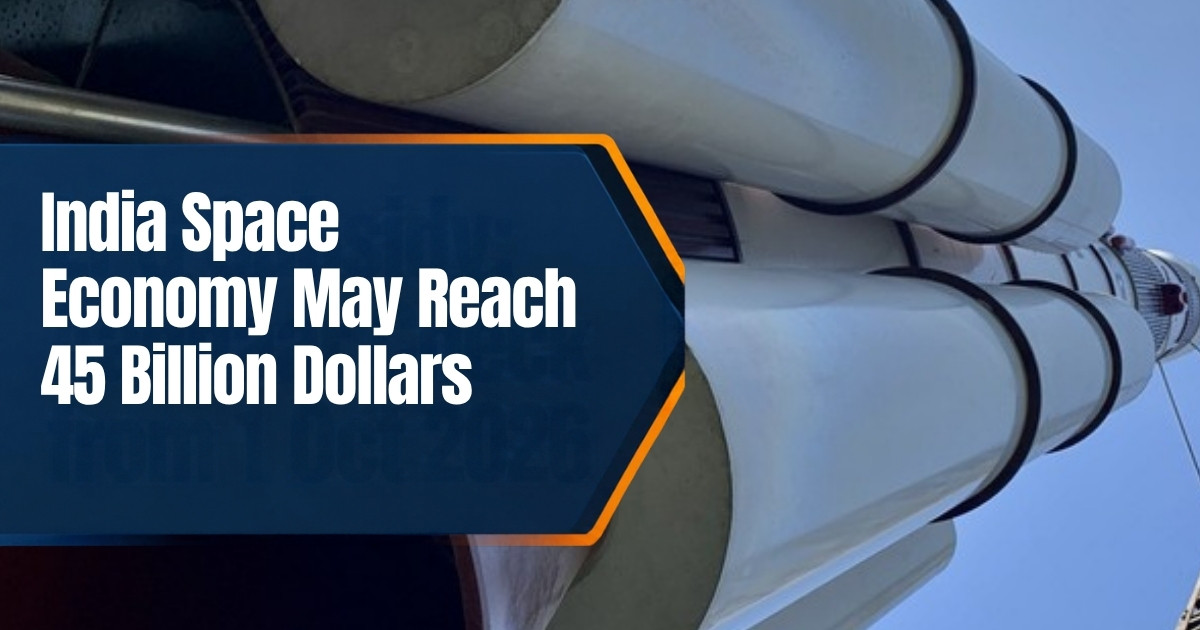

New Delhi: India’s space economy, now valued at about 9 billion dollars, could grow to 40 to 45 billion dollars in the next seven to eight years, Union Minister of State for Space Jitendra Singh said. He spoke at a media roundtable on Space, Sovereignty and New Economy organised by the Bloomberg New Economy Forum in New Delhi. News On AIR, The New Indian Express, DD India and The Financial Express reported his remarks on 17 October 2026.
Singh, who also holds Science and Technology and Earth Sciences among his portfolios, said India must move beyond showing what its rockets and satellites can do. The next step, he said, is to build commercial space companies that can compete in world markets.
Table of Contents
India space economy: the size of the target
- Current size: about 9 billion dollars, according to the minister’s figures reported across outlets.
- Projected size: 40 to 45 billion dollars in seven to eight years.
- That is close to a fivefold rise from today’s level, The Financial Express noted.
- Focus of the next phase: private investment, predictable demand, faster clearances and lasting business models.
Why private capital and demand matter
Singh said opening the space sector to private firms in 2019 to 2020 under Prime Minister Narendra Modi had already shown results within five to six years. Government labs and private industry can work together in a field that needs deep technical skill, large money and long timelines, he said, as quoted by The New Indian Express and News On AIR.
The priority now is to turn those skills into firms that sell products and services at home and abroad. Space projects need buyers before factories scale up. Singh said government agencies can act as early anchor customers. Support for proof of concept projects can help private teams prove technology and then move to commercial use. A steady customer base, he said, gives firms the confidence to invest in production and build regular revenue.
Faster clearances and lower costs
The minister called for timely regulatory approvals, lower business costs and stronger supply chain links. DD India reported that firms seeking installation or export licences should get decisions within clear timelines. Delays raise costs and hurt India’s bid against overseas rivals, The Financial Express explained.
On GST measures linked to space products, Singh said policy change must bring real benefits to industry. Sustainable investment, he argued, rests on demand that can be planned for, efficient processes and a clear road to sales.
Investment, security and global partners
India is opening the sector to more domestic and foreign capital while keeping home grown capability strong, the minister said. More investment can speed research, manufacturing and access to foreign markets. At the same time, indigenous strength remains vital for national security and strategic autonomy.
He urged closer work between Indian public bodies and private firms, backed by overseas partners, so Indian companies can join global supply chains and widen their customer base without giving up national interests. Stronger public private partnerships at home and abroad can mobilise money, share technology and open markets, he said.
Space tech on the ground
Singh stressed that the economic value of space is not only in launchers and satellites. Satellite communications, geospatial tools and Earth observation already support infrastructure, farming, disaster response, defence and the monitoring of government projects. Space data helps with project clearances, tracking timelines and geotagging works. India also shares space based disaster information with neighbours such as Myanmar, Bangladesh and Sri Lanka, according to a PIB linked account carried by DD India and The Financial Express.
Downstream firms that analyse satellite data or build specialised software can grow even if they never build a rocket. For readers following India’s missions, our explainer on Chandrayaan 3 and India’s moon programme covers a landmark flight. Manufacturing and trade scale show up in stories such as Apple iPhone exports from India. Students eyeing STEM paths can start with great reasons to study for a science degree.
Who was in the room
DD India said the roundtable brought together space industry, start up, academic and international voices. Among those named were Vinod Kumar, Director (Promotion) at IN SPACe, the Indian National Space Promotion and Authorisation Centre, and Aisha Bowe, a former NASA engineer and Blue Origin astronaut who leads STEMBoard and LINGO.
What to watch next
Hitting 40 to 45 billion dollars will depend on how fast private firms find paying customers, how quickly licences move, and how well public agencies buy Indian space products. The minister’s message was clear: capability alone is not enough; India needs commercial scale.
India already flies missions and sells launch services, yet the commercial stack still has room to grow in satellite manufacturing, ground stations, data analytics and specialised apps. Singh’s pitch is that public demand can de risk early products while private capital funds scale. That mix, he argued, is how a 9 billion dollar sector moves toward the 40 to 45 billion dollar band.
Global competition is rising as more countries court private space firms. Clear time limits on licences, simpler tax treatment for space goods and credible government orders can keep Indian start ups from shifting work overseas. The roundtable message was that sovereignty and commerce can advance together if policy stays predictable.
FAQ
What size did Jitendra Singh give for India’s space economy today?
About 9 billion dollars, with a target of 40 to 45 billion dollars in seven to eight years.
What did he say private firms need most?
Investment, predictable demand (including government as an early customer), faster regulatory clearances and sustainable business models.
Where did he speak?
At a Bloomberg New Economy Forum media roundtable on Space, Sovereignty and New Economy in New Delhi, reported on 17 October 2026.
Sources
- News On AIR, 17 October 2026: 9 billion to 40 to 45 billion dollars; Bloomberg roundtable; investment, clearances and business models.
- The New Indian Express, 17 October 2026: commercial companies, anchor customers, proof of concept, GST note, disaster support to neighbours.
- DD India (PIB), 17 October 2026: IN SPACe participant Vinod Kumar; Aisha Bowe; licence timelines; geotagging and downstream services.
- The Financial Express, 17 October 2026: fivefold growth framing; demand and clearance analysis; Earth observation uses.
- Swarajya, 17 October 2026: fivefold growth to 40 to 45 billion dollars; private investment emphasis.
- Daily Excelsior, 17 October 2026: Bloomberg Roundtable coverage and growth highlight.