

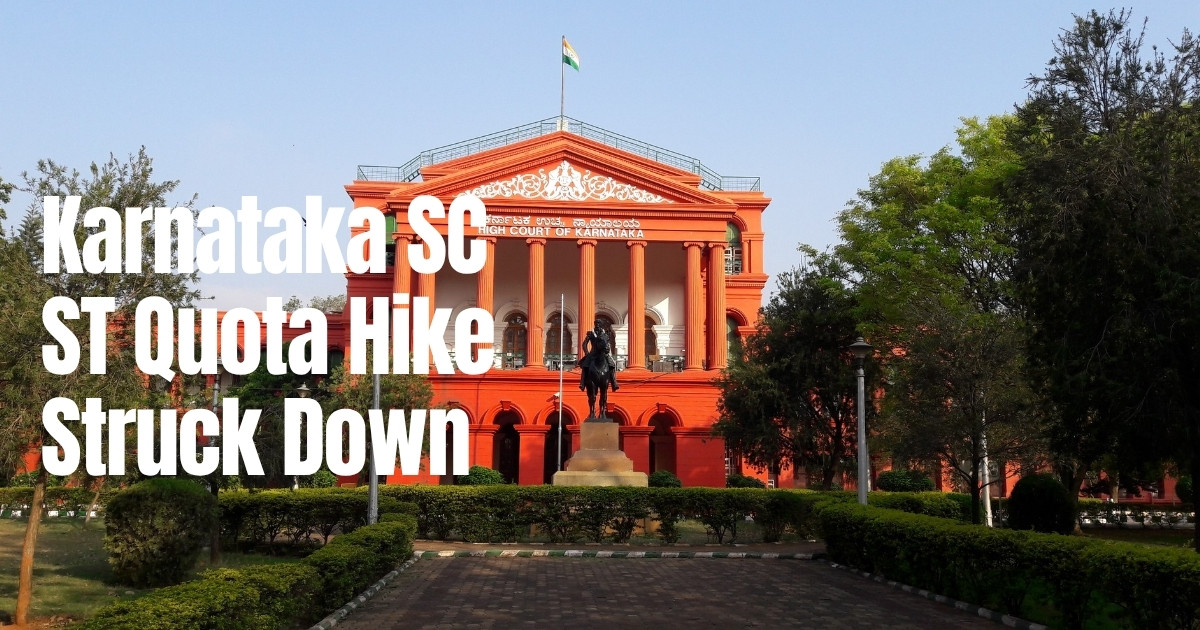

Bengaluru: The Karnataka High Court on Monday, 12 October 2026, struck down the Karnataka SC ST reservation hike made by a 2022 state law. The law had raised the quota for Scheduled Castes (SC) from 15 to 17 per cent and for Scheduled Tribes (ST) from 3 to 7 per cent. This took the total reservation in the state from 50 to 56 per cent. The court said this broke the 50 per cent limit set by the Supreme Court.
The ruling came from a bench of Chief Justice Vibhu Bakhru and Justice K S Hemalekha. The state government says it may appeal in the Supreme Court. Here is a simple guide to the case.
Table of Contents
What is reservation?
Reservation means a fixed share of seats in government colleges and posts in government jobs is kept aside for certain groups. In Karnataka, there is reservation for SC, ST and Other Backward Classes (OBC). The OBC share is 32 per cent. When the SC and ST shares went up and the OBC share stayed the same, the total rose to 56 per cent.
What did the 2022 law do?
The law is called the Karnataka Scheduled Castes and Scheduled Tribes (Reservation of Seats in Educational Institutions and of Appointments or Posts in the Services under the State) Act, 2022. It was passed when the BJP government led by Basavaraj Bommai was in power. Its main parts were:
- Section 3 raised the SC and ST share in admissions to educational institutions to 17 per cent and 7 per cent.
- Section 4 raised their share in state government jobs by the same amounts.
- The Governor signed the law on 11 January 2023. It was treated as being in force from 1 November 2022, Bar and Bench reported.
The increase was based on reports by the Justice Nagamohan Das Commission and a committee headed by retired High Court judge Justice Subhash B Adi.
What the court said on the Karnataka SC ST reservation hike
The court struck down Section 3 to the extent that it takes total reservation above 50 per cent. It said this breaks Articles 14 and 15 of the Constitution. Article 14 promises equality before the law. Article 15 bans unfair treatment, while allowing special help for weaker groups. The court also struck down Section 4 for breaking Articles 14 and 16. Article 16 promises equal chances in government jobs.
“Any reservation in excess thereof would breach the equality clauses, which would be impermissible,” the bench said, as reported by The Indian Express.
The state had argued that more than 90 per cent of Karnataka’s people belong to SC, ST and OBC groups, so reservation should match their share of the population. The court did not accept this. “To accept the said contention would be destructive of the principle of equality enshrined under the Constitution,” it said, according to Bar and Bench.
The court said reports showing poor representation of SC and ST groups can support reservation within the limit. But they do not, on their own, allow a state to cross 50 per cent.
National commissions were not consulted first
The Constitution says governments must consult the National Commission for Scheduled Castes and the National Commission for Scheduled Tribes on major policy matters affecting these groups. The court said this was compulsory. The state had relied on letters sent on 10 December 2025 and 20 January 2026, nearly three years after the law was passed. “Consultation, to be meaningful and effective, must precede the decision,” the court said.
Where does the 50 per cent limit come from?
In 1992, nine judges of the Supreme Court decided the Indra Sawhney case. They set a limit of 50 per cent on reservation. The Indian Express noted that the court left room for an exception only in extraordinary situations.
Who went to court?
Two petitions challenged the law. One was filed by Mahendra Kumar Mitra, state president of the Dr Ambedkar Scheduled Castes Federation. The other was filed by Sagar H R, Prajwal Kumar D and Purushotham Gowda G M. They are civil engineering graduates who had applied for Assistant Engineer posts in the Bruhat Bengaluru Mahanagara Palike, the city’s civic body.
What happens to jobs and admissions?
The judgment records that on 19 November 2025, the High Court stopped the state from using the higher quota. On 27 November 2025, it changed that order:
- No new recruitment notice could be issued under the higher quota.
- Recruitment that had already started could go on.
- Any appointment made would depend on the final result of the case, and appointment letters had to say so.
- Candidates could not claim any special right to their posts if the higher quota was struck down.
How the state will now handle these appointments is not yet clear. Deputy Chief Minister G Parameshwara said the government will protect ongoing recruitment and education chances in line with the law.
How leaders reacted
Mr. Parameshwara called the ruling a serious development. He blamed the previous BJP state government for passing the law without legal protection. He asked the Centre to review the 50 per cent limit and to consider Karnataka’s request to add the law to the Ninth Schedule. This is a special list in the Constitution, and laws placed in it get some protection from court challenges. The Indian Express said the Centre told Parliament on 25 July 2026 that this request was on hold because the case was pending.
Former Chief Minister Siddaramaiah said the Nagamohan Das Committee, set up by a Congress government, laid the base for the increase. Former Chief Minister Basavaraj Bommai, whose government passed the law, urged the D K Shivakumar government to go to the Supreme Court. He pointed to states such as Tamil Nadu and Chhattisgarh, where he said reservation is above 50 per cent, Deccan Herald reported.
To learn more about the state, read our guide to Karnataka’s history, geography and economy. You can also read about Dr B R Ambedkar, the main architect of the Constitution.
Short FAQ
Does this end SC and ST reservation in Karnataka?
No. The court struck down the 2022 increase because it pushed the total above 50 per cent. Reservation within the 50 per cent limit is not touched by this ruling.
Do I still need a caste certificate?
Yes. Students and job seekers who claim reservation still need a valid caste certificate. See our guide on how to apply for a caste and income certificate in Karnataka.
Sources
- Karnataka High Court, judgment in Mahendra Kumar Mitra and others vs Union of India and others (WP No. 200448 of 2025 with WP No. 25515 of 2025), 12 October 2026
- Bar and Bench, Karnataka High Court strikes down law enhancing SC/ST reservation as total quota exceeds 50% cap, 12 October 2026
- The Indian Express, Karnataka High Court strikes down SC, ST quota hikes for breaching 50% cap, 12 October 2026
- The Indian Express, Karnataka urges Centre to review 50% quota ceiling, will pursue legal options, 13 October 2026
- India Today, Karnataka High Court quashes SC, ST quota hike over 50 per cent cap, 13 October 2026
- The Hindu BusinessLine, Karnataka High Court strikes down enhanced SC/ST quota, upholds 50% reservation ceiling, 12 October 2026
- Deccan Herald, Karnataka High Court ruling on SC/ST quota: Basavaraj Bommai tells govt to move Supreme Court, 12 October 2026