

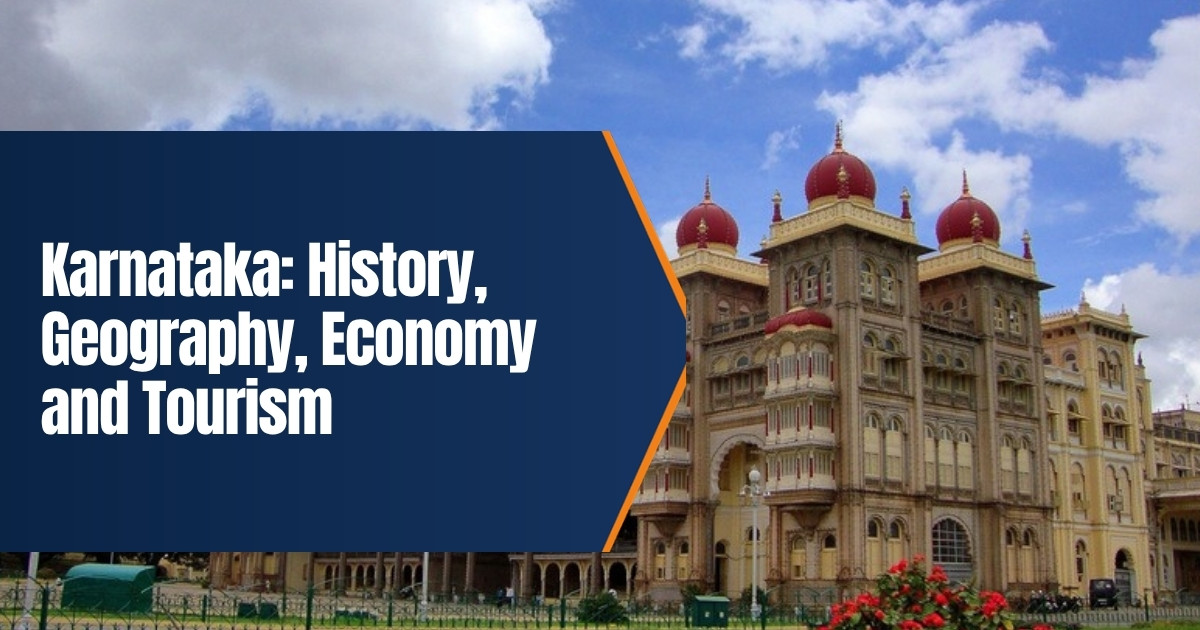
Karnataka: History, Geography, Economy and Tourism
Karnataka is a large state in south western India, stretching from the Arabian Sea coast across the Western Ghats to the Deccan plateau. It is home to Bengaluru, India’s technology capital, as well as the ruins of Hampi, the palaces of Mysuru and the coffee hills of Kodagu. This guide covers Karnataka’s history, geography, economy and tourism, with details updated for October 2026.
Table of Contents
Quick Facts
| Item | Detail |
|---|---|
| Capital | Bengaluru |
| Area | 191,791 square kilometres |
| Population (2011 census) | 61,095,297 |
| Districts | 31 |
| Formed | 1 November 1956; renamed Karnataka in 1973 |
| Assembly seats | 224 |
| Highest peak | Mullayanagiri, 1,925 metres |
| Chief minister | D. K. Shivakumar, since 3 June 2026 |
History
Early Times
People have lived in Karnataka since the Stone Age. Iron objects dated to around 1200 BCE have been found at Hallur, which points to early metal working in the region. Ashoka’s edicts at sites such as Brahmagiri and Maski show that northern Karnataka was part of the Mauryan empire in the 3rd century BCE. The Satavahanas later ruled much of the Deccan.
The First Kannada Kingdoms
The Kadambas, founded by Mayurasharma in the 4th century with their capital at Banavasi, are often called the first native kingdom of Karnataka. The Western Gangas ruled the south from Talakad around the same time. The Chalukyas of Badami rose in the 6th century, and their king Pulakeshin II stopped Harsha’s advance south. The temples at Aihole, Badami and Pattadakal date from this period.
Rashtrakutas and Hoysalas
The Rashtrakutas built a large empire from the 8th to the 10th century, and Kannada literature grew under their rule. The later Chalukyas of Kalyani followed. In the south, the Hoysalas ruled from Belur and then Halebidu, and built richly carved star shaped temples. In 2023 UNESCO listed the Hoysala temples at Belur, Halebidu and Somanathapura as a World Heritage Site.
Vijayanagara
Harihara and Bukka founded the Vijayanagara empire in 1336, with its capital at Hampi on the Tungabhadra. Under rulers such as Krishnadevaraya it became one of the richest states in the world. After its defeat at Talikota in 1565 the capital was sacked, and its ruins now form a UNESCO site.
Mysore, Hyder Ali and Tipu Sultan
The Wodeyar family ruled the Kingdom of Mysore from the late 14th century. In the 18th century Hyder Ali took real power, and his son Tipu Sultan fought four wars with the British East India Company. Tipu was killed at Srirangapatna in 1799, and the British restored the Wodeyars as rulers under their control. Mysore became known for its modern administration, with dams, railways and an early university.
Unification and Statehood
Before independence, Kannada speaking areas were split between Mysore, the Bombay and Madras Presidencies and Hyderabad State. The Karnataka unification movement, with leaders such as Aluru Venkata Rao, pushed to bring them together. On 1 November 1956, under the States Reorganisation Act, they were joined as Mysore State. It was renamed Karnataka on 1 November 1973, and the date is marked every year as Rajyotsava.
Politics Today
The Congress party won the 2023 assembly election, and Siddaramaiah became chief minister. He stepped down in 2026, and D. K. Shivakumar was sworn in as chief minister on 3 June 2026. G. Parameshwara serves as deputy chief minister.
Geography
Karnataka borders Goa and Maharashtra to the north, Telangana and Andhra Pradesh to the east, Tamil Nadu and Kerala to the south, and the Arabian Sea to the west. It has three main zones:
- The coast. A narrow strip of about 320 kilometres with beaches, ports and fishing towns such as Mangaluru, Udupi and Karwar.
- The Western Ghats, or Malnad. Hills and dense forests with heavy rain, part of a UNESCO World Heritage Site since 2012. Mullayanagiri in the Chikkamagaluru hills is the highest peak.
- The Deccan plateau. Drier, open country that covers most of the north and east of the state.
Rivers and Climate
The Krishna and its tributaries, including the Tungabhadra, Ghataprabha and Malaprabha, drain the north. The Kaveri rises at Talakaveri in Kodagu and flows east into Tamil Nadu, and sharing its water has long been a dispute between the two states. Jog Falls, where the Sharavathi drops about 253 metres, is one of the highest waterfalls in India. The coast and Ghats get very heavy monsoon rain, while the plateau is much drier. Bengaluru, at around 900 metres, has a mild climate for most of the year.
Wildlife
The forests of the Western Ghats and the southern hills shelter a large share of India’s big mammals. The 2023 elephant estimate counted about 6,400 wild elephants in Karnataka, the highest of any state, and the 2022 tiger count placed it second in India with 563 tigers. Bandipur, Nagarhole, BRT and Bhadra are major tiger reserves, and the Ghats are also rich in frogs, birds and rare plants found nowhere else.
Economy
Bengaluru is the centre of India’s software and technology industry, home to thousands of IT companies, startups and research centres. The Indian Space Research Organisation has its headquarters there, and Hindustan Aeronautics builds aircraft and helicopters in the city. Biotechnology, electronics and car manufacturing add to the industrial base, with clusters around Mysuru, Hubballi and Belagavi.
Farming remains vital for rural families. Karnataka grows about 70 percent of India’s coffee, mainly in Kodagu, Chikkamagaluru and Hassan. It is the leading producer of mulberry silk, and Mysore silk sarees are famous. The state also grows ragi, rice, sugarcane, areca nut and spices, and Mysore sandalwood has long been prized. Iron ore is mined in the Ballari region, and the port at New Mangaluru handles oil and cargo. Tourism, retail and services also employ many people in the cities.
Tourism
Karnataka offers heritage, hills, wildlife and beaches. Popular places include:
- Mysuru. The Mysore Palace, Chamundi hill and the Dasara festival in autumn.
- Hampi. The ruins of Vijayanagara, with the Virupaksha temple and the stone chariot at Vittala temple.
- Badami, Aihole and Pattadakal. Cave temples and early Chalukya architecture.
- Belur and Halebidu. Hoysala temples with detailed stone carving.
- Kodagu and Chikkamagaluru. Coffee estates, misty hills and treks.
- Bandipur and Nagarhole. National parks known for tigers and elephants.
- Gokarna, Murudeshwar and Udupi. Coastal temples and beaches.
- Shravanabelagola. The 57 foot statue of Gommateshwara, a major Jain pilgrimage site.
Culture
Kannada is the official language and was declared a classical language in 2008. Kannada writers have won eight Jnanpith awards, among the most for any Indian language. Tulu, Konkani and Kodava are spoken in coastal and hill areas. Yakshagana, a night long dance drama, is the best known folk art of the coast. Carnatic music has deep roots here through poet saints such as Purandara Dasa. Food ranges from bisi bele bath and Mysore pak to Mangalorean seafood and Udupi vegetarian meals.
Festivals
Mysuru Dasara is the best known festival, with a lit palace, a royal procession and decorated elephants carrying the goddess Chamundeshwari. Ugadi marks the Kannada new year in spring. On the coast, Kambala buffalo races are held in flooded paddy fields in winter, and the Karaga festival in Bengaluru is one of the city’s oldest. Hampi Utsav brings music and dance to the ruins.
Getting Around
Kempegowda International Airport in Bengaluru is the main gateway, with other airports at Mangaluru, Mysuru, Hubballi, Belagavi and Kalaburagi. Trains link Bengaluru to Mysuru, Hubballi and the coast, and the Konkan Railway runs along the shore. State buses reach most towns, and roads through the Ghats can be slow during the monsoon.
Plan a visit with our guides to the Mysore Palace, the hill district of Coorg and Lalbagh in Bengaluru. For the end of Tipu Sultan’s rule, read our account of the Fourth Anglo Mysore War.
Hampi is spread over a wide area, so many visitors hire bicycles or autos and start early to avoid the midday heat.
Safari slots in Bandipur and Nagarhole are limited and booked through the state forest department’s official site.
Coastal beaches can have strong currents in the monsoon, so swimmers should use only marked and guarded areas.
Bengaluru traffic is heavy at peak hours, and the Namma Metro is often the quickest way across the city.
Homestays on coffee estates in Kodagu and Chikkamagaluru give visitors a close look at plantation life and local food.
What We Changed From the Old Post
The old post was machine spun and included unsourced claims, such as a link between early Karnataka and African civilisation and the idea that its first rulers were mostly from the north. We removed those claims, rewrote the text in plain English, removed the dash from the title, and added a quick facts table, a clear dynasty timeline, unification and the 1973 renaming, the 2026 change of chief minister, regional geography, the main industries, UNESCO sites and a culture section.
Frequently Asked Questions
What is the capital of Karnataka?
Bengaluru, formerly Bangalore, is the capital.
When was Karnataka formed?
The state was formed on 1 November 1956 as Mysore State and renamed Karnataka in 1973.
Who is the chief minister of Karnataka?
D. K. Shivakumar of the Congress, in office since 3 June 2026.
When is the best time to visit?
October to March suits most of the state. Mysuru Dasara falls in September or October.