

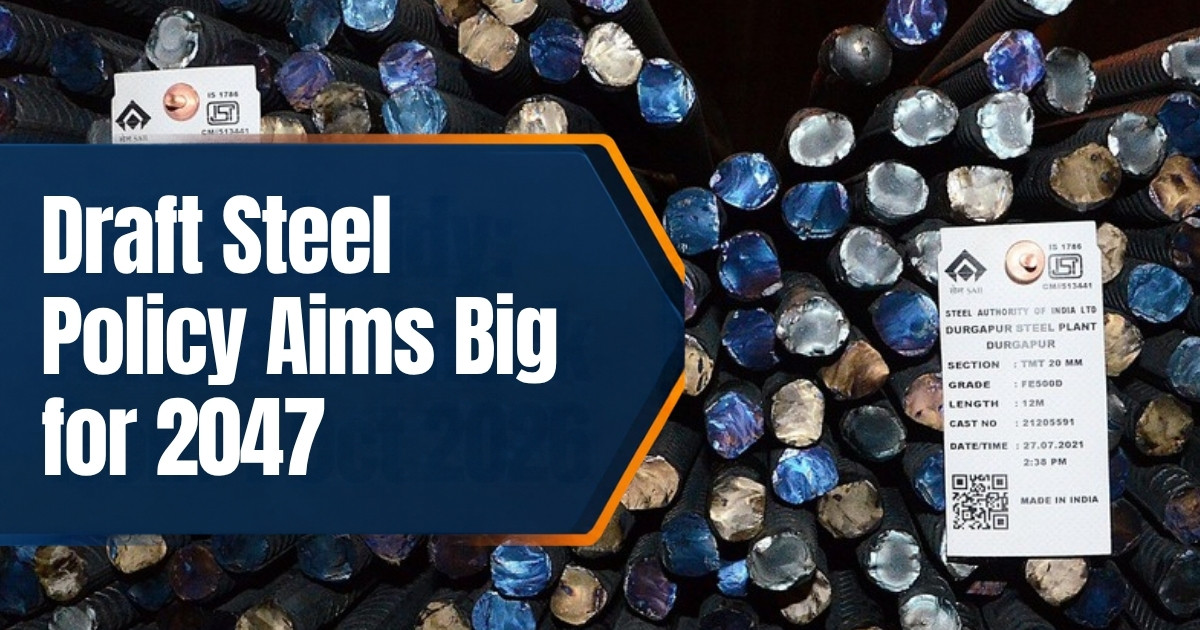

New Delhi: India wants to make almost three times more steel by 2047. The Ministry of Steel has released a draft of the National Steel Policy 2047, also called NSP Vision 2047. It was put out for public comments late on Saturday, 10 October 2026, Reuters reported. The draft says India should be able to make 604 million tonnes (MT) of crude steel a year by 2047. Today, the country can make about 220 MT a year. Anyone can send suggestions on the draft until 30 October 2026, the ministry’s website says.
Steel is in almost everything around us. It is in houses, bridges, railway tracks, cars, fridges and even food tins. So a plan for steel is really a plan for how India will build itself in the next 21 years. Here is what the draft says, in simple words.
Table of Contents
Why a new steel policy now?
India already has a steel policy from 2017. That policy aimed for 300 MT of capacity by 2030 and steel use of 160 kg per person. Its time frame runs till 2030 to 2031.
A lot has changed since then. India’s crude steel output rose from about 89 MT in the 2014 to 2015 financial year to 170 MT in 2025 to 2026, the draft says. Steel use in the country more than doubled, from 77 MT to 164 MT. India is now the world’s second largest maker and user of steel.
Steel Secretary Sandeep Poundrik had said the 2017 policy “needed a relook”, PTI reported. He said new areas like artificial intelligence and new technology now need more focus.
National Steel Policy 2047: the main targets
The draft lists these goals for the year 2047:
- Capacity: 604 MT of crude steel a year. Crude steel is the first form of steel that comes out of a plant, before it is shaped into rods, sheets or pipes.
- Demand: Use of finished steel in India to reach 505 MT a year.
- Use per person: 302 kg of steel per person every year. In 2025 to 2026, it was just 116 kg, while the world average is 209 kg.
- Exports: 45 MT of steel sold to other countries every year.
- Cleaner steel: Cut the carbon dioxide released for every tonne of steel from 2.54 tonnes to about 1.54 tonnes.
Business Standard reported that these numbers assume India’s economy grows by about 7 per cent a year. They also assume plants run at 88 per cent of their full capacity. In 2025, the figure was 77 per cent.
Where the steel will be used
The draft says construction and infrastructure use about 67 per cent of all steel in India. Buildings like homes, offices and factories take about 37 per cent. Roads, railways, metro lines, bridges, ports, airports and power projects take another 30 per cent. Cars, machines, home appliances and packaging use about 28 per cent.
New areas will add to demand, the draft says. These include faster growth of cities, solar and wind power, electric vehicles and digital networks.
The raw material problem
To make steel, plants need iron ore and a special kind of coal called coking coal. Raw materials make up 65 to 70 per cent of the cost of making steel. India has plenty of iron ore. But it buys nearly 92 per cent of its coking coal from other countries. This makes Indian steel makers depend on foreign supply and prices.
The draft wants to change this. It plans more mining at home, more plants that wash and clean Indian coal, long term supply deals, and buying mines in other countries. Business Standard reported that iron ore demand may rise from 299 MT in 2025 to 772 MT by 2047. Coking coal demand may rise from 72 MT to 236 MT.
Cleaner steel and a scrap drive
Making steel releases a lot of carbon dioxide, a gas that heats up the planet. The draft says the sector gives out about 10 to 12 per cent of India’s carbon dioxide. On average, India releases 2.54 tonnes of carbon dioxide for every tonne of steel. The world average is 1.92 tonnes.
The plan is to clean up step by step. First, plants will save energy, use more solar and wind power, and use more scrap. Later, they will move to newer methods, such as making iron with green hydrogen and trapping carbon before it reaches the air. The final goal is Net Zero by 2070. This means India would release no more carbon than it removes.
Scrap is old steel that can be melted and used again. In 2025 to 2026, India used 36 MT of scrap. The draft wants this to reach 123 MT by 2047. To get there, it plans a large drive like the Swachhata Abhiyan. This drive will collect old steel from homes, broken goods, demolished buildings and old vehicles. Makers of cars and home appliances may also be made responsible for collecting their old products.
Other key ideas in the draft
- Small steel units: About 2,550 smaller units make up nearly 47 per cent of capacity. They will get help with raw materials, technology, skills and safety.
- Safety: A new Steel Industry Safety Council will set common safety rules for all plants, aiming for zero tolerance of safety violations.
- Quality checks: Artificial intelligence will help track imports, to stop poor quality steel from entering India.
- Jobs and skills: The sector gives direct jobs to about 6 lakh people and supports nearly 20 lakh more. The draft plans more training centres.
What it means for you
This is only a draft. It is not final yet. The ministry is asking for comments before the policy is made final. If you run a business that uses steel, or you simply have an idea, you can send it through the Ministry of Steel website before 30 October 2026.
India has a long history with this metal. Read how the invention of crucible steel began in ancient India. Many of today’s big plants are in mineral rich states like Jharkhand.
Short FAQ
Is the National Steel Policy 2047 final?
No. It is a draft. The ministry has asked for comments until 30 October 2026.
Will steel become cheaper because of this policy?
The draft sets no price target for buyers. It speaks of keeping steel affordable and getting raw materials at competitive prices, with less coal bought from abroad.
Smoke from factories affects the people living nearby. Learn more about how industrial pollution impacts health and daily life.
Sources
- Ministry of Steel, Government of India, Draft National Steel Policy: Vision 2047 (draft document dated 1 October 2026) and the ministry website notice inviting suggestions by 30 October 2026
- Business Standard (PTI), Govt releases draft National Steel Policy 2047, targets 604 MT capacity, 11 October 2026
- Business Standard, Draft steel policy eyes nearly threefold rise in capacity by 2047, 11 October 2026
- The Hindu BusinessLine (Reuters), India unveils steel policy aiming for 604 million tonne capacity by 2047, 11 October 2026