

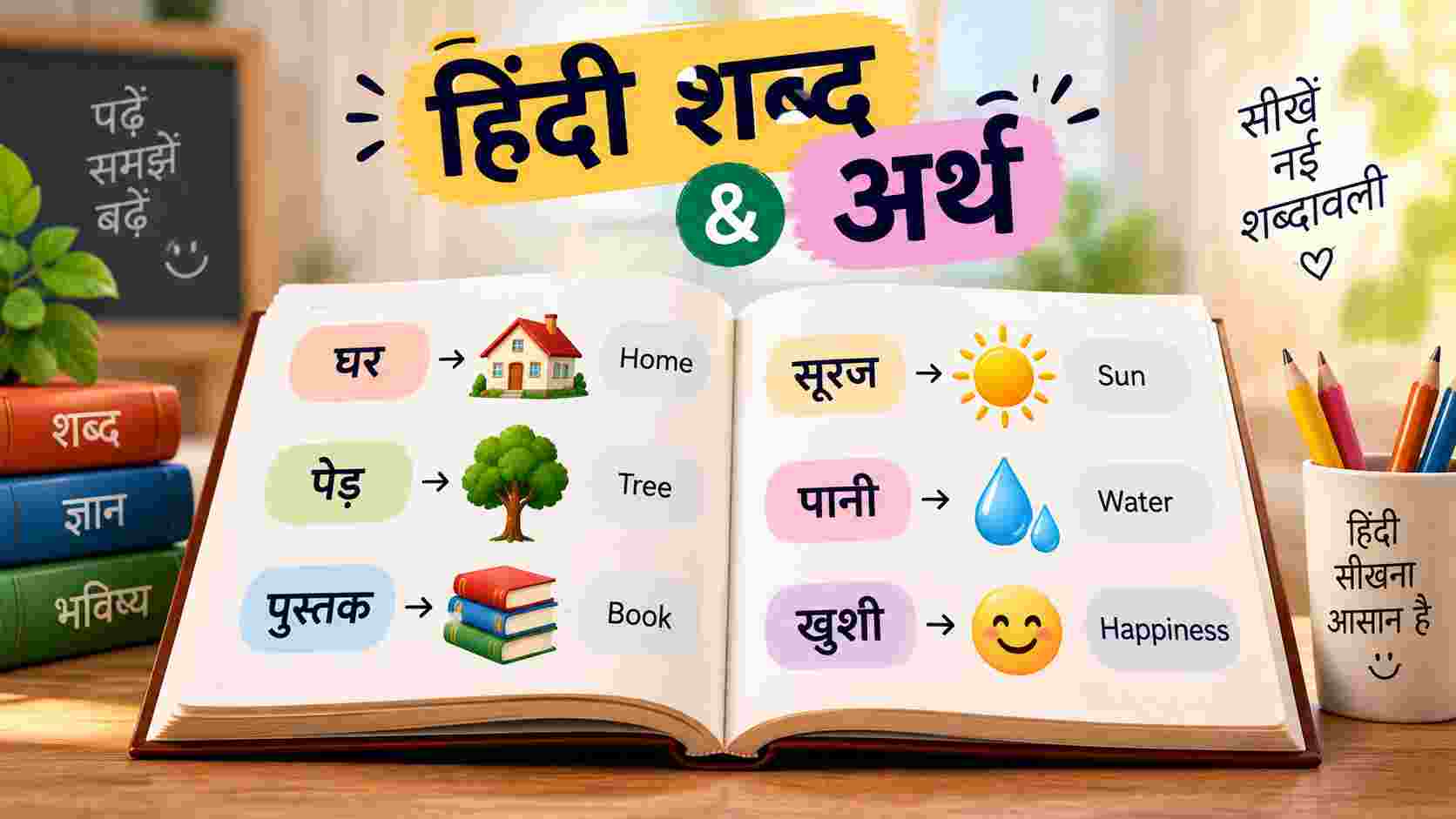
Hindi Words & Meanings
There’s a strange little moment that happens to almost every Hindi speaker at some point. You’re mid-conversation with someone who only speaks English, and a word comes to your tongue that says exactly what you mean, except it’s Hindi, and there’s no English word that fits the same way.
You end up saying the whole sentence again, longer, and it still doesn’t land the same. That gap is real, and it’s not just about vocabulary. It’s about how a language grows around the life of its people, and Hindi has grown around centuries of festivals, kitchens, relationships, and roadside chai stalls that English never had to name.
This piece is about that gap. We’re looking at Hindi words with meaning that don’t fold neatly into English, along with a few that already live comfortably inside English sentences. Some are everyday and practical, some are almost spiritual, and a few are just plain fun to say out loud.
Table of Contents
Why Some Hindi Words Just Refuse to Translate
Language carries culture, and Hindi carries a lot of it. A word like ‘jugaad’ is a good example. Ask someone to translate it and they’ll probably say ‘a quick fix’ or ‘a workaround,’ but that misses half the point.
Jugaad isn’t just about solving a problem cheaply, it’s about the pride and cleverness in doing it with whatever is lying around, often with a small grin on your face because you know it shouldn’t have worked, but it did. English has words for improvisation and frugality, but none of them carry that specific mix of jugadu confidence and mischief.
The same goes for feelings tied to rituals or relationships. English can describe a father giving his daughter away at a wedding, but it takes a whole sentence to do it, while Hindi does it in one word: kanyadaan. When a language has to build a sentence to explain what another language says in a syllable or two, that’s usually a sign the second language has lived with that idea for a very long time.
Everyday Hindi Words With Meaning You Already Use
A lot of unique Hindi words have quietly become part of daily English speech in India, and honestly, in a few pockets of the world too. Take ‘adda.’ It’s not just a hangout spot, it’s the specific place where a group of friends keeps returning, where the same corner table or the same paan shop becomes a kind of second home. You could call it a ‘regular spot’ in English, but that phrase sounds like a Yelp review, not a memory.
Then there’s ‘dhaba,’ which most people now use in English sentences without a second thought. A dhaba is a roadside eatery, usually with cots or plastic chairs, open at odd hours, serving food that tastes better than it has any right to for the price. ‘Roadside restaurant’ technically works as a translation, but it strips away the dust, the diesel smell, the truck drivers dozing on charpais, and the tadka that hits different at 2 a.m. on a highway.
Unique Hindi Words That Carry a Whole Feeling
Some Hindi words exist almost entirely to describe internal states that English tends to split into several separate words, none of which quite fit. ‘Jijivisha’ is one of these. It roughly means the deep, almost stubborn will to live, not survival out of fear, but a hunger to keep experiencing life fully. English doesn’t really have a single word for that kind of fierce love of living.
‘Indriya’ is another one worth knowing. It refers to control over the senses, the discipline to not be pulled around by every craving or temptation that shows up. You could translate it as ‘self-restraint,’ but that sounds clinical, almost like a diet plan, when indriya is really about a quieter, more mature kind of strength.
Weather gets poetic treatment too. ‘Ghataa’ describes those heavy, dark monsoon clouds that roll in low and slow, and in Hindi poetry it’s often tied to longing or sadness, the kind of sky that makes you miss someone even if you’re not sure who. ‘Rimjhim’ sits on the opposite end, the light pitter-patter of gentle rain, a word that’s almost onomatopoeic and impossible to say without picturing a quiet evening at a window.
Beautiful Hindi Words People Fall in Love With
There’s a reason people collect Hindi words the way they collect old coins or postcards. Some of them are just beautiful Hindi words to hear. ‘Rasa’ is one of those words used in Indian classical arts to describe the emotional essence conveyed through expression, gesture, and voice, the invisible thread that connects a performer to an audience. It’s used in dance, theatre, and even cooking, since food is also said to carry its own rasa.
‘Moksh’ carries weight from both Hindu and Jain thought, describing liberation from the cycle of birth and rebirth, a kind of ultimate freedom that isn’t really about escaping life so much as understanding it completely. Words like this are part of why so many non-Hindi speakers get curious about the language in the first place. They sound gentle, but they’re carrying centuries of philosophy on their backs.
Even the lighter, more playful words have their own charm. ‘Angdai’ is that full-body stretch and yawn you do when you’re sleepy or just waking up, arms thrown wide, back arched a little. English just says ‘stretch,’ which honestly doesn’t capture the small, satisfying drama of an angdai.
Hindi Words That Have Slipped Into English
Some Hindi words in English usage today aren’t even treated as foreign anymore. ‘Bindi,’ ‘prasad,’ ‘rakhi,’ and ‘hookah’ show up in English dictionaries and everyday conversation, especially wherever there’s a sizable Indian community.
A bindi is the mark worn on the forehead, prasad is the food offered to deities and later shared among devotees, rakhi is the thread tied on a brother’s wrist during Rakshabandhan, and hookah has travelled so far into global lounge culture that a lot of people using the word have no idea it started as a Hindi and Urdu term for a water pipe.
This kind of borrowing happens because these words describe things that either didn’t exist in English-speaking cultures or existed differently enough that a direct translation felt clumsy. Once enough people use a word often enough, it stops feeling foreign and just becomes part of the shared vocabulary.
Slang, Sass, and the Words Nobody Teaches You in Class
Not every unique Hindi word is soft or poetic. Some are sharp, funny, or downright cheeky, and these tend to be the ones people learn fastest from friends rather than textbooks. ‘Namoona’ literally means ‘sample’ or ‘specimen,’ but say it about a person and it turns into a light jab, implying they’re a real character, usually not in the most flattering way.
‘Chichora’ describes someone acting indecent or a little too flirtatious for comfort, and ‘kalmoohi’ is an old-school insult aimed at someone considered unlucky or foolish.
These words rarely show up in formal Hindi lessons, yet they’re the ones that make conversations feel alive, the kind of vocabulary that tells you someone actually grew up speaking the language rather than learning it from a phrasebook.
Frequently Asked Questions
What are some unique Hindi words with no English equivalent?
Words like jugaad, jijivisha, indriya, ghamasan, and kanyadaan are often mentioned as Hindi words that don’t have a clean one-word English match. Each one carries a cultural or emotional layer that a direct translation tends to flatten out.
Why do some Hindi words sound better than their English translation?
A lot of it comes down to rhythm and history. Hindi words like rimjhim or angdai are almost musical, built to mimic a sound or a feeling, while the English versions tend to be more literal and less playful.
Are Hindi words commonly used in English conversations today?
Yes, quite a few have become part of regular English usage, especially bindi, hookah, prasad, dhaba, and rakhi. Many English speakers use these words without even thinking of them as borrowed.
What makes a Hindi word ‘untranslatable’?
It usually means the word carries a specific cultural, emotional, or ritual meaning that English would need a full sentence or paragraph to explain properly, rather than a single matching word.
Is it useful to learn beautiful Hindi words even if I don’t speak Hindi fluently?
Definitely. Even a small vocabulary of meaningful Hindi words can help you understand Indian films, music, festivals, and everyday conversations a lot better, and it often makes conversations with Hindi speakers feel warmer and more personal.