

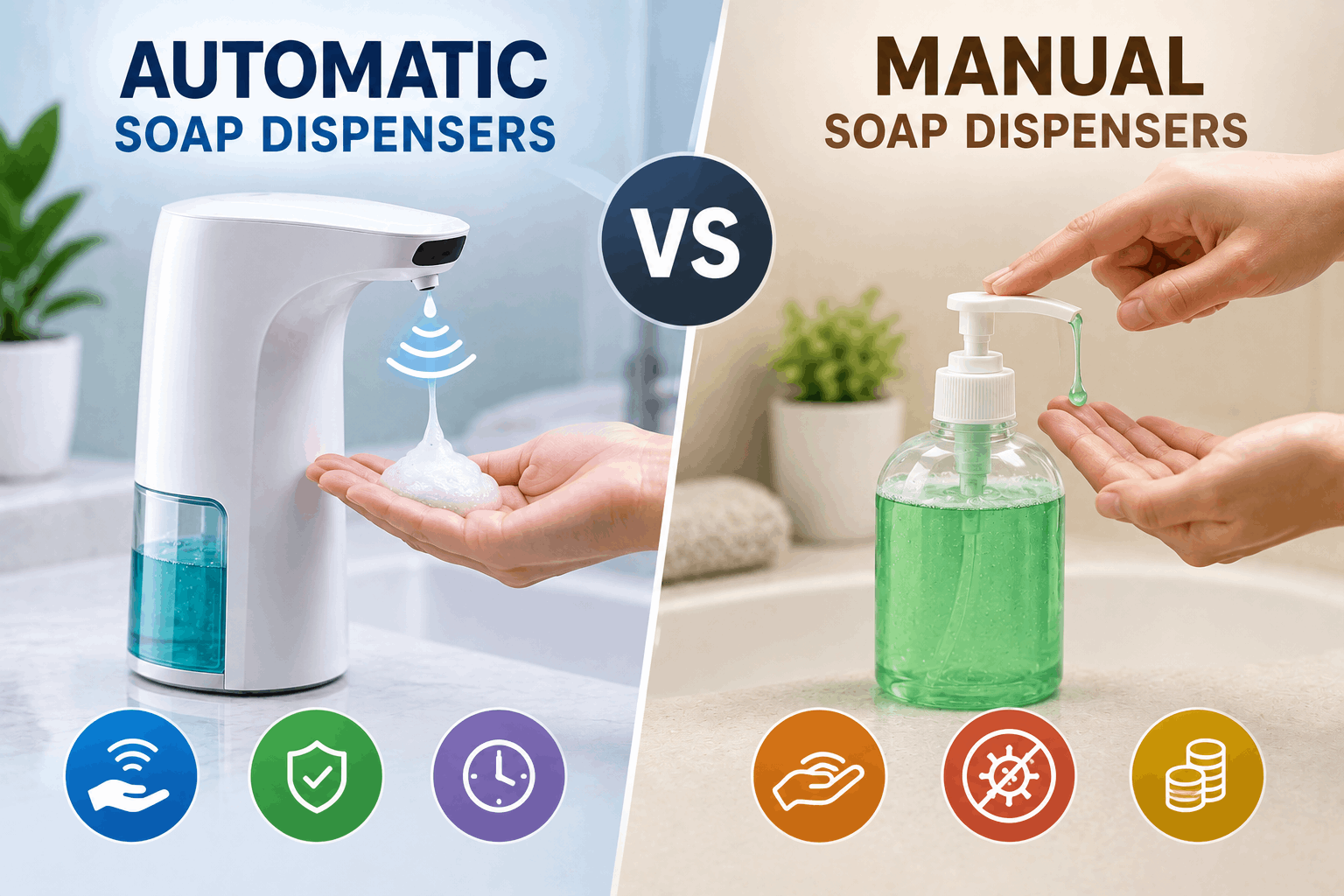
Automatic Soap Dispensers vs Manual: Which One Should You Choose?
In most commercial washrooms, soap dispensers don’t get much attention. They’re installed, refilled, and expected to just work.
But once the space starts seeing regular usage, the difference between a well-suited system and a poorly chosen one becomes obvious. Sometimes it shows up as empty units, sometimes as leakage, and sometimes in the way people interact with it.
That’s when the choice of a soap dispenser stops being a small decision.
Table of Contents
It’s Not About the Product, It’s About the Environment
On paper, both automatic and manual systems do the same job. They dispense soap.
But public washrooms don’t operate on paper conditions. They deal with constant usage, different user behaviors, and very little patience for things that don’t respond instantly.
In that kind of setup, how a soap dispenser works becomes more important than what it is.
How Manual Dispensers Behave Over Time
Manual systems are straightforward. Press, push, or pump, and soap comes out.
In low-traffic spaces, this usually works without much trouble. But in commercial environments, a few patterns start to appear.
Every user touches the same surface. That repeated contact builds up over time, even with regular cleaning.
Then there’s inconsistency. Some users press harder, some lightly. The amount of soap varies, which affects both usage and wastage.
And after a while, the mechanism itself starts showing wear. Buttons loosen, springs weaken, and sometimes the unit doesn’t respond properly.
What Changes With Automatic Soap Dispensers
An automatic soap dispenser removes most of that variation.
There’s no physical interaction. You place your hand under the unit, and it dispenses a fixed amount.
That changes the experience immediately. There’s no hesitation, no second attempt, and no need to touch anything.
It also brings consistency. Every user gets roughly the same amount, which helps control both usage and refilling frequency.
Hygiene: Where the Difference Becomes Clear
In shared environments, hygiene isn’t just about cleaning. It’s about how many surfaces people need to touch.
Manual systems add one more contact point into the process. And in high-traffic washrooms, that contact repeats throughout the day.
An automatic soap dispenser removes that step completely.
The World Health Organization has emphasized the importance of proper hand hygiene in reducing infection spread. Reducing touchpoints supports that in a simple, practical way.
Maintenance Feels Different in Practice
At first glance, manual dispensers seem easier. There are no sensors, no electronics, nothing complex.
But over time, they require more attention than expected.
Refilling becomes frequent due to uneven usage. Mechanical parts wear out. Leakage and clogging show up gradually.
An automatic soap dispenser shifts that pattern.
It may need occasional checks, but the dispensing remains consistent. That reduces unnecessary wastage and makes maintenance more predictable.
User Experience (Often Ignored, But Important)
People don’t usually think about dispensers, but they notice when something doesn’t work smoothly.
Manual systems sometimes require a second attempt. Press again, adjust, try harder.
An automatic soap dispenser removes that friction. It responds instantly and feels easier to use.
Over time, this affects how people perceive the space. It feels cleaner, more controlled, and better maintained.
Cost: What Looks Cheaper Isn’t Always Cheaper
Manual dispensers usually have a lower upfront cost. That’s one of the reasons they’re still widely used.
But in high-traffic environments, operational cost becomes more relevant than initial price.
Frequent maintenance, inconsistent usage, and part replacements add up.
An automatic soap dispenser may cost more initially, but it tends to perform more consistently over time. That stability often offsets the initial investment.
Side-by-Side Comparison
| Factor | Manual Soap Dispenser | Automatic Soap Dispenser |
| Contact | High (touch required) | Minimal (touch-free) |
| Hygiene consistency | Depends on cleaning | More controlled |
| Dispensing | User-dependent | Fixed output |
| Maintenance | Mechanical wear | Predictable checks |
| Cost over time | Variable | More stable |
So, Which One Should You Choose?
It depends on how the space is used.
In smaller or low-traffic environments, manual systems can still work without major issues.
But in public washrooms with continuous usage, the limitations start to show.
An automatic soap dispenser fits better in these environments because it reduces contact, improves consistency, and requires less day-to-day intervention.
Final Thoughts
A soap dispenser may not seem like a critical decision, but in commercial spaces, it directly affects hygiene and maintenance.
Manual systems are simple and familiar, but they depend heavily on user behavior.
Automatic systems remove that dependency and bring more consistency into the process.
And in high-traffic environments, consistency is what keeps everything running smoothly.