

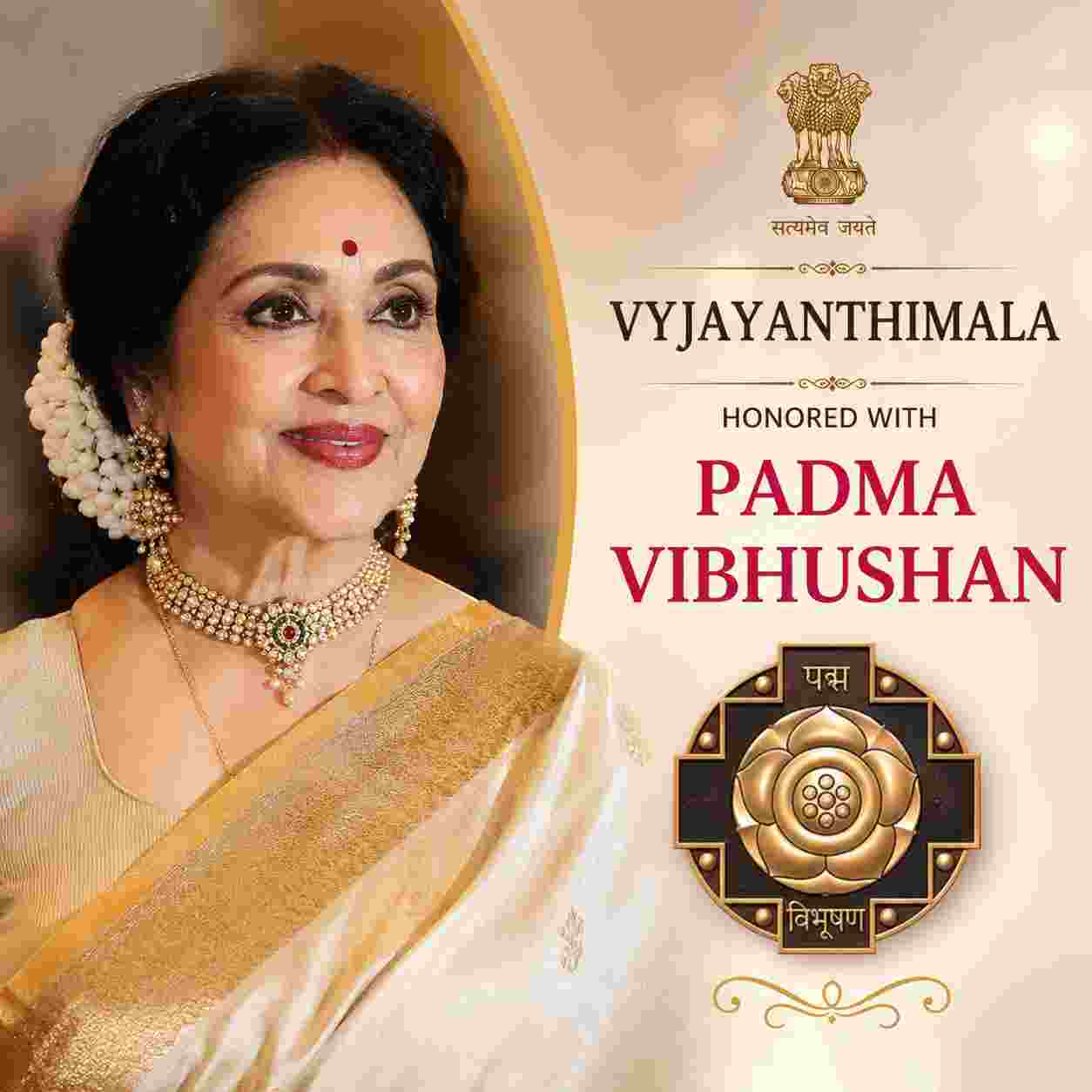
Vyjayanthimala Padma Vibhushan
Very few people in Indian cinema have been genuinely excellent at more than one thing. Vyjayanthimala did it across three — acting, dancing, and connecting with audiences in a way that sustained her career for decades. The Vyjayanthimala Padma Vibhushan recognition is the government’s formal acknowledgment of what film lovers in India have known for a long time.
It looks at the woman behind this honour, the career she built, and why this recognition carries the weight it does.
Table of Contents
A Brief Look at the Vyjayanthimala Biography
The Vyjayanthimala biography begins in Chennai, where she was born on August 13, 1936. She grew up surrounded by classical arts. Her family encouraged her toward Bharatanatyam from an early age. She trained seriously and performed publicly before she was a teenager.
She entered Tamil cinema first. Her film debut came in 1949 with Vaazhkai. Audiences noticed her immediately — not just for her looks but for the way she moved. Dance was already inseparable from her screen presence.
Hindi cinema came calling shortly after. She made her Bollywood debut with Bahar in 1951. That was the beginning of a career that would place her firmly among the Bollywood legends of the 1950s and 1960s.
What Made Her Stand Apart
Many actresses from her era were beautiful. Many could act. Very few matched what Vyjayanthimala brought to the screen — classical dance executed at a level that belonged in a concert hall, combined with full emotional range.
She was a classical dancer India had trained and cinema had claimed. That combination was rare. She wasn’t performing choreographed steps. She was bringing a serious art form into popular entertainment without diluting either one.
Her films attracted audiences partly because of the dance sequences. Devdas (1955), Naya Daur (1957), Sadhna (1958), Sangam (1964) — these films formed part of the cultural core of Hindi cinema’s golden era. She appeared in all of them and held the screen in each.
The Films That Defined Her Legacy
Looking at the actress’s achievements in Vyjayanthimala’s career, a handful of films carry particular weight.
Nagin in 1954 was one of her early Hindi successes. The film was a commercial hit and established her as a star in Hindi cinema.
Devdas in 1955 brought her alongside Dilip Kumar and Suchitra Sen. She played Chandramukhi — the courtesan who loves Devdas without expectation. It was a subtle performance in a film full of strong performers. She held her own and won the Filmfare Award for Best Actress.
Naya Daur in 1957, again opposite Dilip Kumar, gave her a role with physicality and emotion. She matched him scene for scene.
Sangam in 1964 was a Raj Kapoor production that became one of the biggest hits of its decade. She starred opposite both Raj Kapoor and Rajendra Kumar. Film historians often cite her performance as one of the defining pieces of work from that era.
These actress achievements weren’t confined to one genre. She worked across drama, romance, social films, and mythological stories. She adapted to whatever the film needed without losing what made her recognisable.
Classical Dance and Cinema Together
Vyjayanthimala is one of the rare people in Indian cinema who carried her classical training all the way through her career. She didn’t set aside her Bharatanatyam when she became a film star. She brought it with her.
She trained under Vazhuvoor Ramaiah Pillai, one of the foremost Bharatanatyam gurus of the twentieth century. That training showed in every gesture on screen. She set a standard that made audiences understand classical dance differently.
She is recognised as one of the most significant classical dancers India has produced in the modern era — not just a film actress who could dance, but a trained artist who chose cinema as her platform.
Beyond Acting: A Life After Cinema
Vyjayanthimala stepped back from films in the late 1960s. She married Dr. Chamanlal Bali in 1968. She didn’t disappear from public life, though.
She continued performing Bharatanatyam and teaching dance. She received the Sangeet Natak Akademi Award in 1996 — recognising her contribution to Indian performing arts specifically.
She entered politics. She was elected to the Rajya Sabha and represented the Indian National Congress for two terms. This reflected the breadth of her engagement with public life well beyond entertainment.
What the Padma Vibhushan Means
India’s Padma awards recognise exceptional contribution to national life. The Padma Vibhushan is the second-highest category, below only the Bharat Ratna.
For the Vyjayanthimala Padma Vibhushan to be awarded at this level, it means the government acknowledges a contribution that crossed professional boundaries. She didn’t just act in successful films. She shaped Indian cinema’s relationship with classical dance. She proved that high art and popular entertainment could exist on the same screen.
Among the Bollywood legends who have received Padma awards over the years, Vyjayanthimala stands apart because her contributions span cinema, classical dance, and public service together.
Her Place Among Bollywood Legends
Talk to anyone who grew up watching Hindi films in the 1950s and 1960s, and Vyjayanthimala’s name comes up with a specific kind of warmth. She wasn’t just a star. She was a standard.
Her influence on subsequent generations of film actresses who also trained in classical dance is real. The path she walked — taking serious classical training into popular cinema without compromising either — gave others permission to do the same.
Among the Bollywood legends of her era, she occupies a unique position. She succeeded on screen alongside towering male stars — Dilip Kumar, Raj Kapoor, Dev Anand. She matched them in terms of star power and screen presence. She did it without imitating them.
The Vyjayanthimala Padma Vibhushan places her contribution officially in the national record. It joins the Sangeet Natak Akademi Award, her parliamentary service, and her ongoing work in classical dance as evidence of a life of genuine and varied public contribution.
Key Highlights from the Career
A summary of what the Vyjayanthimala biography includes:
- Bharatanatyam training from childhood under master guru Vazhuvoor Ramaiah Pillai
- Film debut in Tamil cinema at age 13 with Vaazhkai in 1949
- Bollywood debut with Bahar in 1951
- Major films including Nagin (1954), Devdas (1955), Naya Daur (1957), Sadhna (1958), and Sangam (1964)
- Recognised as one of the finest classical dancer India has produced in the modern era
- Sangeet Natak Akademi Award in 1996 for contribution to performing arts
- Two terms as Member of Parliament in the Rajya Sabha
- Vyjayanthimala Padma Vibhushan recognised by the Government of India
This list spans over five decades of public life across three entirely different fields. Very few public figures in India can claim a comparable range of genuine contribution.
Frequently Asked Questions
-
What is the Vyjayanthimala Padma Vibhushan and when was it awarded?
The Vyjayanthimala Padma Vibhushan is India’s second-highest civilian honour, awarded to Vyjayanthimala in recognition of her exceptional contributions to Indian cinema, classical dance, and public life. It is part of the Padma awards given by the Government of India.
-
What does the Vyjayanthimala biography tell us about her background?
The Vyjayanthimala biography shows a woman who trained seriously in Bharatanatyam from childhood, entered Tamil cinema as a teenager, and built one of the most significant careers in Hindi cinema during the 1950s and 1960s. She combined classical arts training with mainstream film success throughout her career.
-
How did Vyjayanthimala compare to other Bollywood legends of her era?
Among the Bollywood legends of the 1950s and 1960s, Vyjayanthimala was distinctive because of her classical dance training. She starred opposite Dilip Kumar, Raj Kapoor, and Dev Anand. She held her own in terms of screen presence and was one of the few female stars of the era who could claim equal billing in major productions.
-
What are the most important actress achievements in her career?
Her most significant actress achievements include Devdas (1955), Naya Daur (1957), and Sangam (1964). She won the Filmfare Award for Best Actress for Devdas and Sadhna. She received the Sangeet Natak Akademi Award in 1996 for her contribution to classical performing arts.
-
Why is she called one of the finest classical dancers India produced?
She trained under Vazhuvoor Ramaiah Pillai, one of the leading Bharatanatyam gurus of the twentieth century. She performed classical dance at professional concert levels. She brought that standard into her film work. The Sangeet Natak Akademi — India’s highest body for performing arts recognition — formally acknowledged her contribution as a classical dancer India can genuinely count among its most significant.