

Used Car Buying Checklist: 8 Essential Steps to Buy a Used Car Safely
Buying a used car feels exciting right up until something goes wrong with it. The paint looked great in photos. The seller seemed honest. The price was too good to pass up. Two weeks later, you are sitting at a mechanic’s shop wondering where it all went sideways.
This happens because buyers skip a proper check before signing. This used car buying guide walks you through exactly what to look at, what to ask, and what to walk away from — so you buy a used car that is actually worth what you pay.
Table of Contents
Why a Checklist Matters More Than You Think
Second hand car buying is not like walking into a showroom. There is no warranty on the windshield. No brand promise behind the sale. What you miss before buying stays with you long after.
A good checklist slows you down when excitement is pushing you to decide too fast. It asks the questions you forget when the car looks nice and the seller seems friendly. Experienced buyers use one every time — even when they know cars well.
Step 1 — Do Your Research Before You Even See the Car
Before calling any seller, know what you are looking for. Decide on the make, model, and year range that fits your budget. Look up common problems with that specific model online. Check fair pricing on platforms like CarDekho, CarWale, or Cars24.
When you find a listing, ask for service history and ownership details before visiting. A seller who hesitates at this is already a yellow flag. The conversation before the visit tells you as much as the visit itself.
Step 2 — Check the Paperwork First
Many buyers fall in love with the car before checking if documents are clean. Do not do that. Here is what to verify first:
- Registration Certificate (RC): The name on the RC must match the seller’s ID. If it does not, stop right there.
- Insurance papers: Check if the policy is valid and whether there are any outstanding claims.
- Pollution Under Control (PUC) certificate: Must be current and valid.
- Loan clearance letter: If the car had a loan on it, the seller must have a No Objection Certificate (NOC) from the bank.
- Challan history: Check the vehicle number on the Vahan portal for any unpaid traffic challans.
If the paperwork is messy, walk away. A good car with bad documents is still a bad deal.
Step 3 — The Physical Inspection Outside
Do this in daylight — never inspect a second hand car at night or in a dark parking lot. Bad lighting hides a lot.
Walk slowly around the entire car. Look at the gaps between panels — doors, bonnet, and boot should all have even gaps on both sides. Uneven gaps usually mean accident repair work. Run your hand along the body. Ripples or rough patches under paint mean filler has been used.
Check every panel under direct sunlight. Colour differences between panels mean repainting — a clear sign from any used car inspection checklist that the car has had work done.
Step 4 — The Inspection Inside the Car
Sit in every seat. Check upholstery for tears, stains, or burning smells. A musty smell means water got in somewhere — check under the mats and in the boot for damp patches or rust.
Test every button and switch — windows, AC, heater, USB ports, dashboard lights, and sunroof. Compare the odometer reading to the wear on the pedals and steering wheel. High mileage with a suspiciously fresh interior is a warning sign.
Step 5 — Check Under the Bonnet
You do not need to be a mechanic here. Open the bonnet and look at the engine bay. It should be reasonably clean — not showroom spotless, but not dripping with oil either.
Look for these specific things:
- Oil level and colour: Pull the dipstick. Oil should be amber-brown. Black, thick oil means poor servicing.
- Coolant level: Should sit between the min and max marks.
- Battery condition: Look for corrosion around the terminals.
- Rubber hoses and belts: Cracks or fraying mean upcoming replacement costs.
- Chassis number: Match it exactly against the RC — a non-negotiable part of any proper used car inspection.
Step 6 — The Test Drive
Do not skip this. A test drive is not about how the car feels — it is about what the car tells you when it is moving.
Drive it on different road types. Start slow, then pick up speed on an open road. The engine should idle without shaking. Listen for any knocking sounds while running. Brake firmly at a safe spot — the car should stop straight, not pull to one side.
Turn the steering wheel fully to each side at low speed. Clicking or grinding from the wheels points to CV joint issues. Check if the car holds a straight line on a flat road without constant correction. Persistent pull means alignment problems or something worse.
Step 7 — Get a Professional Inspection Done
This is the step most buyers skip. It is not an extra hassle — it is the most important step. Paying a mechanic ₹500 to ₹1,500 for an independent used car inspection before buying is money very well spent.
A good mechanic puts the car on a lift and checks the undercarriage, suspension, and signs of accident damage that are invisible from above. Platforms like GoMechanic and Maruti True Value offer pre-purchase inspection services across many Indian cities.
If the seller refuses to allow this, that refusal itself tells you what you need to know.
Step 8 — Negotiate Based on What You Found
Once you have done the inspection, you are in a strong position to negotiate. Every issue you spotted — a tyre that needs replacing, AC not cooling, minor dents — is a reason to ask for a lower price.
Sellers of used cars expect negotiation. Come with a fair number based on market research and the car’s actual condition. If the seller will not move at all, there are plenty of other used cars out there.
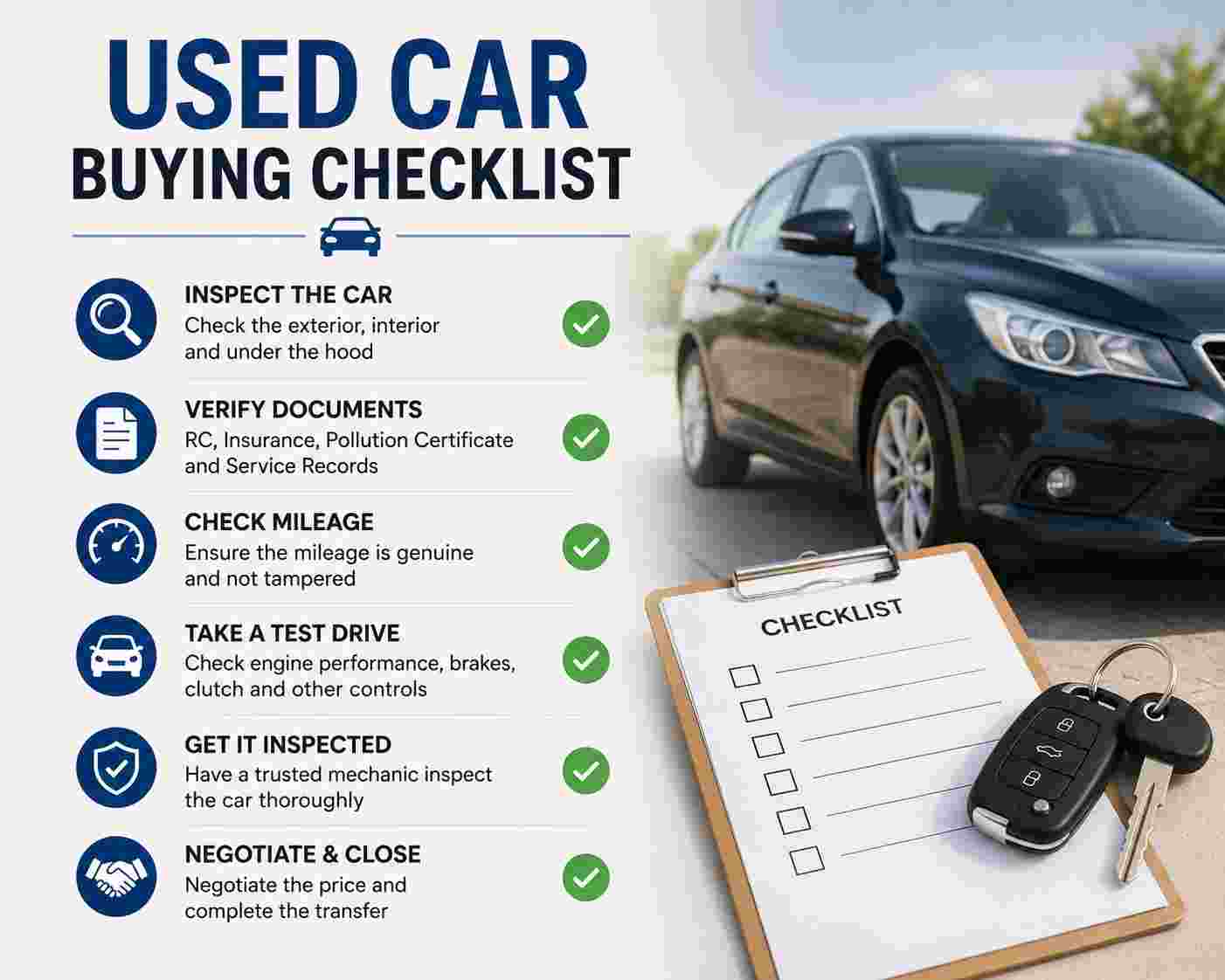
The Short Version — Your Quick Checklist
- Before you finalise any second hand car, run through this fast:
- Are documents clean and matching?
- No panel gaps or colour mismatch?
- Interior dry with no musty smell?
- Are all buttons and features working?
- Test drive smooth with no pulling or knocking?
- Mechanic inspection done?
- Price negotiated based on condition?
Final Word
There is a good second hand car out there for almost every budget. The difference between a great deal and a costly mistake is how carefully the buyer checked before signing. Use this used car buying guide, take your time, and never let a low price rush you into skipping the basics.
Frequently Asked Questions
-
What documents should I check when buying a used car in India?
Check the RC, insurance papers, PUC certificate, loan NOC if applicable, and transfer forms 28, 29, 30, and 35. Run the vehicle number on the Vahan portal for unpaid challans. No used car buying guide worth reading skips this step.
-
How do I know if a used car has been in an accident?
Look for uneven panel gaps, colour differences across body panels, and rough patches under paint. A mechanic doing a thorough used car inspection can spot frame damage from underneath — things that are completely invisible from the outside.
-
Is it safe to buy used cars from individual sellers?
It can be, but it needs more caution than buying from a certified platform. Verify documents independently, insist on a test drive, and get a mechanic to check the car before paying anything. Individual sellers of used cars are not bound by any quality standards — that responsibility is entirely on you.
-
How many kilometres is too many for a second hand car?
Most experts suggest caution above 80,000 to 1,00,000 km for petrol cars and above 1,50,000 km for diesel. But mileage alone is not everything — service history and how well the car was maintained matter just as much.
-
Should I always get a professional inspection before buying a used car?
Yes, always. Even if the car looks perfect, a professional used car inspection gives you a real picture of what you are actually buying. It costs very little compared to a surprise repair bill after the purchase. Never skip it when you buy a used car.