

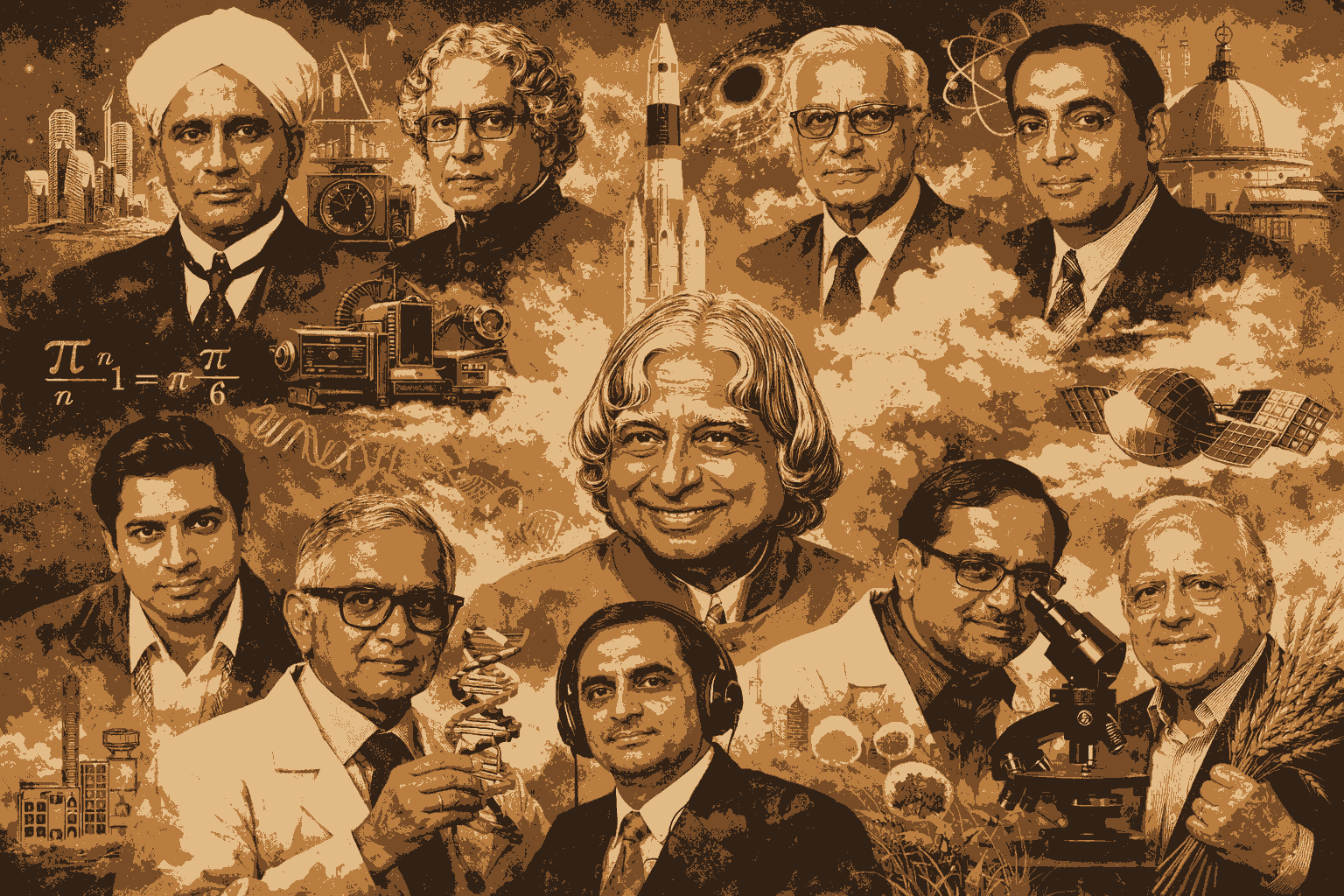

The world has seen numerous scientific geniuses of India whose efforts have brought about development in the world. When individuals consult an Indian scientists list, however, what they can find are a few that are commonly known. In addition to those who are commonly featured, there are also other notable personalities whose works transformed physics, medicine, biology, and the environment.
Several of the contemporary thoughts were founded by these scientists. Their work is a part and parcel of the Indian contribution to science and is still actively used in discussions around the world. This article focuses on their biographies, demonstrates their accomplishments, and introduces the most famous Indian scientists discoveries that should be more popular.
Learning about these little-known Indian inventors, a reader can have a better idea about the contribution of India to the world of Indian inventions and discoveries.
Table of Contents
Bose Acharya Jagadish Chandra: A Pathfinder in the field of plant study
One of the first Indian scientists to get international attention was Jagadish Chandra Bose. Nonetheless, he has not yet been as popularized in popular discourse as he deserves.
Bose was able to demonstrate that plants are sensitive to external factors like light, heat, and sound. It was a radical statement when numerous researchers thought that plants were inanimate beings.
Key Contributions
- To determine the growth of plants, he invented the crescograph.
- Developed pioneering studies in wireless communication.
- Plants have been shown to respond electrophysiologically.
His discoveries are among the most significant known famous Indian scientists’ discoveries in the field of plant physiology. Bose never attempted to patent numerous inventions since he was most likely to think the knowledge should be useful to society.
His work has been a significant contribution to Indian science, particularly in the fields of biology and physics.
Satyendra Nath Bose: The Scientist behind Bosons
A significant contribution to theoretical physics was made by Satyendra Nath Bose. The phenomenon of bosons, the particles of his concept named after him, was the result of his work in quantum mechanics.
He also worked with Albert Einstein, and this resulted in the theory of Bose-Einstein statistics. This theory is used to explain the behavior of some particles at extremely low temperatures.
Why His Work Matters
- These were Bose-Einstein statistics that were introduced.
- It led to the development of quantum mechanics.
- Research on particle physics was subsequently influenced.
His name is the very first name of an Indian scientist nowadays on any respectable list. His works are some of the highly ranked Indian discoveries and inventions in physics.
Nevertheless, his impact is unknown to many people who are not experts in the field of science.
Meghnad Saha: the Astrophysics Visionary
Meghnad Saha came up with the Saha Ionization Equation, which proposes an understanding of the impact of temperature on the ionization of elements by the stars. This assisted the scientists in knowing about the stellar atmospheres.
His theory gained much ground in the field of astrophysics and is still used in research.
Major Achievements
- Both Saha Ionization Equations were developed.
- Donation to astrophysics in India.
- Was instrumental in creating institutions of science.
His work is frequently cited in scholarly literature, but it is not a very popular subject in popular media. Nevertheless, his work continues to form the core of contributions towards Indian science in space science.
Anna Mani: Enhancing Indian Meteorology
Anna Mani contributed greatly to the field of meteorology and environmental science. Her efforts were on bettering weather instruments and standardization of data collection in India.
Her works were used to develop dependable weather forecasting models.
Important Contributions
- Standardized meteorological devices.
- Researched the solar radiation measurement.
- Enhanced climate information investigation.
She is not widely remembered, but she contributed to the development of the field of research on the environment in India. Her name should be mentioned among a few well-known Indian inventors who defined the infrastructure in society.
Her work is a subset of the Indian discoveries and research in climate sciences.
Srinivasa Ramanujan: the Genius of Math
Srinivasa Ramanujan has gained much encouragement and is being revered, but in his life, he had problems gaining attention. He made a breakthrough with minimal formal training in mind.
He collaborated with mathematicians at Trinity College, Cambridge, and pioneered novel thoughts in number theory.
His Impact Includes
- Donations to infinite series.
- Work on partition theory.
- Development of continued fractions
Mathematicians continue to study his notebooks all over the world. The story of Ramanujan demonstrates the potential of strong Indian science contributions by having both profound curiosity and studying himself.
Though he is better known now, he used to be one of the unknown Indian mathematicians in the world arena.
Yellapragada Subbarow: An Innovator in the field of medicine
Yellapragada Subbarow contributed much to the field of medicine, particularly in developing drugs. However, his name is not commonly featured in a popular debate.
He researched areas that resulted in the treatment of:
- Cancer
- Tuberculosis
- Parasitic infections
His health work saved thousands of lives. Such discoveries are some of the most famous Indian scientists discoveries in pharmaceutical science.
Although world-famous among medical fraternities, he can be seen to be omitted from the popular Indian scientists list.
N. Ramachandran: Learning about Protein Structures
The contribution of G. N. Ramachandran to structural biology was great. He came up with the Ramachandran Plot that assists scientists in learning the protein structure.
Proteins play a crucial role in life, and an insight into their shape aids researchers in examining diseases and even creating medicines.
Why His Work Is Important
- It will offer a way to analyze protein structures.
- Impacted international studies of molecular biology.
- Funded medical-pharmaceutical research.
His discoveries make a big contribution to Indian inventions and discoveries in life sciences.
Why Most Indian Scientists Go Unnoticed
There are a variety of reasons why so many scientists have not reached so much fame:
- Barriers during the colonial times constrained international exposure.
- Fewer funding opportunities for research
- Limited media coverage
- Put academic service (rather than personal fame) first.
Even after many years, when a student checks an Indian scientist’s list, some names might not be outstanding. The impact they had on the Indian science contributions, however, cannot be ignored.
Beyond the Effect of Indian Science Work
These scientists have impacted an area beyond India. Their works influenced the world’s thought in numerous aspects:
- Quantum mechanics is based on the statistical work of Bose.
- The equation used in astrophysics is attributed to Saha.
- Medical processes can be dated back to the work of Subbarow.
- The models contributed to protein science by Ramachandran.
- Plant physiology recognizes the experiments of Bose.
Such illustrations indicate that the Indian inventions and discoveries are closely intertwined with the scientific advancements of the world.
The lessons that can be learned from the stories of these little-known Indian inventors also stand out:
- Incidentally, curiosity is more important than recognition.
- Even limited resources do not imply the failure of research.
- International cooperation enhances skills.
- The long-term effect is brought about by persistence.
The Importance of Understanding Forgotten Scientists in the Modern Era
Young learners can, by watching a few repeated names, think that scientific success is difficult to achieve. The wider list of Indian scientists provides students with more role models that they can relate to.
Being aware of the findings of other fields made by renowned Indian scientists also enables one to value the sheer diversity of the scientific legacy of India.
The schools, universities, and research institutions are still enjoying the contributions of Indian science in the past. This recognition of the past gives hope and inspiration to the next generations.
By honoring these pioneers, the society can make sure that the Indian inventions and discoveries receive the respect they deserve.
Conclusion
Lost Indian scientists transformed the world’s science in physics, mathematics, biology, and medicine. They are not small auxiliaries to the history of modern science, but important architects of it.
Since Bose had theorized about the quantum theory through to Subbarow with medical research, since Saha had formulated the equation of astrophysics, and Ramanujan, with his mathematical understanding, they influenced these key fields of study.
Their effort fortifies any Indian scientist’s list, which is accurate and portrays how Indian science has contributed over centuries.
Identifying the few unknown inventors among Indians makes their works remembered by the students, researchers, and educators.
The Indian inventions and discoveries have a wide and significant history. Through these stories, the readers can develop a better insight into the ways in which Indian scientists contributed to the formation of the contemporary world of science.
Frequently Asked Questions (FAQs)
Why are there not a number of Indian scientists well known overseas?
Some of them have worked in colonial times when international academic networks were not that widely available. There was also limited media coverage and research funding as compared to Western institutions.
What are the well-known Indian scientists’ discoveries?
These include Bose-Einstein statistics, the Saha Ionization Equation, the Ramachandran Plot, and significant medical drugs invented by Subbarow.
What do we know about little-known Indian-made inventions?
Strong examples are Jagadish Chandra Bose, Anna Mani, Yellapragada Subbarow, Meghnad Saha, and G. N. Ramachandran.
What is the rationale to learn about the contribution of Indian science?
The examinations of these contributions generate awareness about the level of scientific contribution in India, encourage young scholars, and demonstrate that the world has been researched using effective discoveries and inventions made by educated Indians.