

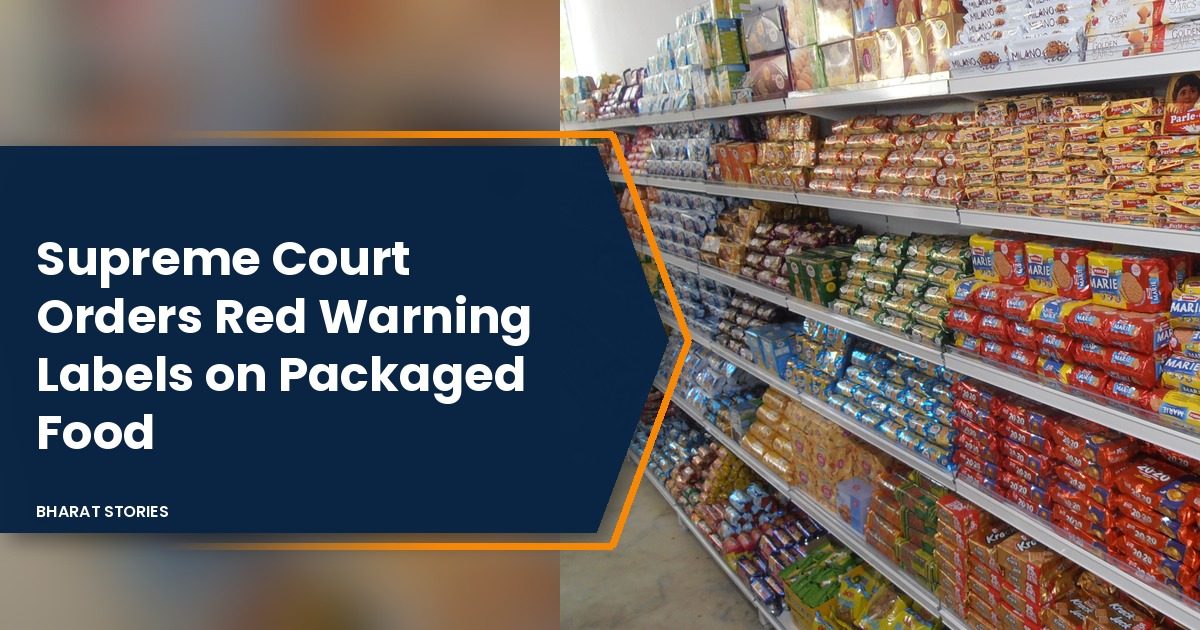

The Supreme Court on Thursday, 26 November 2026, told the Food Safety and Standards Authority of India (FSSAI) to bring in a single phase, mandatory system of front of pack labelling that puts red warning hexagons on packaged foods high in sugar, saturated fat or salt. A Bench of Justices J.B. Pardiwala and K. Vinod Chandran issued the directions in New Delhi on a plea by the Kerala based NGO 3S and Our Health Society, and held the regulator to its own deadline of about four months for finalising the rules, The Hindu reported.
The 131 page ruling ties the labels to the rights to health, food and informed choice. For shoppers the aim is simple: a glance at the front of a biscuit or juice pack should show whether it is high in fat, sugar or salt.
Table of Contents
What did the court order on front of pack labelling?
Each nutrient gets its own warning. The judgment says every hexagon must carry a standard pictogram and the words High Fat, High Sugar or High Salt, and that there must be a separate hexagon for each nutrient rather than one combined symbol. A snack over the limits for sugar and fat would carry two warnings.
Size is fixed too. Each hexagon has to cover at least 4% to 5% of the principal display panel, the main face of the pack, unless there are explicit reasons not to. FSSAI must also prescribe a font size that is easy to read in a shop.
Why total sugars and not added sugar?
The court told FSSAI to treat total sugars and saturated fat, not added sugar and added fat, as the nutrients of concern alongside salt, as the regulator itself did before the Dietary Guidelines for Indians, 2024. Because the limits in Table 15.1 of those guidelines were calculated for added sugar and added fat, the Bench said they cannot be used as they stand, and every threshold has to be worked out again.
The Bench warned that limits set too low would put a warning on almost every packaged food, until buyers stop noticing; it called this label fatigue. Limits set too high would let most products escape. In its view, the thresholds now on record are too low.
When will the new labels show up on packs?
Not soon. FSSAI told the court it needs roughly four months to finalise the rules. In that time it must publish a draft for 60 days of comments, at home and through the World Trade Organization, examine the responses, approve the regulation and send it to the ministry for the Official Gazette. The court called that schedule reasonable but said it must be strictly kept. “Every day of delay means that packaged foods continue to be sold without such labels,” the Bench wrote.
Once the rules are notified, companies get 365 days to switch to the new packs, Mint reported. The petitioner wanted the labels compulsory from day one, but the court accepted the transition period with conditions. FSSAI should set sub deadlines and track them, firms should not ordinarily get any further extension, and the regulator must state clearly that compliance is mandatory once the 365 days are over. Companies that want to print the hexagons earlier are free to do so.
Add the two timelines and the labels are unlikely to be compulsory before 2028, even if every date is met.
Can companies stockpile old packaging?
The court saw that risk coming. Firms could use the transition year to print large stocks of packaging without the warning, or to step up production of current recipes, so unlabelled products stay in shops long after the deadline. FSSAI must draw up a clear plan to phase out such stock and stop excess production, either in the regulations or by other means.
What else is in the judgment?
Several smaller directions will shape how the system works, Bar and Bench reported:
- Sweetened drinks that stay under the limits must not use a front label that looks identical or deceptively similar to the warning label just to show their food category.
- FSSAI must publish a clear list of foods exempted from the labels, with reasons, without letting products that should be covered slip through.
- If companies start using artificial preservatives or other additives to get around the labels, FSSAI should act, including by revising its rules.
- The Centre must enforce the Food Safety and Standards (Safe food and balanced diets for children in school) Regulations, 2020, and give children hands on ways to learn about nutrition, such as workshops and co curricular activities.
The Bench also addressed concerns that some multinational food companies treat Indian buyers differently, in recipes and labels. “A consumer in India is entitled to no less protection, and no less information, than a consumer in the United States or the United Kingdom,” it said, and urged such firms to follow uniform standards everywhere.
How did the case reach this point?
In September 2022 FSSAI published a draft amendment to its 2020 labelling rules proposing an Indian Nutrition Rating, a star system running from 0.5 to 5 stars. More than 14,000 comments came in, and an expert committee was set up in February 2023. The petitioner said stars would confuse buyers and pushed for warnings. When the court closed the original petition in April 2025, it asked the committee to report within three months; the report is dated 8 October 2025, according to the judgment.
In August 2026 the regulator suggested printing only the recommended daily limits from the 2024 guidelines in a table on the front of the pack. The petitioner said that told the buyer nothing about the product itself. After the Bench pointed to models used abroad, FSSAI proposed the red hexagon in affidavits filed in August and September 2026. The two sides still disagreed on thresholds, size and timing, the points Thursday’s directions now settle.
Packaging claims have drawn the regulator’s attention before. In October it sent notices to Nestle India and Zydus Wellness over health claims, which we covered in our report on the FSSAI notices over infant formula and Complan. The ruling itself rests on Article 21, explained in our guide to the fundamental rights of India.
What happens next?
The case will come up again after ten weeks, when FSSAI has to file an affidavit on how far the draft regulations have got, LiveLaw reported. A copy of the judgment goes to the Principal Secretary of the Union Health Ministry.
Until the new rules arrive, the nutrition table on the back of the pack is still the main place to check sugar, fat and salt.
Sources
- Supreme Court of India: judgment in 3S and Our Health Society v Union of India, 2026 INSC 1275 (PDF via LiveLaw), 26 November 2026
- The Hindu: Supreme Court sets four month deadline for FSSAI to finalise stricter food labelling norms, 26 November 2026
- Mint: Supreme Court gives 4 months to FSSAI to roll out front of package labelling standards, 26 November 2026
- Bar and Bench: Warning labels on packaged food should disclose total sugar, fat, 26 November 2026
- LiveLaw: Packaged foods need separate pictorial warnings on high fat, high sugar or high salt, 26 November 2026