

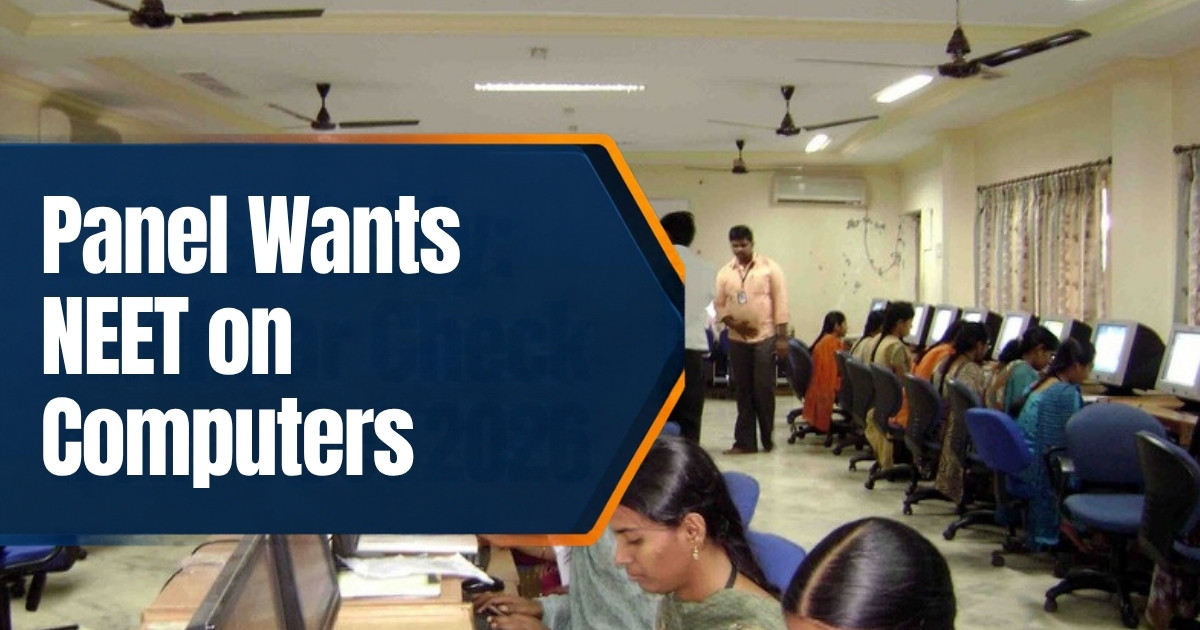

New Delhi: NEET UG, India’s biggest medical entrance exam, may soon move from paper to computers. A committee of Parliament has said the exam should become a computer based test, often called CBT. The same report asks for a huge question bank, exam centres owned by the government, and a fair chance for students who reach the centre a few minutes late. The Parliamentary Standing Committee on Education, led by Rajya Sabha MP Mukul Wasnik, gave its report to the Chairman of the Rajya Sabha on Friday, 9 October 2026.
Table of Contents
Why this report matters now
The NTA is the body that runs JEE Main, NEET UG, UGC NET, CUET and other big tests. The committee says about 1.2 crore students sit for NTA exams every year. NEET UG alone has more than 22 lakh candidates.
Trust in the agency took a big hit this year. The NTA cancelled NEET UG 2026 on 12 May, after the exam held on 3 May faced allegations of a paper leak, The Indian Express reported. The committee said that even after steps like biometric checks and mobile jammers, the exam had to be cancelled. That, it said, shows the need for deeper changes.
What is a NEET computer based test?
In a computer based test, each student sits at a computer and answers questions on the screen. There is no printed question paper. JEE Main, UGC NET and CUET already work this way. The panel called NEET UG an “outlier” because it still uses pen and paper.
Why does this help? A printed paper is set weeks in advance, then printed, packed and carried to thousands of centres. Every step is a chance for a leak. On a computer, the paper does not travel at all. So, the panel said, it can be set very close to the exam date.
According to PTI, the Centre had already announced that NEET UG will be held as a computer based test from next year. The committee’s report now adds a set of conditions for that change.
The conditions the panel attached
The panel does not want a sudden switch. It worries about students from remote areas and poor families. Its main suggestions are:
- Set up 1,000 secure government computer test centres, as the earlier expert committee advised, with a clear timeline.
- Have at least one test centre in every district, so students do not have to travel far or pay for a hotel.
- Let the NTA pay for computer labs of 100 to 200 machines in schools and colleges, which it can use on exam days.
- Run all centres through the Union or State governments. The panel said private centres hired on contract have often been a weak link.
- Give students mock tests on computers so they get used to the screen.
- Until every area is ready, send locked digital papers to the centre and print them there.
A NEET on computers may run in more than one shift, with different papers. So marks have to be adjusted to keep things fair. This is called normalisation. The panel said the method must be checked by an outside auditor and explained to the public before any change.
A big question bank to stop leaks
The committee called a large question bank “the most viable defense against paper leaks in the long run”. Today, a few experts write a fresh paper each year. Instead, the NTA should keep a huge and growing pool of questions. Papers would be picked from this pool with digital tools, so no single person knows the full paper in advance.
Experts from IITs, AIIMS and IIMs should prepare the questions. But their background must be checked first, to keep out people like coaching centre owners or those whose family members are writing the exam. The final paper checkers should be kept in isolation until the exam is over.
Relief for students who arrive late
Right now, a student who reaches the centre a few minutes late is usually sent back. The panel said this can waste a whole year of hard work over a small delay. It suggested that such students be let in after they sign a note about their late arrival. They would only get the time that is left. No extra time would be given.
It also wants invigilators to finish signing work in a separate 15 minute slot, not in the middle of the test. And it asked for a change in the Public Examinations (Prevention of Unfair Means) Act, 2024, so that rallies are not allowed on exam days.
Other big ideas in the report
- Age and attempt limits: NEET UG has no cap on attempts and no real upper age limit. The panel said even people above 70 have taken it. It asked the government to explore sensible limits, with UGC NET as the only exception.
- Two stage NEET: One common first exam for all medical courses, then separate second exams, so a nursing or AYUSH student is not ranked against MBBS hopefuls.
- Blacklist of firms: A public list of banned exam firms, so a firm banned in one State cannot win exam work somewhere else.
- More staff: Only 23 of the 39 officer posts are filled, a gap of 41 per cent. The panel wants permanent experts, not officers on loan from other departments.
What happens next?
A committee report is advice to the government. It does not change any exam rule by itself. The Ministry of Education will decide which ideas to accept. Students preparing for NEET UG should keep studying as usual and trust only official NTA notices for dates and exam pattern.
If you are planning a career in medicine, our guide on how to get admission in MBBS in India explains the basic steps. Students aiming for Delhi University can also read about the tie breaker rule in CUET DU admissions.
Short FAQ
Has NEET UG already become a computer based test?
Not yet. The committee has recommended it, and PTI reported that the Centre had announced the shift from next year. Wait for an official NTA notice on the exam mode.
Will late students really be allowed in?
Only if the government accepts the idea. The panel suggested entry after a signed note, with no extra time.
Bright science students can also look at the INSPIRE Scholarship, which supports higher studies in science.
Sources
- Press Information Bureau (Rajya Sabha Secretariat), Press release on the 382nd Report on Reforms and Strengthening of the National Testing Agency (NTA), 9 October 2026
- The Hindu, NEET UG paper leak: Parliamentary panel recommends switching NTA run exams to CBT mode, 9 October 2026
- The Indian Express, Invest in question banks, set question paper closer to examination: House panel to National Testing Agency, 10 October 2026
- The Indian Express, Two stage exam, age cap, CBT shift in NEET: Parliamentary panel calls for major changes, 10 October 2026
- ETEducation, The Economic Times (PTI), Parliamentary panel calls for question bank overhaul to prevent exam paper leaks, 10 October 2026