

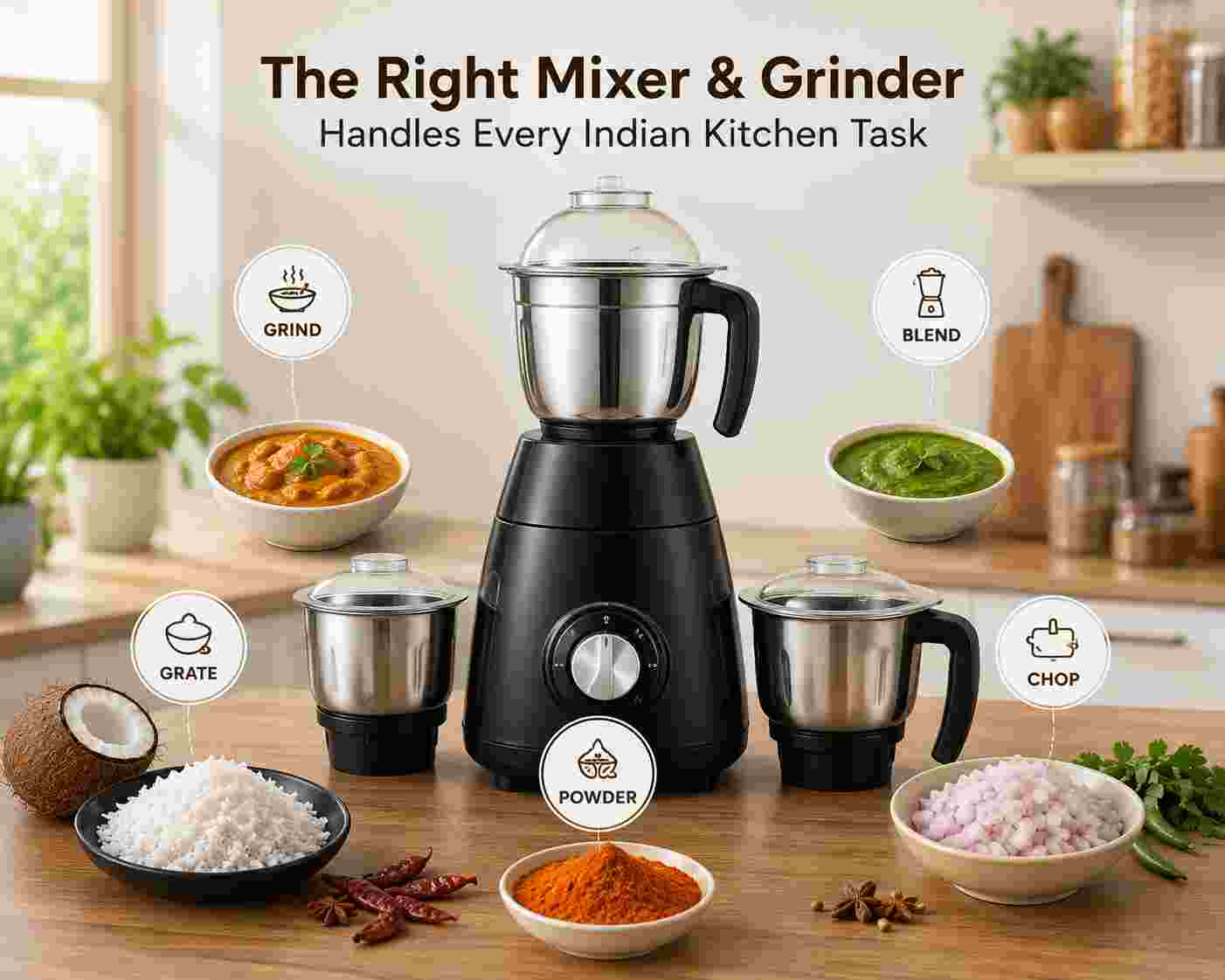
From Batters to Spice Blends: How the Right Mixer and Grinder Handles Every Indian Kitchen Task

There’s a mixer and grinder in almost every Indian kitchen. Most were bought quickly, installed the same day, and never thought about again until something stopped working right. That’s fine until you’ve spent four minutes grinding coconut that should’ve taken ninety seconds, or the idli batter’s come out wrong three weeks running and nobody can explain it. The machine isn’t broken. It was never matched properly to what this particular kitchen asks of it every day.
Table of Contents
The Daily Tasks That Define What Your Machine Needs to Be
Wet grinding is where the motor earns its place. Coconut chutney, tamarind paste, onion-tomato bases, soaked dal for batter. None of these are light work. Coconut is dense and fibrous and genuinely resists the blade. Dal needs the motor running continuously for several minutes to reach the right texture, which builds heat and tells you quickly whether the machine handles sustained load or just about manages it.
Most households doing this regularly need at least 750 watts. A 500-watt machine gets through small batches but starts to struggle on anything bigger. Blades lose momentum, the jar warms up, and texture suffers in ways that are difficult to fix after the fact. That’s not a faulty machine. It’s a mismatched one. If you’re currently researching which mixer grinder suits a household that cooks like this daily, motor wattage should be the deciding factor before anything else.
The difference shows up every morning.
Spice Grinding and Why Most People Are Using the Wrong Jar
Here’s something most buying guides don’t mention. Dry spice grinding needs a completely different jar from wet grinding, and using the wrong one is one of the most common reasons people end up with uneven masala powder and assume the mixer and grinder are to blame.
Coriander seeds, dried chillies, black pepper, fenugreek. These need impact more than circulation. The blade geometry on a large wet grinding jar wasn’t designed for dry ingredients. Put whole dried spices into a 1.5-litre jar, and the blades don’t reach them consistently.
A dedicated dry jar, usually around 0.75 litres, has blades set lower and closer together. What comes out is fine, even powder in one pass. What comes out of the wrong jar is coarse at the bottom, dust at the top, and something in between that suits neither purpose.
Fresh ground masala tastes different from packaged. Not slightly. Actually different. No anti-caking agents, no added colour, no flavour sitting in a warehouse for four months. Once you start doing it at home, buying packaged masala starts to feel like a peculiar compromise.
Batter: the Real Test of Motor and Jar Working Together
Idli batter is genuinely the benchmark task for any mixer and grinder doing serious Indian cooking. Urad dal, soaked for six to eight hours, needs to reach a smooth and slightly elastic consistency. Not blended. Actually ground. Rice for dosa needs a slightly coarser texture and is typically a separate grind.
Don’t fill the large jar beyond two-thirds. The contents stop circulating properly when overpacked, and the blades push the same material around instead of grinding through it. Two smaller batches consistently outperform one overloaded jar.
At 750 watts, a full family batter batch finishes without the motor running hot. Below 500 watts, the machine’s warm to the touch by the end and the batter usually needs a second pass. That second pass is the practical cost of buying too little power to save money upfront. It rarely works out cheaper.
The Tasks Most Kitchens Never Think to Ask of Their Machine
A well-specced mixer and grinder handles things most Indian households currently buy pre-made or skip entirely.
Nut butters are the obvious starting point. Roasted peanuts in the dry jar for sixty to ninety seconds give you fresh peanut butter with one ingredient, no palm oil, nothing stabilised. Tahini takes about two minutes from raw sesame seeds and forms the base of hummus, which has found its way into enough urban Indian kitchens to be worth mentioning. Both cost a fraction of packaged alternatives.
Baby food is the one most people genuinely don’t consider. Steamed sweet potato, carrot, apple, or pear in the chutney jar takes under a minute. No salt, no sugar, no texture compromise. A mixer and grinder that handles dal and coconut daily manages this without any effort at all.
| Task | Jar to Use | Motor Needed |
| Coconut chutney, wet masalas | Large wet jar | 500W minimum |
| Idli and dosa batter | Large wet jar | 750W recommended |
| Dry spice blends, masala powder | Dry grinding jar | 500W minimum |
| Fresh chutneys, small pastes | Small chutney jar | 500W minimum |
| Nut butters, tahini | Dry grinding jar | 750W recommended |
What to Actually Look for Before Buying
Wattage and jar count settle most of the decision. Blade material matters more than most product pages let on. Stainless steel blades handling coconut and hard dried spices daily outlast mild steel by years. Jar coupling quality, the mechanical connection between jar base and motor body, is what typically fails first on cheaper machines. Reviews mentioning coupling problems after six to twelve months are a reliable signal worth taking seriously.
Pulse function gives texture control that continuous running doesn’t. For anything between whole spice and fine powder, pulse gets you there in a way the speed dial can’t. A mixer and grinder without a pulse function loses that control entirely, which matters more for dry grinding tasks than most people expect before they’ve tried it.
Service network is the practical consideration most buyers only think about after something needs fixing. How easily that gets resolved depends entirely on whether the brand has people in your area.
Conclusion
The right mixer and grinder isn’t the most powerful or the most expensive. It’s the one whose motor wattage, jar configuration, and build quality are matched to what the household actually cooks every day. Get those three things right, and the machine disappears into the background the way a good appliance should.
Most people work this out the second time they buy one. There’s genuinely no reason it has to take that long.