

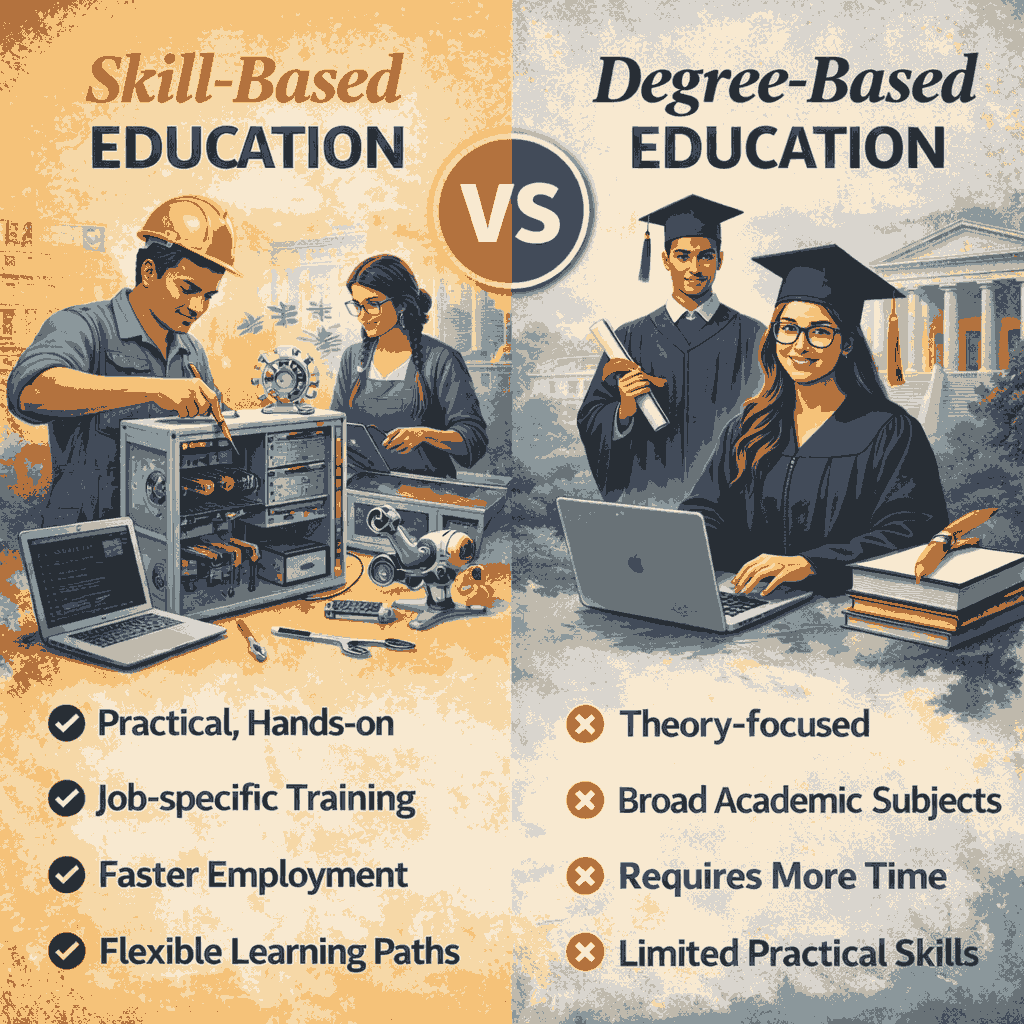
Skill-Based Education vs Degree-Based Education
The way of education in India is transforming. A college degree is a proven path to success. A traditional degree guaranteed parents stability, respect, and a good job. However, now companies are posing another question: What can you actually do?
It is here that the debate over ability-based education in India becomes relevant. There is a desire among students and parents to know. Which is the course for better career development? Which is providing real job security? And how should they decide?
This article outlines and provides simple explanations of both methods, supported by professional knowledge and current practice. trends.
Table of Contents
Mastering Degree-Based Education
Academic education is encouraged in colleges and universities, which promote degree-based education. The undergraduate or postgraduate undertakings include scientific, commerce, management, arts, and engineering.
What It Offers
- Structured curriculum
- Theoretical knowledge
- Recognized qualification
- Placements in campuses (in certain institutions)
- Prolonged educational basis.
A degree is still relevant in fields such as medicine, law, teaching, and the civil service. Formal degrees are also required for many government employment positions.
But having a degree may not necessarily get one a job. Most graduates are finding it difficult because they are not exposed to practical jobs and industry-readyindustry-ready skills expected by employers in India.
What is Skilling-based Education?
India’s skill-based education emphasizes practical education. Students are taught how to perform certain tasks required in jobs, rather than just learning the theory to be applied in the job.
It includes:
- Vocational training in India
- Technical certifications
- Apprenticeships
- Hands-on workshops
Course certification on the Internet in India.
The point is plain and simple: train the students to work on the first day.
This is a method that ties education to industry demands. Employers usually hire candidates who do not require extensive training before they can work.
The Push behind the Growing Skill-based Education in India
India is also inhabited by one of the youngest populations in the world. Millions of students continuously enter the job market every year. The traditional degrees cannot be used to absorb this workforce.
Government programs such as Skill India have promoted vocational training and work-oriented projects in India.
Key Reasons Behind the Shift
- Increasing graduate unemployment.
- Fast development in technological industries.
- India’s industrial-ready skills are in demand.
- Growth of the startups and MSMEs.
- Growth in online certification programs in India.
Firms are now favoring candidates who are familiar with tools and software, and the processes related to their jobs.
The degree vs. skill-based education: the major differences
-
Learning Approach
Degree-Based
- Focus on theory
- Classroom-driven
- Long duration (3-4 years or more)
Skill-Based
- Practical and task-focused
- Courses that are offered in the short term.
- Simulations and projects in the real world.
-
Career Readiness
Degree graduates are likely to require post-employment training. Courses in India, in turn, are job-oriented and designed to equip learners with the skills for roles such as digital marketing executive/data analyst/electrician, healthcare technician, or web developer.
This ensures that skill-based education in India is more closely aligned with employment.
-
Cost and Time Investment
A complete degree course might cost lakhs and years.
In comparison:
- Vocational training programs in India are cheap.
- India offers flexible online certification courses.
- It is possible to earn many job-oriented courses in India in a few months.
This makes it easier to enter the labour force.
Skill-based Learning is more preferred in industries
Practical ability has become more important than degrees in several areas.
Technology and IT
- Coding
- Data analytics
- Cybersecurity
- UI/UX design
Employers value project experience and certifications.
Healthcare Support
- Lab technicians
- Medical assistants
- Nursing aides
In this, Vocational Training India has a significant role to play.
Technological and Engineering sectors
- Electricians
- Welders
- CNC operators
- Automotive technicians
These positions require extensive practical training.
Digital Marketing and Media
- SEO specialists
- Content strategists
- Social media managers
The majority of professionals working in this field are based on online certification courses, including those in India, and on experience.
Online Learning in Developing a Skill
The internet has altered access to education. Town students are no longer required to move to obtain their online certification courses in India.
Benefits include:
- Flexible schedules
- Affordable fees
- Updated course material
- Industry-led training
- Positioning with the help (on selected platforms)
It has led to the development of job-oriented courses in India that meet the current market demands on many platforms.
This movement favours skill-based education in India, as it enables more individuals to access training.
Are Degrees Becoming Irrelevant?
Not at all.
Degrees still matter in:
- Government jobs
- Research fields
- Higher studies
- Professional courses in law or medicine.
Nevertheless, the professionals reckon that this is achieved by incorporating a degree plus industry-ready skills in India.
For example:
An individual who has graduated with a B.Com degree and studied digital marketing has better employment opportunities than someone who has acquired a B.Com degree.
What the Employers are seeking
Recruiters today check for:
- Practical skills
- Internship experience
- Certifications
- Communication ability
- Problem-solving skills
They desire graduates who can deliver immediately.
That is why skills-based, job-oriented education is important, and India is franchising.
Pros and Cons: A Balanced View
The Benefits of Degree-Based Education
- Familiarity with higher education.
- Wider theoretical experience.
- Aspired to certain careers.
- Structured campus life
Disadvantages
- Limited practical exposure
- High costs
- Longer duration
- Skill gap issues
This has the benefits of Skill-Based Education
- Job-focused training
- Short-term learning options
- Affordable programs
- Quickly increased employment.
- Specialization in industry-prepared skills in India.
Disadvantages
- Unqualified to work in some government posts.
- Limited academic depth
- Quality is institutionally different.
The Hybrid Model: The Brilliant Option?
Many scholars in the field of education recommend integrating the two systems.
Students can:
- Pursue a formal degree
- Complete online certification courses in India.
- Complete courses in vocational training in India.
- Build practical portfolios
Such a moderate course provides both academics and marketable talents.
How Students Should Decide
The decision to rely on degree learning or skill-based learning varies according to:
- Career goals
- Financial situation
- Industry demand
- Learning style
When a person wishes to become a doctor or a professor, they need a degree.
Job-oriented courses and skills-based education in India can be more appropriate options if the person wants to start earning quickly in tech, design, or technical trades.
Parents and students are advised to research industries before making decisions.
Skills Development by the Government
In skill development, the Indian government strongly supports vocational training in India through its skill development schemes.
These programs aim to:
- Reduce unemployment
- Increase productivity
- Train the young people towards industrial development.
- Promote entrepreneurship
That demonstrates that skill-based learning is not a trend but a component of national planning.
Final Thoughts
It is not about which is better in the argument between skill-based and degree-based education. It is about relevance.
The current market values workplace performance. Although the foundation is done through degrees, industry-ready skills in India make one employable.
Skills-based education in India provides learners with practical knowledge. Learning is done online through certification courses in India. Job-oriented courses in India equip their students for specific roles. And vocational training in India favors technical industries.
The most intelligent course of action might not be choosing between them, but rather including both.
Students who stay up to date with the latest information and keep their skills and market needs current will never be left behind.
Frequently Asked Questions (FAQs)
Is Indian skill-based education superior to a regular degree?
It depends on career goals. In technical and industry jobs, rapid employment can be achieved through skill-based education in India. In careers such as law or medicine, a formal degree is compulsory. The skill-based programs are more focused on practical exposure, which most employers prefer when recruiting employees. A degree, though, might be more openly used later in a career, particularly in higher education or government jobs.
Do online certification courses in India have employer acceptance?
Rightly so, as online certification courses in India are well accepted by many employers, particularly when they are industry-relevant and supported by real-world assignments. Recruiters usually consider the skills demonstrated in assignments and portfolios but do not focus solely on the certificate itself. If the course is on a reputable platform and aligns with current industry requirements, it can greatly aid career advancement and employment opportunities.
What are the examples of job-oriented courses in India?
These include digital marketing, data analytics, web development, healthcare technician programmes, and electrical training programmes from vocational training India. These programs are supposed to align with actual job descriptions and place a strong emphasis on hands-on learning. Many institutes also incorporate internships or live projects to help learners experience the work environment firsthand before entering the job market.
Is it possible to blend a degree and vocational training in India programs?
Yes. Many students pursue job-oriented courses and vocational training programs in India to gain industry-ready skills and become positioned to find. The combination enables them to develop academic skills, as well as practical skills. Consequently, they shine through placements and possible recruitment drives on the campuses and in the private sector.