

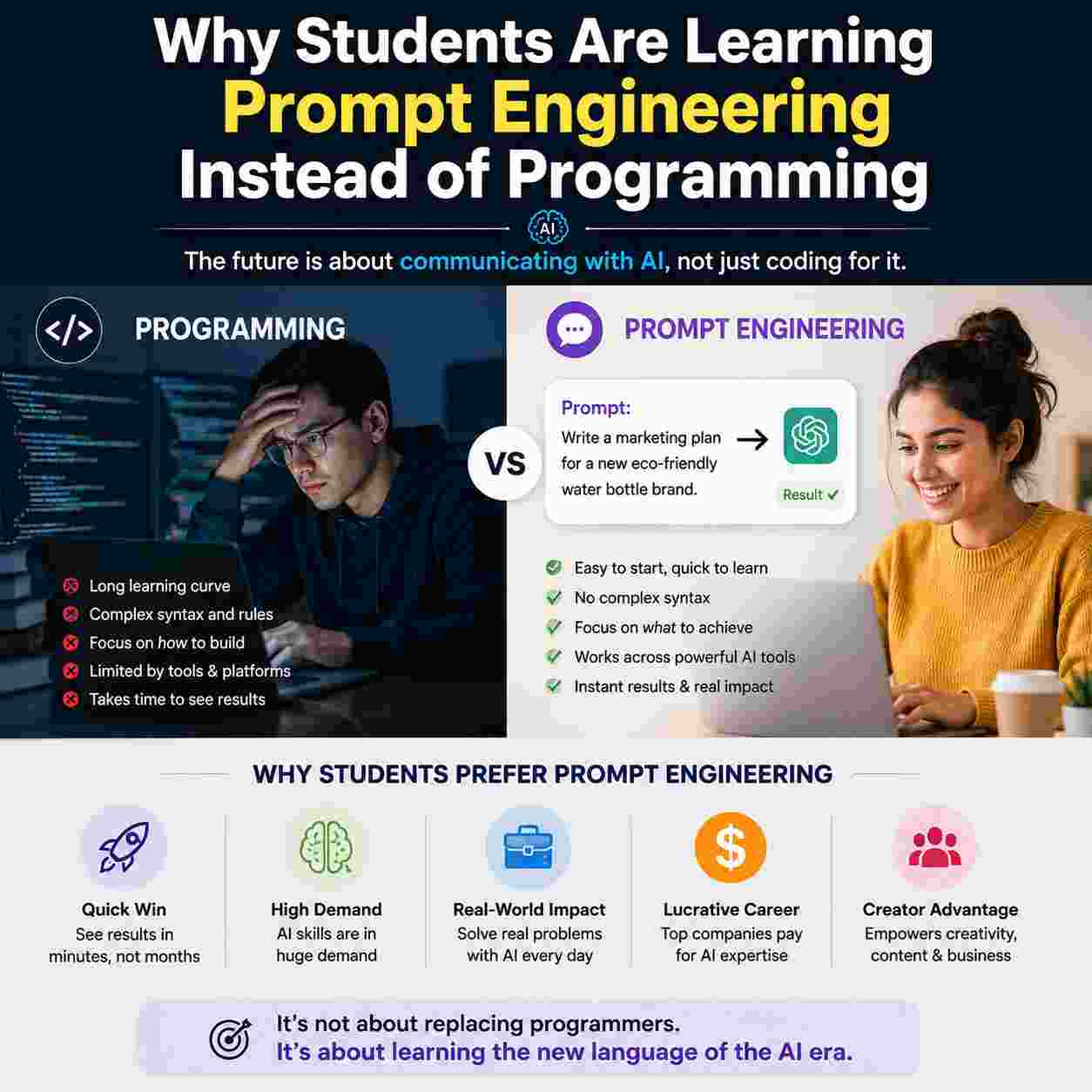
Why Students Are Learning Prompt Engineering Instead of Programming
Students aren’t just talking about coding bootcamps or computer science degrees anymore. A lot of them are picking up prompt engineering instead, and choosing it over the traditional programming route. This isn’t a small trend either; it’s happening fast, and there are good reasons why.
Table of Contents
What Is Prompt Engineering, Really?
Prompt engineering is the skill of writing clear instructions for AI tools, so they return useful results. Think of it like learning how to talk to a computer in a way it actually gets. Readers should not expect to encounter any outputs that anyone types into ChatGPT prompts. They are creating specific, well-thought-out directions that can yield the most accurate answer from the AI. The key is a proper prompt that yields an answer you’ll get, versus a dull one that is not helpful.
The best part? This skill doesn’t take years of coding classes to learn. Most students figure it out through practice, a bit of trial and error, and some patience. That’s probably the main reason it’s spreading so quickly among younger learners.
Why Programming Feels Out of Reach for Many Students
Let’s be honest, traditional programming takes a while to click. Learning something like Python, Java, or C++ means getting your head around syntax, logic, and debugging code that doesn’t work for reasons you can’t always figure out. For a lot of students, this gets old fast, especially before they’ve built anything they’re proud of.
All students hate programming because of the following:
- It will be several months before you can create something that really works
- Making things work consumes time, and often nothing is achieved
- The learning curve is steep if you don’t know how to code before even starting out
- They are already busily occupied, and often cannot fit deep practice into their schedules
- Many people are leaving the program early because they don’t feel they are making enough progress
Prompt engineering doesn’t have that problem. You type something, get a response right away, tweak it, and see it get better almost instantly. That quick feedback is honestly what keeps people interested.
AI Skills Are Becoming Job Requirements
Here’s something worth noticing: job listings across all kinds of industries now mention AI skills. Marketing teams want people to be comfortable using AI for content. Customer support teams want staff who can set up and manage AI chatbots. Even HR departments are using AI to screen resumes and write job ads.
This is where AI careers come in. Job titles like AI content strategist, prompt engineer, AI trainer, and automation specialist are fairly new, but they’re showing up more and more on job boards. And the pay for a lot of these roles is right up there with entry-level programming jobs.
Recruiters have started saying they want to see candidates actually demonstrate how they’ve used AI in real work, not just drop it as a buzzword on their resume.
Future Skills Don’t Always Mean Coding Anymore
For years, the advice was simple: learn to code, and you’ll be set for life. That made sense back when software development was basically running the entire tech industry. But that’s changing now.
Future skills increasingly mean knowing how to work with AI, not just building software from the ground up. Students who can guide an AI tool, double-cite output, and add their own judgment on top are picking up something genuinely valuable.
That doesn’t mean programming is dead, not even close. Developers are still in demand, and the good ones still get paid well. But the line between “technical” and “non-technical” people is blurring because AI has made certain tasks open to pretty much anyone willing to learn.
How Students Are Learning Prompt Engineering
Here’s the thing: most students aren’t enrolling in some formal program to pick this up. They’re learning it on their own, through:
- Free videos and tutorials they find online
- Daily practice with ChatGPT prompts, Claude, and other AI tools
- Online communities where people swap prompt ideas
- Short, practical courses instead of long theory-heavy ones
- Just trying different ways of phrasing the same request
- Copying ideas they see others use and tweaking them
This casual way of learning fits with how a lot of students already pick up new things outside of school. Watch something, try it, mess it up a bit, fix it, and keep going.
The Cost Factor Matters Too
Programming bootcamps can run into thousands of dollars. A computer science degree takes years and comes with tuition that not every family can manage.
Prompt engineering doesn’t carry that kind of cost. Most of what you need is free or close to it. As long as someone has internet access and a willingness to try, they can start today with little to no cost.
That makes a real difference for students whose families are watching every rupee, or anyone who wants to build a useful future skill without taking on debt.
Real-World Use Beats Theory
A lot of programming courses spend ages on theory before students get to build anything. Data structures and algorithms matter, sure, but they can feel pretty disconnected from everyday life when you’re just getting started.
With prompt engineering, students put what they learn to use right away. Maybe it’s a prompt that helps with homework, drafts an email, or sparks ideas for a project. The learning happens by actually doing it, not by sitting through chapter after chapter of theory first.
What This Means for Parents and Educators
Schools and colleges are slowly catching up, adding bits of AI literacy into their courses. Some are running workshops on using these tools responsibly. Parents who used to push their kids toward coding classes are now asking about AI skills too. They’re seeing job ads that constantly mention AI tools, and naturally, they want their kids ready for that.
Many educators are trying to do both, keeping the basics of programming while also showing students how AI tools fit alongside them. It’s not really one replacing the other, but the balance is shifting.
Looking Ahead
The job market is moving, and students are simply reacting to what they see. Prompt engineering offers a quicker, cheaper way to work with technology. For many students, it just feels like a smarter use of their time than spending years learning a programming language they might never actually use at work.
However, programming will continue to be an art, especially in software, app, and systems development. It’s becoming as necessary as the basic skill of using conventional tools; however, for those who want to stay competitive, AI becomes a large part of every business.
Frequently Asked Questions
-
Do students need to know programming to learn prompt engineering?
No, not really. It is more about writing clear instructions in plain language than writing code. With that said, some knowledge of how AI models work should help achieve better results over time.
-
Will one be able to get a stable job through prompt engineering?
Yes, it can. Companies are increasingly hiring for roles focused on AI, such as prompt engineering, AI training, and content automation. The field is still new, but demand for these AI careers continues to grow.
-
Is prompt engineering only useful for tech jobs?
Not at all. Marketing, education, healthcare, customer service, and creative work all now rely on AI tools. Anyone who can write a solid prompt can use this skill, regardless of their job title.
-
Should students completely skip learning to code?
That really depends on what they’re aiming for. If someone wants to build software or become a developer, programming is still essential. But for students who want to use AI tools well in their day-to-day work, prompt engineering is a good starting point.
-
How long does it take to get good at writing ChatGPT prompts?
There’s no exact timeline, but most students start seeing real improvement within a few weeks of regular practice. It mostly comes down to trying different phrasing, checking the results, and adjusting based on what actually works.