

West Bengal: History, Geography, Economy and Tourism
West Bengal is a state in eastern India that stretches from the Himalaya in the north to the Bay of Bengal in the south. It is the fourth most populous state in the country and its capital, Kolkata, was once the capital of British India. This guide covers the history, geography, economy and tourism of West Bengal, with political and travel details updated for October 2026.
Table of Contents
Quick Facts
| Item | Detail |
|---|---|
| Capital | Kolkata |
| Area | 88,752 square kilometres |
| Population (2011 census) | 91,276,115 |
| Official language | Bengali |
| Assembly seats | 294 |
| Lok Sabha seats | 42 |
| Highest point | Sandakphu, 3,636 metres |
| Chief minister | Suvendu Adhikari, since 9 May 2026 |
History
Ancient Bengal
Ancient texts call the region Vanga, and Greek writers mention a powerful people called the Gangaridai living near the mouths of the Ganga. Parts of Bengal came under the Mauryas and later the Guptas. In the early 7th century, Shashanka ruled an independent kingdom from Gauda and was a rival of Harsha of Kannauj.
The Palas and the Senas
The Pala dynasty, which rose in the 8th century, ruled Bengal and Bihar for about four hundred years. The Palas were Buddhist patrons and supported great learning centres such as Nalanda and Vikramashila. The Sena dynasty followed and favoured Hindu traditions until Bakhtiyar Khalji’s raid at the start of the 13th century brought Bengal under the Delhi Sultanate.
Sultans, Mughals and Nawabs
From the 14th century, independent sultans ruled Bengal, and the region became known for its rich farmland and textiles. The Mughals took control in the late 16th century. As Mughal power weakened, the Nawabs of Bengal ruled from Murshidabad in all but name.
Company Rule and the British Raj
The British East India Company had set up trading posts at Calcutta in 1690. Its victory over Nawab Siraj ud Daulah at the Battle of Plassey in 1757, and then at Buxar in 1764, gave the Company control of Bengal’s revenue. Calcutta became the capital of British India and stayed so until the capital moved to Delhi in 1911.
The 19th century brought the Bengal Renaissance, a wave of social reform, literature and science led by figures such as Raja Rammohan Roy, Ishwar Chandra Vidyasagar and Swami Vivekananda. Rabindranath Tagore won the Nobel Prize for Literature in 1913. Lord Curzon’s partition of Bengal in 1905 met fierce protest and was reversed in 1911. The Bengal famine of 1943 killed millions and remains one of the darkest chapters of the period.
After Independence
At independence in 1947, Bengal was divided. The Muslim majority east became East Pakistan, later Bangladesh, and the west joined India as West Bengal. The princely state of Cooch Behar merged with it in 1950, the former French town of Chandannagar in 1954, and parts of Bihar, including Purulia, in 1956.
The Left Front governed the state from 1977 to 2011, with Jyoti Basu as chief minister for most of that time. Mamata Banerjee’s Trinamool Congress then held power from 2011 to 2026.
The 2026 Election
The assembly election held in 2026 brought a major change. According to Election Commission results declared in May 2026, the Bharatiya Janata Party won 207 of the 294 seats and the Trinamool Congress won 80, on a turnout of about 92.5 percent. Suvendu Adhikari was sworn in on 9 May 2026 as the first BJP chief minister of West Bengal. He won from Nandigram and also defeated Mamata Banerjee in Bhabanipur.
Geography
West Bengal is long and narrow. It borders Bangladesh to the east, Nepal and Bhutan to the north, and the states of Sikkim, Assam, Bihar, Jharkhand and Odisha. Its main regions are:
- The northern hills. Darjeeling and Kalimpong sit in the Himalayan foothills. Sandakphu, on the Singalila ridge, is the highest point and offers views of Kanchenjunga and Everest.
- The Terai and Dooars. A belt of forests, grasslands and tea gardens at the foot of the hills, home to rhinos and elephants in parks such as Jaldapara and Gorumara.
- The Gangetic plain. Flat, fertile land that covers most of the state and supports intensive farming.
- The western plateau. Red soil uplands in Purulia, Bankura and parts of Birbhum, an extension of the Chota Nagpur plateau.
- The Sundarbans delta. The world’s largest mangrove forest, shared with Bangladesh and home to the Bengal tiger.
Rivers and Climate
The Ganga enters the state and splits. Its main channel, the Padma, flows into Bangladesh, while the Bhagirathi and Hooghly run south past Kolkata to the sea. The Teesta, Mahananda, Damodar and Rupnarayan are other important rivers. The climate is tropical in the plains, with hot, humid summers and heavy monsoon rain from June to September. Cyclones from the Bay of Bengal sometimes hit the coast and the Sundarbans.
Economy
Farming employs a large share of people. West Bengal is one of India’s largest producers of rice and the leading producer of raw jute, and it grows potatoes, vegetables and fish in large amounts. Darjeeling tea was the first Indian product to receive a geographical indication tag, in 2004, and tea from the Dooars and Terai adds to the output.
Kolkata and Howrah have long been centres of engineering, jute mills and trade. Durgapur and Asansol form an industrial belt based on steel and coal. The Kolkata port, now named after Syama Prasad Mookerjee, and the Haldia dock serve eastern India, Nepal and Bhutan. Information technology hubs in Salt Lake and New Town, handloom weaving, leather goods and small industries also matter to the state’s income.
Tourism
West Bengal offers mountains, forests, beaches and historic cities within one state. Popular places include:
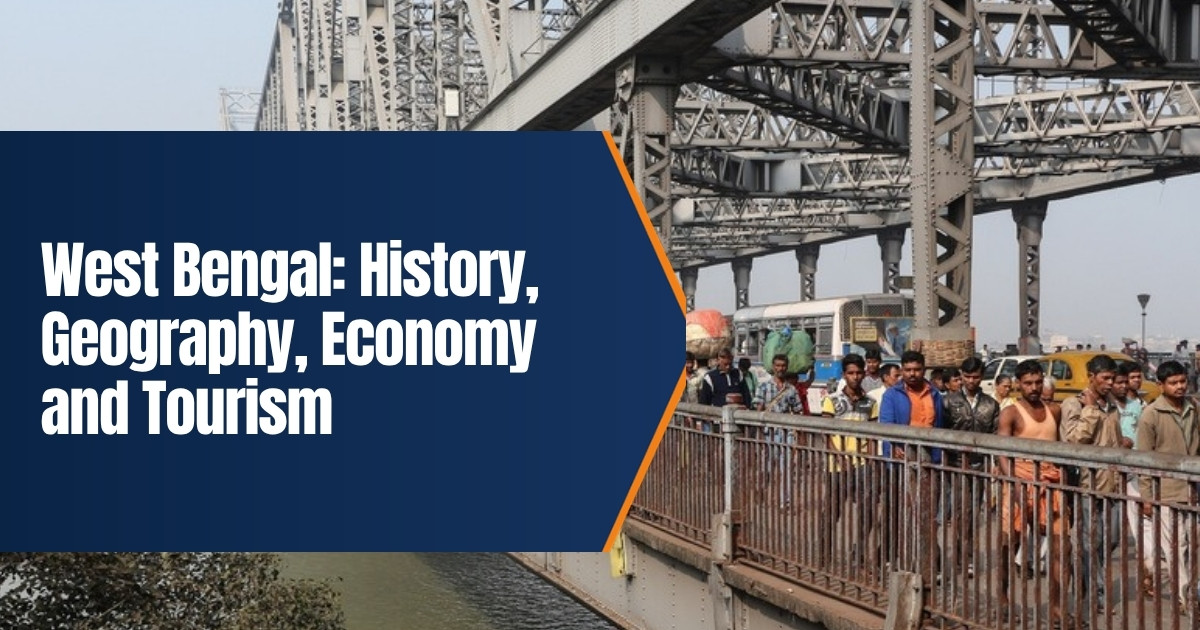
- Kolkata. The Victoria Memorial, Howrah Bridge, Indian Museum, College Street book market and the riverside ghats.
- Darjeeling. Tea gardens, Tiger Hill sunrise and the Darjeeling Himalayan Railway, a UNESCO World Heritage Site since 1999.
- The Sundarbans. Boat trips through mangrove creeks, with a chance of seeing tigers, crocodiles and birds. The national park became a UNESCO site in 1987.
- Shantiniketan. Tagore’s university town, added to the World Heritage list in 2023.
- Bishnupur. Terracotta temples built by the Malla kings.
- Murshidabad. The Hazarduari Palace and other relics of the Nawabs.
- Digha and Mandarmani. Beach towns on the Bay of Bengal.
Getting Around
Kolkata’s Netaji Subhas Chandra Bose International Airport is the main gateway, and Bagdogra airport near Siliguri serves the hills and the Dooars. Howrah and Sealdah are two of the busiest railway stations in India, and New Jalpaiguri is the rail hub for the north. From there, shared jeeps and the toy train climb to Darjeeling, while roads lead on to Sikkim and Bhutan. Ferries cross the Hooghly in Kolkata, and boats are the only way to reach many islands in the Sundarbans.
Culture
Bengali is the official language, with Nepali used in the hill areas. Durga Puja is the biggest festival, and Durga Puja in Kolkata was added to UNESCO’s list of intangible cultural heritage in 2021. Bengali literature, cinema and music have a long reach, from Tagore and Satyajit Ray to the Baul folk singers. Food lovers know the state for fish curry, mishti doi and sweets such as rasgulla and sandesh.
Food
Rice and fish form the base of most Bengali meals. Hilsa, or ilish, cooked in mustard sauce is a seasonal favourite, and prawn malai curry is served at weddings and feasts. Vegetarian dishes such as shukto, a mildly bitter mixed vegetable stew, open a traditional meal. Street food in Kolkata includes phuchka, kathi rolls and jhal muri. Sweet shops sell rasgulla, sandesh and mishti doi, and Bengalis take great pride in them. In the hills, momos and thukpa show Tibetan and Nepali influence.
Read more in our guides to Durga Puja in West Bengal, the hill town of Darjeeling and the Bengali language. Our guide to neighbouring Odisha covers another part of the old Bengal Presidency.
Toy train tickets in Darjeeling sell out quickly in peak months, so book through official railway channels well ahead.
Sundarbans trips need permits for the protected areas, and visitors should travel only with registered boat operators.
Kolkata’s metro is the oldest in India, and it remains a quick way to cross the city during busy hours.
Cyclone warnings are issued by the India Meteorological Department, so coastal travellers should check forecasts in May and October.
What We Changed From the Old Post
The old post was short and machine spun, with phrases such as “limitless zone” and no recent facts. We rewrote it in plain English, removed the dash from the title, and added a quick facts table, a clear timeline from the Palas to the 1947 partition, the 2026 election result and new chief minister, regional geography, the main parts of the economy, UNESCO listed places and a short culture section.
Frequently Asked Questions
What is the capital of West Bengal?
Kolkata, formerly Calcutta, is the capital.
Who is the chief minister of West Bengal?
Suvendu Adhikari of the BJP, sworn in on 9 May 2026.
What is West Bengal famous for?
Durga Puja, Darjeeling tea, the Sundarbans, rasgulla, jute and a long tradition of literature and film.
When is the best time to visit?
October to March suits the plains and the Sundarbans. The hills are pleasant from March to May and again in autumn.