

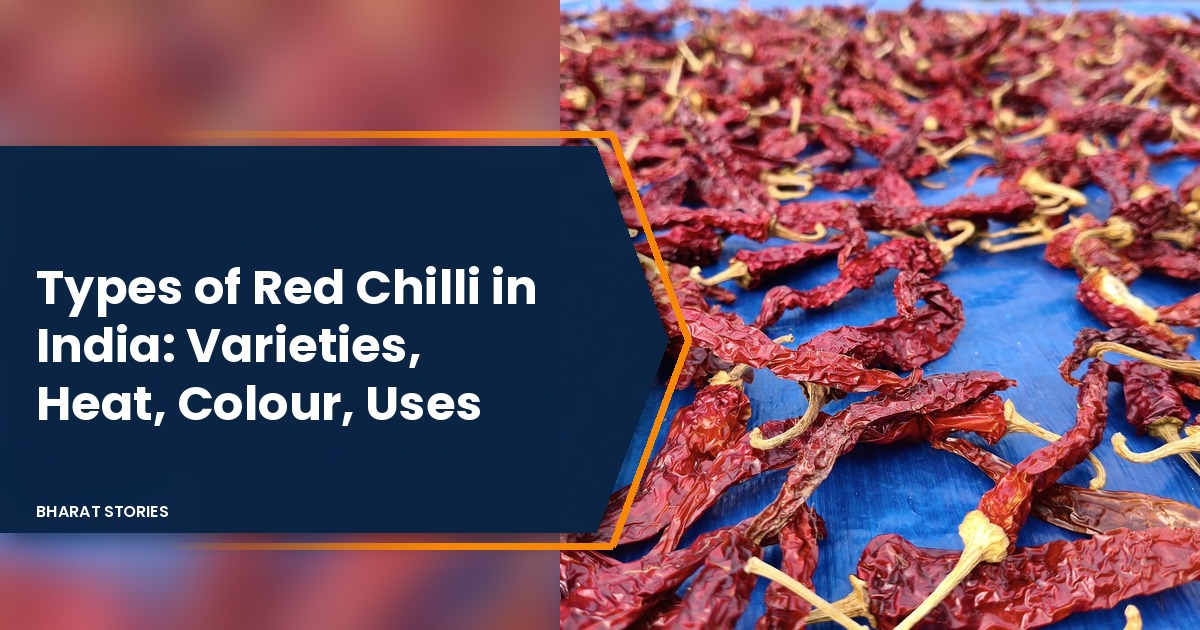
Types of Red Chilli in India: Varieties, Heat, Colour, Uses
India grows and uses more chilli than almost any other country, and there are many types of red chilli in India, each with its own place in the kitchen. Some are prized for deep colour with little heat, others for fierce pungency, and a few, like the bhut jolokia, are among the hottest chillies in the world. Knowing the difference helps you pick the right chilli for a curry, a tadka, a pickle or a spice blend.
This guide explains the main types of red chilli in India, where each one grows, how hot and how red it is, and how to use them in cooking.
Table of Contents
How many types of red chilli are grown in India?
India grows dozens of chilli varieties, but a handful of dried red types dominate kitchens and trade: Guntur Sannam, Byadgi, Kashmiri, Teja, bird’s eye, Jwala, Kanthari and the bhut jolokia. They differ mainly in colour, pungency, skin thickness and size.
Chilli is not native to India. The Spices Board of India notes that it came from South America and was introduced by the Portuguese towards the end of the fifteenth century. Within a few centuries it became central to Indian food, from Andhra pickles to Kashmiri rogan josh.
What are the main red chilli varieties of India?
The table below compares the best known Indian red chillies using colour (ASTA value), pungency and growing region, based on Spices Board data where available. A higher ASTA number means more extractable red colour; a higher capsaicin share means more heat.
| Variety | Main growing area | Colour (ASTA) | Heat | Best known for |
|---|---|---|---|---|
| Byadgi (Kaddi) | Dharwad and Haveri, Karnataka | 159.9 | Negligible to mild | Deep red colour, masala blends |
| Kashmiri | Himachal Pradesh, Jammu and Kashmir, North India winter crop | 54.10 | Mild (0.325% capsaicin) | Bright colour in curries |
| Guntur Sannam S4 | Guntur, Warangal, Khammam | 32.11 | Hot (0.226% capsaicin) | Everyday heat, chilli powder |
| Bird’s eye (Dhani) | Mizoram, Manipur | 41.7 | Very hot (0.589% capsaicin) | Fiery sauces and chutneys |
| Jwala | Kheda, Mehsana and South Gujarat | Not listed | Very hot (0.4% capsaicin) | Short, light red, compact seeds |
| Kanthari white | Kerala, parts of Tamil Nadu | 2.96 | Very hot (0.504% capsaicin) | Homestead crop, ivory colour |
| Bhut jolokia | Assam, Nagaland, Manipur | Not listed | Extremely hot | One of the world’s hottest chillies |
Which red chilli gives the most colour?
Byadgi chilli gives the most colour of the common Indian varieties, with an ASTA colour value of about 160 and negligible capsaicin, so it reddens food without making it very hot. It is the backbone of many South Indian sambar, rasam and masala powders.
Byadgi is named after the market town of Byadgi in Haveri district of Karnataka and received a Geographical Indication (GI) tag in 2011. It comes in two main forms: the small, plump Dabbi type, valued for colour and flavour, and the longer, wrinkled Kaddi type. Its deep red oleoresin is also extracted for food colouring and even cosmetics.
What is the difference between Kashmiri chilli and normal red chilli?
Kashmiri chilli is long, fleshy and deep red, and it is noticeably milder than the common Guntur type. Cooks use it mainly for colour in dishes like rogan josh, tandoori marinades and butter chicken. “Normal” red chilli powder sold in markets is often made from hotter varieties such as Guntur, so it adds more heat and less colour. Many households mix both to balance heat and colour.
Because genuine Kashmiri chilli is limited in supply, a lot of what is sold as “Kashmiri chilli powder” is made from other mild, high colour varieties such as Byadgi. Buy from trusted brands and check the label.
Which is the hottest chilli in India?
The bhut jolokia, also called ghost pepper or naga chilli, is the hottest chilli grown in India, rated at around one million Scoville Heat Units. In 2007 Guinness World Records certified it as the world’s hottest chilli, a title later taken by newer hybrids.
The bhut jolokia belongs to a different species, Capsicum chinense, and is grown in Assam, Nagaland and Manipur. The Naga Mircha from Nagaland holds a GI tag. Use it in tiny amounts, wear gloves when cutting it and keep it away from your eyes.
Among everyday dried chillies, Guntur types and bird’s eye chillies are the hottest. Guntur Sannam is usually rated at about 35,000 to 40,000 SHU, many times hotter than Kashmiri or Byadgi.
Why is Guntur called the chilli capital of India?
Guntur in Andhra Pradesh hosts one of Asia’s largest chilli markets, and Andhra Pradesh is India’s biggest chilli producing state. The Guntur Sannam variety alone has an annual production of about 2.8 lakh tonnes, according to Spices Board data.
Guntur Sannam has thick skin, long fruits and strong heat, and it is a registered GI product of Andhra Pradesh. The Teja chilli, a very hot, bright red type grown around Khammam and Warangal in Telangana, is another big export variety and is popular with chilli powder and sauce makers.
What are some lesser known Indian red chillies?
Regional chillies like Ramnad Mundu, Sankeshwari, Ellachipur Sannam and Madhya Pradesh G.T. Sannam give local cuisines their distinct character. They are worth looking for if you cook regional food.
- Ramnad Mundu: round, plump chilli from the Ramanathapuram area of Tamil Nadu, used in Chettinad and Tamil cooking for its rich flavour.
- Sankeshwari: a hot chilli from the Belagavi region of Karnataka, popular in Kolhapuri and Malvani masalas.
- Ellachipur Sannam S4: a reddish, very hot chilli from Amravati district of Maharashtra.
- Madhya Pradesh G.T. Sannam: red, pungent chilli from the Indore and Malkapur belt.
- Hindpur S7: a hot, highly pungent red chilli from Hindupur in Andhra Pradesh.
How should you use different red chillies in cooking?
Use mild, high colour chillies like Byadgi and Kashmiri for colour, and hot varieties like Guntur, Teja or bird’s eye for heat, then blend to taste. Whole dried chillies suit tempering, while powders suit curries, marinades and rubs.
- Tadka: fry whole Byadgi or Kashmiri chillies briefly in hot oil or ghee for aroma and colour without burning.
- Curry base: combine Kashmiri powder for colour with a smaller amount of Guntur powder for heat.
- Pickles: Andhra style pickles such as avakaya traditionally use hot Guntur chilli powder.
- Chutneys and sauces: bird’s eye or bhut jolokia add sharp heat in very small quantities.
- Spice blends: sambar powder, garam masala blends and Chettinad masala each use different chillies; roast them lightly before grinding.
For dishes that show off these chillies, browse our guide to Indian cuisines you must not miss.
How do you choose and store dried red chillies?
Choose chillies that are evenly coloured, glossy and free of mould, dust and broken stalks, and store them airtight away from light and moisture. Colour fades and flavour weakens with time and sunlight.
- Avoid chillies with white or black patches, which can indicate fungal growth.
- Buy powder in small packs and keep it in a dry, opaque container.
- Whole chillies usually keep their flavour longer than powder.
- Buy packaged powder from brands that follow food safety labelling; our guide to masala spice brands in India lists well known options.
Is red chilli good for health?
In normal food amounts red chilli adds flavour and some vitamins, but very large amounts can irritate the stomach. The Spices Board notes that eating chilli inordinately may cause gastroenteritis. People with acid reflux, ulcers or sensitive digestion should go easy on hot varieties and follow their doctor’s advice.
Capsaicin, the compound that makes chilli hot, is also used in some pain relief balms. This is a medical product use, not a reason to eat large quantities of chilli.
Frequently Asked Questions
Which chilli gives red colour without heat?
Byadgi chilli gives deep red colour with very little heat. Kashmiri chilli is also mild and bright red.
Which type of red chilli is best?
It depends on the dish. Byadgi and Kashmiri are best for colour, Guntur and Teja for heat, and many cooks blend a mild and a hot variety.
Is Kashmiri chilli hot?
Kashmiri chilli is mild compared with most Indian chillies. It is used mainly for colour.
Which state produces the most red chilli in India?
Andhra Pradesh is the largest chilli producing state, with Telangana and Karnataka among the other major producers.