

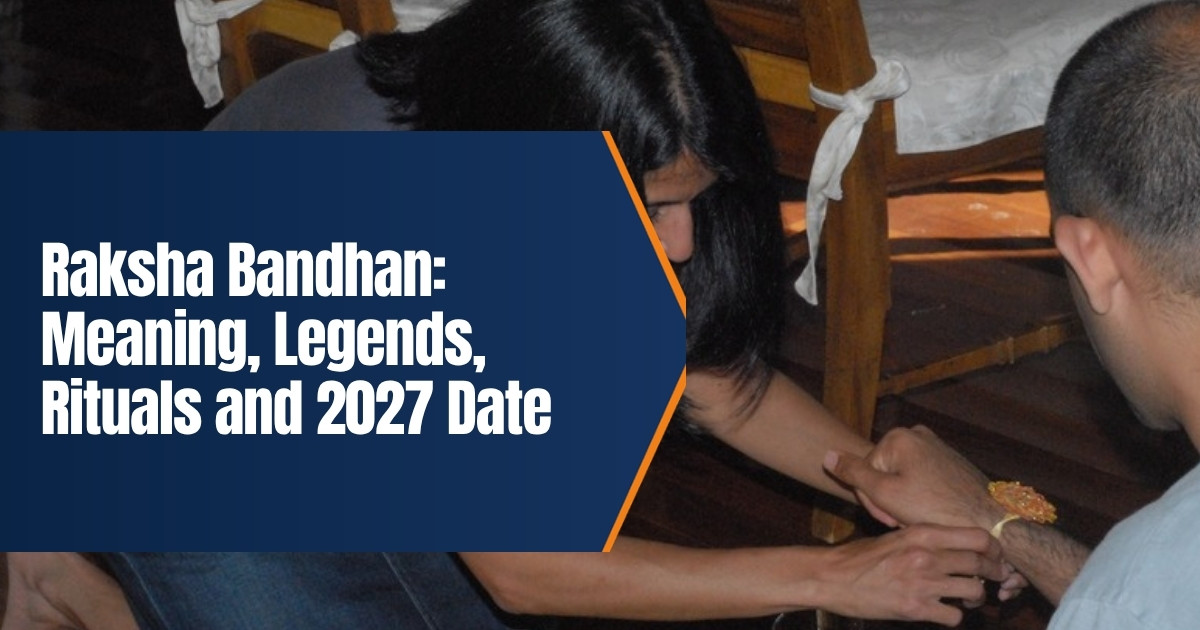
Raksha Bandhan: Meaning, Legends, Rituals and 2027 Date
Raksha Bandhan is a Hindu festival that celebrates the bond between brothers and sisters. On this day a sister ties a decorated thread, called a rakhi, around her brother’s wrist and prays for his wellbeing, and the brother promises to stand by her. The name means “the bond of protection”. It falls on the full moon of the month of Shravana, usually in August. In 2026 it was observed on 28 August, and in 2027 it falls on Tuesday, 17 August.
Table of Contents
Quick Facts
| Item | Detail |
|---|---|
| Meaning of the name | The bond of protection |
| When | Shravana Purnima, the full moon of Shravana |
| 2027 date | Tuesday, 17 August 2027 |
| Other names | Rakhi, Rakhi Purnima |
| Who observes it | Hindus, many Jains and Sikhs, and people of Indian origin worldwide |
| Holiday status | Restricted holiday for central government offices; public holiday in several states |
What Raksha Bandhan Means
At its heart, Raksha Bandhan is about care and trust within a family. The rakhi is a symbol. It carries the sister’s prayers for her brother’s health and success, and it reminds the brother of his promise of support. Over time the meaning has grown wider. Today sisters tie rakhis on sisters, cousins tie them on each other, and many people tie them on close friends who feel like family. Brothers and sisters who live far apart send rakhis by post or courier, and India Post has offered special rakhi envelopes in past years.
The festival is mainly celebrated in India and Nepal, and by Hindu and Sikh families in Mauritius, Fiji, the Caribbean, the UK, the US and other countries with large Indian communities.
When Raksha Bandhan Is Celebrated
The festival follows the Hindu lunisolar calendar, so its date in the Gregorian calendar moves each year, usually between late July and late August. Families often check a panchang for the best time, or muhurat, to tie the rakhi. Many avoid the period called Bhadra, which is considered unsuitable for auspicious work. Timings vary by city, so it is best to check a local almanac or temple.
Legends Behind the Festival
Indra and Indrani
The Bhavishya Purana tells of a long war between the gods and the asuras. When Indra, king of the gods, was losing, his wife Indrani tied a sacred thread on his wrist for protection. Indra went on to win. This story links the thread to protection rather than only to siblings.
Krishna and Draupadi
A popular story from the Mahabharata tradition says that when Krishna cut his finger, Draupadi tore a strip from her sari and tied it around the wound. Krishna promised to protect her, and he later came to her aid when she was humiliated in the royal court.
Bali and Lakshmi
Another legend tells of the demon king Bali, who won Vishnu’s favour and kept him as a guard. Lakshmi, Vishnu’s consort, went to Bali in disguise, tied a thread on his wrist and called him her brother. When Bali offered her a gift, she asked for Vishnu’s return, and Bali agreed.
Yama and Yamuna
In another story, Yamuna tied a thread on her brother Yama, the god of death, who blessed her and declared that any brother who receives a rakhi and protects his sister would be blessed too.
Rani Karnavati and Humayun
A widely told story says that Rani Karnavati of Chittor sent a rakhi to the Mughal emperor Humayun in the 1530s, asking for help against an attack by Bahadur Shah of Gujarat. Historians point out that early sources do not clearly support the rakhi detail, so it is best seen as a popular legend.
Tagore and the Rakhi of Unity
In 1905 the British government announced the Partition of Bengal. Rabindranath Tagore called on Hindus and Muslims to tie rakhis on each other as a sign of brotherhood and unity against the division. Crowds took part in Kolkata and other towns. This gave Raksha Bandhan a social and political meaning that is still remembered in Bengal today.
How the Ritual Is Performed
Customs differ from family to family, but a typical celebration looks like this:
- The family bathes and dresses in new or festive clothes.
- The sister prepares a thali with the rakhi, roli or kumkum, rice grains, a diya and sweets.
- Brother and sister face each other, often with the brother facing east.
- The sister applies a tilak on the brother’s forehead and may perform an aarti with the lit diya.
- She ties the rakhi on his right wrist and says a prayer for his wellbeing.
- They feed each other a sweet, and the brother gives a gift or money and a promise of support.
Many families fast until the rakhi is tied, then share a festive meal. Married women often travel to their parents’ home for the day.
Regional Names and Customs
The same full moon is marked in different ways across India and Nepal:
- Narali Purnima. Fishing communities on the coasts of Maharashtra, Goa and Gujarat offer coconuts to the sea to mark the end of the monsoon and the start of the fishing season.
- Avani Avittam. In Tamil Nadu, Kerala and parts of Karnataka and Andhra Pradesh, many Brahmin men change their sacred thread, or janeu, on this day.
- Janai Purnima. In Nepal, Hindus change their sacred thread and receive a protective yellow thread from priests.
- Kajari Purnima. In parts of Madhya Pradesh, Bihar and Uttar Pradesh, the day is linked with farming and prayers for a good harvest.
- Jhulan Purnima. In Odisha and West Bengal, the day closes the swing festival of Krishna and Radha.
Raksha Bandhan Among Jains and Sikhs
Many Jains observe the day with a story of their own. In Digambara Jain tradition, the monk Vishnukumar is said to have saved a group of 700 monks led by Akampanacharya from harm on this full moon. Jain families mark the day with prayers and by tying threads as a sign of protection and care for one another. In Punjab, the festival is often called Rakhri, and Sikh and Hindu families celebrate it in much the same way as the rest of North India, with threads, sweets and family visits.
Raksha Bandhan and Bhai Dooj
People sometimes confuse Raksha Bandhan with Bhai Dooj. Both celebrate brothers and sisters, but they fall at different times and have different rituals. Raksha Bandhan comes on the full moon of Shravana, around August, and centres on tying the rakhi. Bhai Dooj comes two days after Diwali, in October or November. On Bhai Dooj the sister applies a tilak on her brother’s forehead and prays for his long life, and the brother visits her home for a meal. In Maharashtra it is called Bhau Beej, and in Bengal it is Bhai Phonta.
Food and Sweets
Sweets are central to the day. Popular choices include kaju katli, besan laddoo, ghewar in Rajasthan, coconut barfi on the coast and rasgulla in Bengal. Many families cook a special lunch with puri, kheer and seasonal vegetables.
Gifts and Modern Celebrations
Rakhis today range from simple cotton threads to designs with beads, silver or the names of family members. Children enjoy rakhis shaped like cartoon characters. Some people now choose eco friendly rakhis made of seeds or natural fibre that can be planted after the festival. Gifts have also changed. Brothers and sisters often exchange books, clothes, gadgets or experiences, and many sisters give gifts to their brothers too.
Groups across India also tie rakhis on soldiers, police officers and health workers as a thank you, and some campaigns tie rakhis on trees to promote forest protection.
Raksha Bandhan sits among many festivals that mark India’s calendar. Read our guides to Chhath Puja, Durga Puja in West Bengal, the Garba dance and the Amaravati temple in Guntur.
If you post a rakhi abroad, send it two to three weeks early, as international mail can be slow in the festive season.
Keep the rakhi on for a few days, or as long as family custom suggests, before removing it respectfully.
Schools often hold rakhi making sessions, which help children learn about the festival through craft.
Sweet shops get very busy the day before, so many families order or make sweets in advance.
For families apart, a video call while the rakhi is tied by another relative keeps the moment shared.
What We Changed From the Old Post
The old post used awkward wording that read like a machine translation and had no date for the next festival. We rewrote it in original, plain language. We added the 2026 and 2027 dates, a quick facts table, clearer versions of the main legends, Tagore’s role in 1905, step by step ritual details, regional names, food and modern customs. We labelled the Karnavati and Humayun story as a legend because historians question it.
Frequently Asked Questions
When is Raksha Bandhan in 2027?
Raksha Bandhan falls on Tuesday, 17 August 2027. Check a local panchang for the exact time to tie the rakhi.
Can a sister tie a rakhi on a sister?
Yes. Many families now celebrate between sisters, cousins and close friends.
On which hand is the rakhi tied?
Traditionally on the right wrist.