

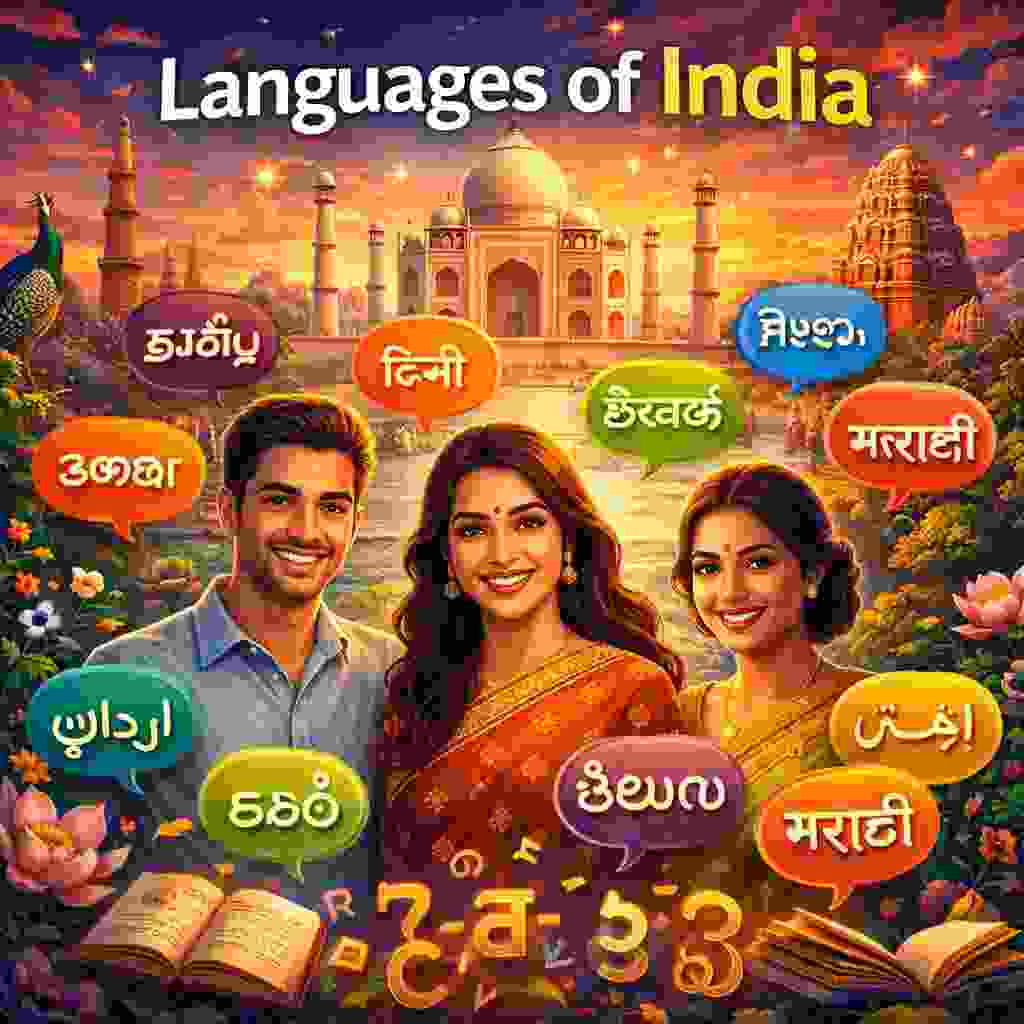
Languages of India
Known globally for its deep cultural roots, India shows this most clearly through its linguistic variety. Moving through different areas, a visitor observes shifts in sound and structure among local tongues. These forms of expression go beyond simple talk; each holds memory, custom, and a sense of belonging. Rooted in daily life, they mirror habits, values, and unseen narratives passed down over time.
This piece outlines the official languages of India, touching on local speech forms alongside those formally listed by policy. Regional expression emerges through varied dialects that influence routine interactions. Understanding these linguistic patterns reveals subtle impacts on social conduct. One sees structure shaped by history, not uniformity. Every day communication carries traces of multiple heritage streams. What results is a system where variety defines function.
Table of Contents
Indian Languages: Many Different
What stands out about India is its wide range of spoken tongues. Across the land, numerous languages exist alongside countless regional dialects. Originating from separate roots, many fall into broad groups like Indo-Aryan or Dravidian. Others trace back to less widespread branches such as Austroasiatic or Tibeto-Burman.
When routines unfold, speech flows across several languages. In family settings, home talk might follow native patterns, while in classrooms or offices, different words are introduced. Exposure from films or trips can sometimes add another layer of understanding. Flexibility in contact emerges quietly when varied tongues shape interactions.
Across India, speech patterns shift with the land. Where the north lies, Indo-Aryan tongues take root. Southward, the air carries Dravidian forms more often. Found within the northeast, speech draws from Tibeto-Burman sources.
Official Languages of India
Among administrative tools nationwide, language holds a position shaped by constitutional design. In federal operations, two tongues serve a functional role: Hindi is recognized alongside English by law.
In northern and central India, Hindi is written in the Devanagari script and is a dominant spoken language. In administrative settings, media circles, or classrooms, its presence grows common. Official exchanges, particularly in law, higher education, or corporate environments, tend to rely on English instead. While one connects regions through local speech, the other links institutions via global usage.
Scheduled Languages of India
The Indian Constitution recognizes 22 scheduled languages. These languages are officially recognized and supported, and they are part of the Eighth Schedule.
Hindi, Bengali, Tamil, Telugu, Marathi, Gujarati, Kannada, Malayalam, Punjabi, and Urdu are among the main scheduled languages of India. Every one of these languages has its own literature, script, and cultural significance.
Their inclusion guarantees the development and preservation of these languages. Government initiatives frequently support education, literature, and media in these languages. Additionally, it helps speakers feel respected and like themselves.
A sizable section of the population speaks these scheduled languages of India. Despite not being officially mentioned, a large number of other languages and dialects are also spoken.
India’s Regional Tongues
Found across particular territories, regional tongues in India emerge from everyday life. Rooted deeply, they carry echoes of cultural habits and histories. One will often find a single state embracing several such languages as the primary means of communication.
In regions like Tamil Nadu, one finds Tamil taking precedence. Meanwhile, across Andhra Pradesh and Telangana, Telugu appears more frequently. West Bengal hosts speakers of Bengali. In contrast, Maharashtra shows stronger Marathi usage.
In schools, local administration, and everyday speech, the regional languages of India are frequently used. Because of them, cultural uniqueness remains intact over time. Through celebrations, melodies, narratives, and customs, transmission occurs naturally. Within a single state, dialect shifts can emerge gradually. Such variety reveals how embedded linguistic differences truly are across India.
Multilingualism in Everyday Living
What stands out about India is its wide range of spoken languages. Often, individuals grasp several tongues beyond their native tongue. Because of this, moving across regions becomes easier. Learning in schools benefits when multiple languages are known. Work settings also gain where speech overlaps occur.
A person from Kerala might use Malayalam at home, encounter English in classrooms, and pick up Hindi through television or films. Because of this adaptability, moving between areas becomes easier. Connections among individuals of varied origins grow stronger when multiple languages are present. With shared linguistic tools, mutual respect tends to emerge more naturally.
Struggles Keeping Languages Alive
Even though India has many different languages, not all of them stay strong. Smaller ones often fade over time. Young people sometimes choose bigger languages instead. Moving to cities, traveling for work, or watching mainstream media can push that change. Without everyday speaking, a tongue loses its place. Slowly, it slips out of reach.
People are working now to save these languages. Schools teaching them, festivals celebrating them, websites sharing them – each piece matters. Writing things down and studying how they work helps too.
Language Policies Matter
Nowhere else does a nation juggle so many tongues quite like this. Official speech keeps things running, yet it is the listed dialects that hold old ways alive. Through one approach runs order; through another flows memory.
Most state governments support the regional languages of India through schools and broadcasts. In classrooms, lessons come in native speech – this helps kids grasp ideas faster. Such moves keep peace across lands where countless languages mix. With shared ways to speak, folks connect without losing who they are.
Future of Languages Spoken in India
Languages across India will survive only if people pay attention and act. With tech on the rise, regional speech finds room beyond paper and classrooms. Online platforms now host videos, posts, and scripts in various native formats. Instead of fading, some dialects gain presence through mobile tools. A fresh wave sees youth lean into ancestral ways of speaking. Their curiosity breathes life into what once loomed in silence. Hope lives quietly in these everyday choices.
Even now, tongues such as English hold strong influence across nations. Yet alongside them, regional speech forms remain vital. What unfolds next for India’s many languages depends on how widely spoken ones mix with those close to home.
Conclusion
What people speak across India goes beyond mere speech. Every tongue carries stories older than records. Whether listed as an official language or spoken in a single valley, each holds weight. Not one exists without meaning. How a village chants its songs matters as much as national proclamations.
Not just a list on paper, those 22 named Indian tongues reflect a real effort to preserve how people have always spoken. Meanwhile, voices outside that count bring extra layers to the mix.
FAQs
What are the official languages of India?
India counts Hindi and English among its official languages. Across the nation, government work leans on Hindi for daily use. Official papers cross desks in English when global talk kicks in. Many offices switch to English just before meetings with foreign partners.
How many officially recognized scheduled languages does India have?
Not all tongues spoken across the land hold equal status – only twenty-two do. Those chosen appear by name in the country’s founding document. Each one carries weight because the law backs its use. Recognition means funds, schools may teach them, and governments answer to them.
Indian Language Diversity Matters?
From one village to another, speech shifts like soil underfoot. Voices carry old ways through syllables passed down through the years. Each tongue holds a mirror to belonging, shaped by what came before.
Regional Languages Spoken Across India?
Across India, different areas speak their own native tongues. These forms of speech naturally occur in homes, schools, and classrooms. One finds them working in government offices close to people.
How many languages are spoken in India?
India hosts hundreds of languages, alongside countless regional speech forms. That variety places it among Earth’s top nations for language diversity.