

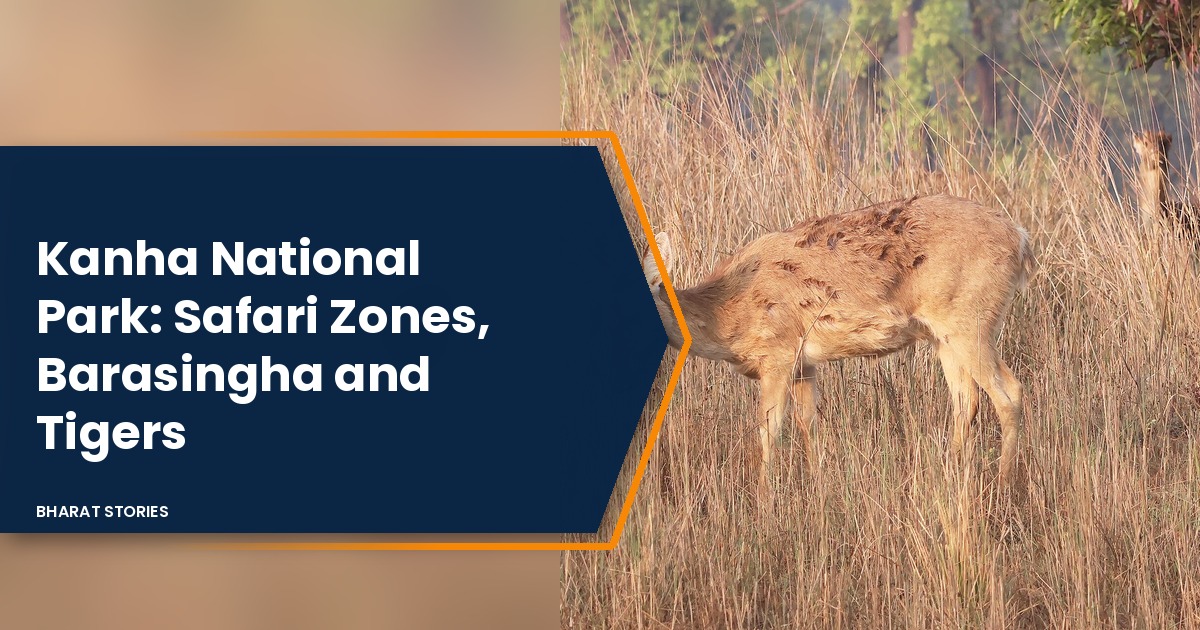
Kanha National Park: Safari Zones, Barasingha and Tigers
Kanha National Park in Madhya Pradesh is one of India’s best known tiger reserves and the only home of the hard ground barasingha, the swamp deer that was brought back from the edge of extinction here. Its sal forests, bamboo slopes and wide grassy meadows also hold leopards, wild dogs, gaur and around 300 kinds of birds. This guide covers where Kanha is, its history, wildlife, safari zones and gates, the best time to visit and how to book a safari.
Table of Contents
Where is Kanha National Park located?
Kanha National Park lies in the Maikal hills of central India, spread across Mandla and Balaghat districts of Madhya Pradesh.
The core of the reserve covers about 940 sq km. Together with a buffer zone of about 1,067 sq km and the neighbouring Phen Sanctuary of about 110 sq km, it forms the Kanha Tiger Reserve, one of the largest in the country. The park is also known as Kanha Kisli National Park, after its two main early blocks. Kanha is the largest national park in Madhya Pradesh, according to the Kanha Tiger Reserve entry on Wikipedia.
| Fact | Detail |
|---|---|
| State and districts | Madhya Pradesh: Mandla and Balaghat |
| National park created | 1 June 1955 |
| Tiger reserve | 1973, among the first under Project Tiger |
| Core area | About 940 sq km |
| Buffer zone | About 1,067 sq km, plus Phen Sanctuary (about 110 sq km) |
| Signature species | Hard ground barasingha, Bengal tiger |
| Mascot | Bhoorsingh the Barasingha |
What is Kanha National Park famous for?
Kanha is famous for tigers, for saving the hard ground barasingha and for its open meadows, which make wildlife easier to see than in many dense forests.
The reserve was also the first tiger reserve in India to adopt an official mascot, Bhoorsingh the Barasingha. Kanha is widely regarded as one of the best managed parks in India, and its grasslands, locally called maidans, are some of the most photographed wildlife landscapes in the country. The forests of this region are often linked with the setting of Rudyard Kipling’s The Jungle Book, although Kipling never named Kanha itself.
How did Kanha save the barasingha?
The hard ground barasingha survives in the wild only in Kanha, and careful protection of its meadows helped the population recover from a few hundred animals.
Unlike the swamp deer of northern India, this subspecies (Rucervus duvaucelii branderi) has hard hooves suited to firm ground in open sal forest. Its numbers fell sharply in the twentieth century. Estimates put the herd at about 500 in 1988, 300 to 350 around the year 2000 and about 750 by 2016, according to the barasingha species account. Park staff managed grasslands, protected breeding areas and later moved animals to other reserves, including Satpura and Bandhavgarh, so the species is not limited to a single site. The barasingha is the state animal of Madhya Pradesh.
Which animals can you see in Kanha?
Common sightings include chital, sambar, barasingha, gaur, wild boar and langurs, while tigers, leopards, dholes and sloth bears are the prized finds.
- Big predators: Bengal tiger, Indian leopard and the dhole, or Indian wild dog, which hunts in packs.
- Other mammals: sloth bear, gaur (Indian bison), Indian jackal and Bengal fox. Blackbuck have become very rare.
- Deer and antelope: chital, sambar, barking deer and the four horned antelope.
- Night animals: porcupines, civets and hyenas, rarely seen on day safaris.
Gaur gather around meadows and waterholes in the dry months, which makes April to June a good time to see them. For other big cat parks in the same state, read our guides to Bandhavgarh National Park and Pench National Park.
Which birds live in Kanha?
Around 300 bird species have been recorded in the reserve, from Indian rollers and hornbills to eagles and paradise flycatchers.
Birds often seen on drives include the Indian grey hornbill, Malabar pied hornbill, crested serpent eagle, Indian roller, red junglefowl, Indian peafowl, plum headed parakeet, hill myna and the Indian paradise flycatcher. Wetland edges attract little grebes, lesser whistling ducks and lesser adjutant storks. Winter adds migrants such as the steppe eagle.
What kind of forest covers Kanha?
The lowlands are dominated by sal forest mixed with other trees and broken by meadows, while the higher hills carry dry deciduous forest with bamboo on the slopes.
Sal (Shorea robusta) is the signature tree of the valleys. On the plateaus and slopes the forest changes to mixed deciduous trees, with bamboo and the Indian ghost tree. Bamni Dadar, one of the highest points in the park, is known for sunset views over the forest. The mix of grassland and woodland is the reason Kanha supports so many grazing animals and, in turn, so many predators.
What are the safari zones and gates in Kanha?
Kanha has four core safari zones, Kanha, Kisli, Mukki and Sarhi, and three buffer zones, Khatia, Khapa and Sijhora, plus a zone in Phen Sanctuary.
The main entry gates are Khatia, Mukki and Sarhi. Each permit is valid only for the zone you book, so you cannot move between zones on one ticket. Central Kanha has traditionally been treated as the premium zone because of its meadows. Mukki, on the southern side, is popular with visitors coming from the Balaghat side. Details of zones, gates and vehicle limits are published by the Madhya Pradesh Forest Department booking portal.
Which safari zone is best in Kanha?
There is no single best zone; Kanha and Kisli are prized for meadows and tiger sightings, while Mukki and Sarhi are quieter and still rich in wildlife.
Tiger movement changes from season to season, so sightings in any zone are a matter of luck. Booking two or three safaris in different zones improves your chances more than chasing one famous route.
When is the best time to visit Kanha National Park?
The core zones open from 1 October to 30 June; November to December is pleasant and green, and March to May is hot but good for tiger sightings near water.
The core area closes during the monsoon, from July to September, while buffer zones generally stay open for safaris. Afternoon safaris in the core zones are not held on Wednesdays, and the park has traditionally closed on Holi and Diwali. Winter mornings in an open jeep can be very cold, so carry warm layers. Rules can change from year to year, so check the official portal before you travel.
How do you book a Kanha safari?
Book jeep safari permits online on the Madhya Pradesh Forest Department portal, choosing the zone, date and morning or afternoon slot.
- Open the official booking portal and pick Kanha Tiger Reserve.
- Select the zone, entry gate, date and shift.
- Enter identity details for every visitor; carry the same original ID to the gate.
- Pay online and keep the permit printout or digital copy.
- Hire the registered gypsy and guide at the gate; these charges are usually paid separately.
Permit fees, vehicle charges and cancellation rules are revised from time to time, so check current rates on the portal rather than relying on old figures. Permits for peak season dates sell out early, so book well in advance.
How do you reach Kanha National Park?
Jabalpur is the most common starting point, with the nearest major airport and railway station; Nagpur and Raipur are other options for longer road trips.
- By air: Jabalpur airport is the closest major airport, a drive of several hours to the Khatia gate. Nagpur and Raipur airports also work, especially for Mukki.
- By rail: Jabalpur is the main railhead; Gondia is another option for the southern side.
- By road: good roads connect Mandla and Balaghat towns with the park gates, and taxis can be hired in Jabalpur.
For more on the state, read our guide to Madhya Pradesh history, geography and tourism, and compare Kanha with other reserves in our list of national parks of India.
Who are the Baiga people of Kanha?
The Baiga are a forest dwelling tribe of central India; villages that once stood inside the park were relocated so the tiger habitat could be protected.
Relocations began in the late 1960s and continued in later decades, and their effect on Baiga families has been widely debated. Today many local people from Baiga and Gond communities work as guides, drivers and resort staff around Kanha.
Frequently Asked Questions
Which district is Kanha National Park in?
Kanha spreads over Mandla and Balaghat districts of Madhya Pradesh. Most visitors enter through Khatia or Mukki.
How many days are enough for Kanha?
Two to three days is ideal. That allows three or four safaris in different zones, which gives a fair chance of seeing a tiger and plenty of other wildlife.
Is Kanha better than Tadoba?
Both are excellent. Tadoba in Maharashtra is often praised for frequent tiger sightings, while Kanha offers bigger landscapes, meadows and the unique barasingha. Many wildlife lovers visit both.
Can you see a tiger in Kanha?
Tiger sightings are common in good seasons, but they are never guaranteed. Several safaris, early starts and a patient guide improve the odds.