

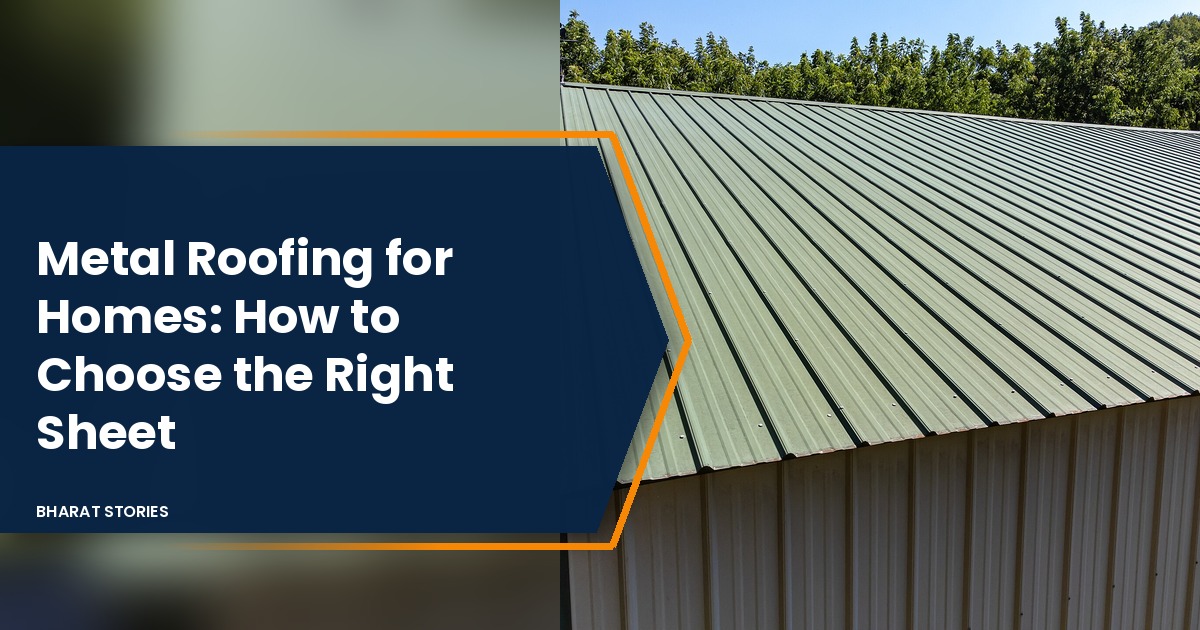

Metal roofing has moved well beyond factory sheds. Across India it now covers upper floors, car porches, terraces, farmhouses and entire homes, valued for being light, quick to install and able to handle heavy rain. But the words used in shops, such as GI, galvalume, PPGI, TCT and PVDF, can be confusing, and a cheap sheet can rust, fade or turn the room below into an oven within a few years.
This guide explains the main types of metal roofing, how to read thickness and coating specifications, how to deal with heat and noise, what the Indian Standards say, and the questions to ask before you buy. It also corrects a few common myths.
Table of Contents
Types of Metal Roofing
Galvanised Steel (GI)
Galvanised iron sheets are steel coated with zinc. The zinc corrodes slowly and protects the steel underneath. GI sheets are the most affordable option and are widely used for sheds and outbuildings. Their weakness is that once the zinc layer wears away, rust follows, especially near the sea or in polluted industrial areas.
Aluminium Zinc Coated Steel (Galvalume)
These sheets are steel coated with an alloy of aluminium and zinc, often sold under brand names or simply called galvalume or AZ sheets. The aluminium in the coating forms a tough protective layer, so these sheets generally resist corrosion better than plain GI of a similar coating weight. They are a common choice for homes.
Colour Coated Sheets (PPGI and PPGL)
Pre painted sheets have a factory applied paint system over a galvanised base (PPGI) or an aluminium zinc base (PPGL). They come in many colours and profiles and are the most popular choice for residential roofs today. Their life depends on both the metal coating underneath and the quality of the paint.
Aluminium
Aluminium sheets do not rust, are very light and handle salty coastal air well. They cost more than steel for the same area, dent more easily and expand more with heat, so fixings must allow for movement.
Copper and Zinc
Copper roofing is used on heritage buildings, temples, domes and premium homes. It lasts a very long time and develops a green patina with age. It is also expensive, needs skilled installers and should not be placed in direct contact with steel or aluminium, because the combination causes galvanic corrosion. The claim that copper is a low cost roofing option is simply wrong.
Stone Coated Steel
These are steel panels covered with granules to look like clay tiles or shingles. They give a traditional appearance with the light weight of metal and some reduction in rain noise.
Understanding Thickness
Indian suppliers usually describe sheet thickness in millimetres, not the gauge numbers often quoted in American articles. Two terms matter:
- BMT, or base metal thickness, is the steel alone.
- TCT, or total coated thickness, includes the metallic coating and paint.
A sheet sold as 0.50 mm TCT has less steel than one sold as 0.50 mm BMT. Always compare like with like. For most homes, sheets in roughly the 0.45 to 0.60 mm range are used, depending on the span between purlins, wind exposure and whether people will walk on the roof for maintenance. Your contractor or the manufacturer’s load tables should confirm the right thickness for your structure.
Understanding Coatings
The metallic coating is measured in grams per square metre, counting both sides of the sheet. You may see it written as Z for zinc or AZ for aluminium zinc, followed by a number, such as Z120 or AZ150. A higher number means more coating and, in general, longer protection against corrosion. The American G90 grade that appears in many online guides is a different system and is not how most Indian sheets are labelled.
Paint Systems
For colour coated sheets, the paint matters as much as the metal. The most common systems are:
- Polyester (RMP): the standard, economical finish used on most roofing.
- Silicone modified polyester (SMP): better resistance to fading and chalking than regular polyester.
- PVDF: a premium fluoropolymer finish with the best colour retention, used where long life and appearance are priorities.
Some older articles state that SMP is more expensive than PVDF. The reverse is true: PVDF is usually the costlier, longer lasting finish. Ask which system you are being offered and what fade warranty comes with it.
Indian Standards and the BIS Mark
The Ministry of Steel’s Steel and Steel Products Quality Control Order, 2024, notified on 29 August 2024, covers the main steel roofing products. It lists IS 277 for galvanised plain and corrugated sheets, IS 15961 for hot dip aluminium zinc coated steel, IS 14246 for pre painted galvanised sheets and IS 15965 for pre painted aluminium zinc coated steel. Products covered by the order must conform to the standard and carry the Standard Mark under a licence from the Bureau of Indian Standards. When buying, check for the mark and the manufacturer’s details on the sheet or its packaging.
Choosing a Profile
| Profile | Typical use | Notes |
|---|---|---|
| Corrugated | Sheds, farm buildings | Traditional wavy shape; economical |
| Trapezoidal | Homes, porches, warehouses | Strong ribs allow wider purlin spacing |
| Tile profile | Homes seeking a tiled look | Steps that imitate clay tiles |
| Standing seam | Premium homes, low slopes | Concealed fixings reduce leak points; needs skilled installers |
Dealing with Heat and Noise
A bare metal sheet heats up quickly under the Indian sun and can be loud in heavy rain. There are effective solutions:
- Sandwich panels: two metal sheets with insulation such as PUF or rock wool between them.
- Underdeck insulation: insulation fixed below the sheet, with a reflective foil layer.
- Light or cool colours: pale colours and special reflective paints absorb less heat.
- Ventilation: a gap or ridge vent lets hot air escape from under the roof.
Insulation also reduces condensation, where moisture forms on the underside of the sheet on cool mornings and drips into the room.
Matching the Roof to Your Climate
- Coastal areas: choose aluminium, or aluminium zinc coated steel with a high coating weight and a good paint system, and wash off salt deposits now and then.
- Heavy rain regions: give the roof enough slope, generous overlaps and good gutters.
- Cyclone and high wind zones: use more fixings at edges and corners, and follow the manufacturer’s wind guidance.
- Very hot regions: prioritise insulation and reflective colours.
Installation Matters
Even the best sheet will leak if it is badly installed. Good practice includes using self drilling screws with weather sealing washers fixed at the correct points, keeping the specified overlaps, sealing flashings properly where the roof meets walls and pipes, and sweeping away metal filings after drilling so they do not rust on the surface. For help finding the right installer, see our guide on why you should hire professional roofing contractors.
Questions to Ask Before You Buy
- Is the thickness quoted as BMT or TCT?
- What is the metallic coating and its weight?
- Which paint system is used, and what is the warranty against fading and corrosion?
- Does the product carry the BIS Standard Mark?
- Are matching ridges, flashings and screws included?
- Will the installer follow the manufacturer’s fixing guidelines?
Frequently Asked Questions
Which metal roofing is best for homes in India?
For most homes, colour coated aluminium zinc steel offers a good balance of cost, strength and corrosion resistance. Coastal homes may justify aluminium, and premium buildings sometimes use copper.
Does a metal roof make the house hot?
An uninsulated sheet can. Insulated sandwich panels, underdeck insulation, light colours and ventilation keep the room below far cooler.
How long does a metal roof last?
It depends on the coating, paint, climate and installation. Good quality coated steel can last for decades. Check the manufacturer’s warranty terms for your area.
Is PVDF better than SMP?
PVDF usually holds its colour longer and costs more. SMP is a good middle option, and standard polyester is the economy choice.
What thickness of metal sheet should I use?
Many homes use sheets between about 0.45 and 0.60 mm, but the right figure depends on purlin spacing and wind load. Confirm whether the figure is base metal or total coated thickness.
Do roofing sheets need a BIS mark?
Steel sheets covered by the 2024 quality control order, including galvanised, aluminium zinc and pre painted types, must carry the BIS Standard Mark.