

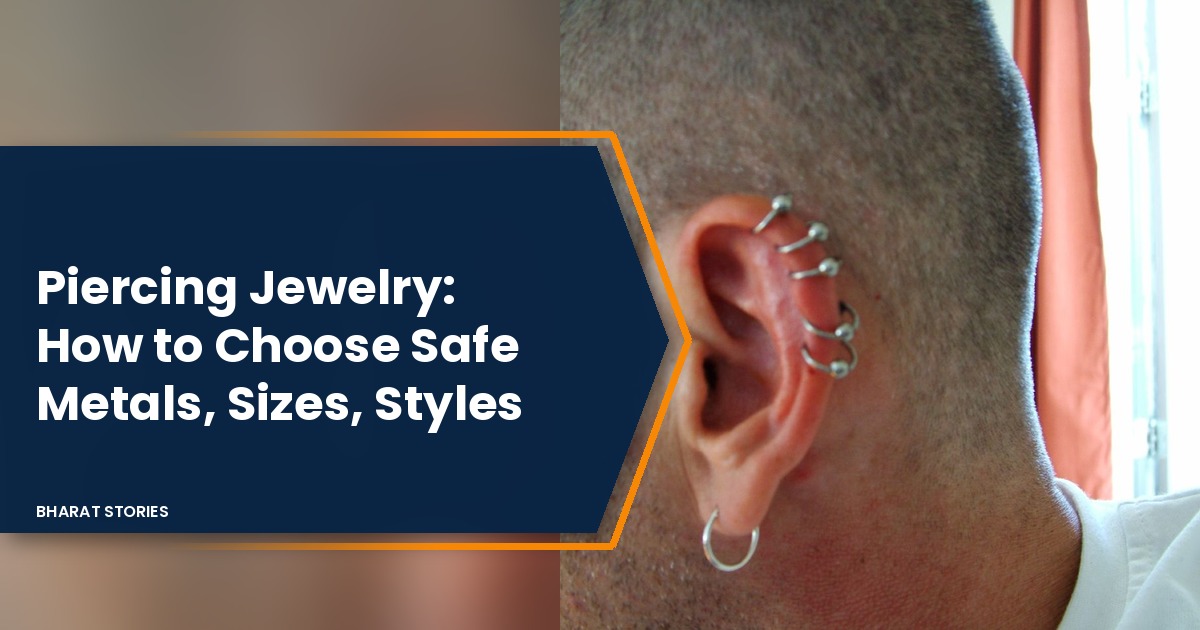

Choosing piercing jewelry is not the same as buying a pair of earrings for an outfit. Body jewelry sits inside a healing wound, so the metal, size and finish matter as much as the look. The right piece helps a new piercing settle quickly, while the wrong one can cause swelling, irritation, allergy or even rejection. This guide explains which materials are safe, how to pick the right gauge and length, which styles suit each piercing, and how to match jewelry to your personal style once you have healed.
Table of Contents
What should you look for in piercing jewelry?
Look at four things: a body safe material, the correct size for your anatomy, a style suited to the piercing site and a smooth, high quality finish.
The Association of Professional Piercers (APP), an international body of piercing professionals, puts it simply: the look of the jewelry in a fresh piercing must come second to safety and compatibility with your body. The placement of a piercing is fixed, but the jewelry can be changed for something more decorative once you have healed. Price alone is not a guide, because the market is full of cheap pieces sold as “surgical steel” or “hypoallergenic” with no proof.
Which metals are safest for a new piercing?
Implant grade titanium is the safest everyday choice; certain grades of surgical steel, niobium, solid 14k to 18k gold, platinum and some glass are also accepted for fresh piercings.
| Material | What to look for | Good to know |
|---|---|---|
| Titanium | Implant grade Ti6Al4V ELI (ASTM F136 or ISO 5832 3) or commercially pure titanium (ASTM F67) | Light, strong and ideal for people with nickel sensitivity; can be anodised in colours |
| Surgical steel | Only specific grades, such as ASTM F138 or ISO 5832 1 | Contains some nickel; many pieces labelled “surgical steel” are not these grades |
| Niobium | Pure niobium | Similar to titanium and can be anodised, including black |
| Gold | Solid 14k to 18k, nickel and cadmium free | Gold above 18k is too soft; plated, filled or vermeil gold is not suitable for fresh piercings |
| Platinum | Solid platinum | Very inert but rare and expensive |
| Glass | Fused quartz, lead free borosilicate or lead free soda lime glass | Inert and can be sterilised |
Ask your piercer for mill certificates, documents from the metal supplier that confirm the ASTM or ISO grade. They do not prove that a specific piece came from that batch, but they show the studio buys from reputable sources.
Is stainless steel or titanium better for piercings?
Implant grade titanium is usually the better pick, especially if you have sensitive skin, because it contains little or no free nickel and is lighter than steel.
Surgical steel of the right grade is safe for most people and often cheaper, but it does contain nickel, and nickel allergy is one of the most common causes of itchy, red, weepy piercings. If you have ever reacted to a cheap belt buckle or watch strap, choose titanium or niobium. Avoid sterling silver in fresh piercings; it tarnishes and can irritate a healing channel and stain the skin.
What gauge and length should piercing jewelry be?
Gauge is the thickness of the post, and length or diameter must suit your anatomy; most ear cartilage piercings use 16 gauge and most nostril piercings use 18 or 20 gauge.
Lower gauge numbers mean thicker jewelry. A 20 gauge post is about 0.8 mm thick, 18 gauge about 1.0 mm, 16 gauge about 1.2 mm and 14 gauge about 1.6 mm, which is common for navel and tongue piercings. The APP warns that jewelry that is too thin can act like a splinter and migrate or reject, while jewelry that is too tight cuts off airflow and blood supply and can sink into swollen tissue. Your first piece is often slightly longer to allow for swelling. Once the swelling settles, usually after a few weeks, a piercer can fit a shorter post so it does not snag.
Do piercers use 16G or 18G?
Both are common: 16 gauge for most ear cartilage and lip piercings, and 18 or 20 gauge for nostril piercings, depending on your anatomy and the jewelry style.
Which jewelry styles suit each piercing?
Rings, straight barbells, curved barbells and flat back studs each suit different placements, so choose by location as well as looks.
- Earlobe: flat back labret studs or simple studs for healing; hoops, huggies and dangles after healing.
- Helix and other cartilage: flat back labret studs heal best; rings are usually fitted once healed.
- Nostril: flat back labret studs or nostril screws for a new piercing; a small seamless ring or a traditional nose pin later.
- Septum: circular barbell or a hinged clicker ring.
- Navel: curved barbell, often with a decorative lower end.
- Eyebrow: curved barbell or small ring.
- Tongue: straight barbell, with a longer bar at first and a shorter one after swelling goes down.
What is the difference between internally threaded, externally threaded and threadless jewelry?
Internally threaded and threadless jewelry have a smooth post, which is gentler on a new piercing; externally threaded posts have rough screw threads that can scrape the channel.
On internally threaded pieces the screw is on the removable end, such as a ball or gem, and the post that passes through your skin stays smooth. Threadless, or press fit, jewelry uses a bent pin that holds the decorative end in place by tension. Both meet the APP standard for initial jewelry. Externally threaded jewelry is common in cheap shops and is best avoided in fresh piercings. Check threaded ends every day or two, because a loose end can mean lost jewelry and a closing hole.
How do you match piercing jewelry to your style?
Once you have healed, choose shapes, metals and gems that match your everyday look, your workplace and the rest of your jewellery.
- Minimal: small titanium studs, tiny hoops and plain balls suit office wear and pair well with any outfit.
- Classic Indian: solid gold nose pins, studs and small hoops complement traditional wear and festive jewellery.
- Bold: stacked cartilage rings, clickers and coloured anodised titanium make a statement.
- Curated ear: mix two or three metals or a single metal with small gems across lobe and helix for a planned look.
Think about your hair, glasses, headphones and helmets, which can catch on long or spiky ends. For ideas on pieces that work with everyday clothes, see our guide to daily wear jewellery and our list of fashion rules you can ignore.
Should you get pierced with a gun or a needle?
A sterile, single use needle used by a trained piercer is the safer option; the APP advises against piercing guns, especially for cartilage.
Guns push a blunt stud through tissue with force, and reusable guns cannot be fully sterilised between clients. The APP’s position on piercing guns notes that using them on cartilage can cause shattered cartilage, inflammation and heavy scarring. Whichever method you choose, make sure needles and jewelry are sterile and opened in front of you. Unsterile tools can spread infections such as hepatitis; our guide on reducing the risk of HIV and other infections explains why sterile equipment matters.
When can you change your piercing jewelry?
Change jewelry only after the piercing has fully healed: earlobes usually take several weeks, and cartilage, navel and nostril piercings can take many months.
Signs of healing include no tenderness, no discharge and no crusting. The APP suggests visiting a piercer for the first change, since they have the right tools and a clean setting. If you change at home, clean your hands and the jewelry, never force a piece in and replace anything that causes itching or redness straight away. Remember that holes can shrink quickly when left empty, so keep a retainer in if you must remove metal for a medical scan or sport. See a doctor if a piercing becomes hot, very painful, swollen or produces pus, or if you develop a fever.
Frequently Asked Questions
Can I shower with titanium earrings?
Yes. Implant grade titanium does not rust or tarnish, so showering with it in is fine. Rinse away soap and shampoo and pat the area dry.
Which piercings are riskiest?
Cartilage piercings heal slowly and are more prone to infection, and oral piercings can chip teeth or irritate gums. Choosing a skilled piercer and correct jewelry lowers the risk.
Is gold plated jewelry safe for a new piercing?
No. The thin gold layer can wear off and expose the base metal underneath. Choose solid 14k to 18k gold that is nickel free.
How do I know if I am allergic to my jewelry?
Itching, a spreading rash, redness and clear fluid around the piercing can point to a metal allergy, often to nickel. Switch to titanium and see a dermatologist if it continues.