

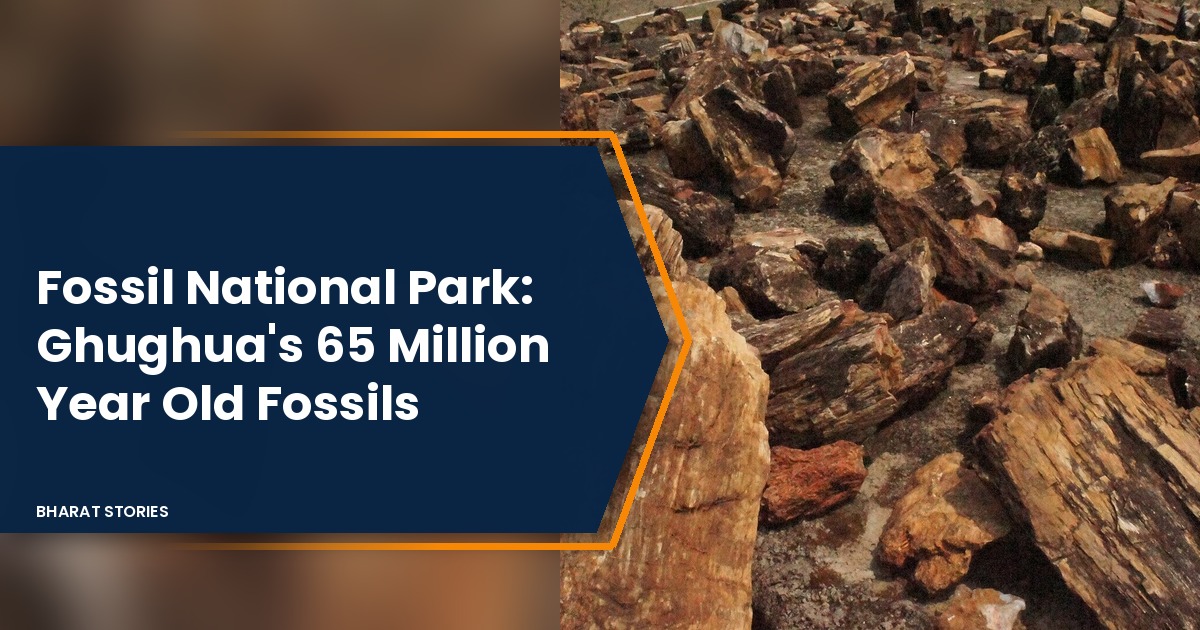
Fossil National Park: Ghughua’s 65 Million Year Old Fossils
Fossil National Park, better known as Ghughua Fossil National Park, protects one of India’s most remarkable records of ancient plant life. In a small patch of forest in Madhya Pradesh, petrified tree trunks, leaves, fruits and seeds turned to stone tell the story of a tropical forest that grew here around 65 million years ago.
Table of Contents
Where is Fossil National Park located?
Ghughua Fossil National Park is in Dindori district of Madhya Pradesh, close to the border with Mandla district. It lies near the village of Ghughua (also spelt Ghughwa), about 70 km from Dindori town according to the Dindori district administration, and roughly 76 km from Jabalpur.
The park appears in national park lists under names such as Mandla Plant Fossils National Park, because the fossil belt stretches across the old Mandla region. Dindori was carved out of Mandla district in 1998, which explains why older sources place the park in Mandla.
How big is the park and when was it declared?
It is one of the smallest national parks in India, covering about 27.34 hectares, or roughly 0.27 sq km. A draft eco sensitive zone notification published by the Ministry of Environment, Forest and Climate Change in 2016 gives the area as 0.27416 sq km.
The Madhya Pradesh government notified the area as a national park in 1983 because of the scientific value of its fossils. Its small size is deliberate. The aim is to protect a concentrated fossil site, not a large wildlife habitat.
How old are the fossils at Ghughua?
Most scientific accounts date the Ghughua fossils to around 65 million years ago, near the end of the Cretaceous period and the start of the Tertiary. That places them close to the time when the dinosaurs disappeared.
The fossils are preserved in sediments laid down between flows of volcanic lava from the Deccan Traps. In the quiet periods between eruptions, forests grew around lakes and rivers. Later flows buried them, and over millions of years minerals replaced the plant tissue, turning wood into stone.
Some older descriptions, including the district’s tourism page, give a broad range of 40 to 150 million years and mention a Jurassic possibility. Recent summaries, such as an overview in Deposits magazine, describe the plants as belonging to the topmost Cretaceous to early Tertiary, which is the view most visitors will hear on site.
What fossils can you see at the park?
The park displays petrified tree trunks, leaves, fruits, seeds and palm fossils, along with a small number of animal fossils. According to an Indian Express report, 31 fossil genera belonging to 18 plant families have been identified here.
- Palms: palm trunks and leaves are among the most common finds.
- Familiar relatives: some fossils closely resemble living plants such as jackfruit, rudraksha, jamun and amla.
- Eucalyptus type fossils: fossils linked to eucalyptus have drawn scientific interest, since the genus is now native mainly to Australia.
- Gymnosperms and monocots: petrified stems include conifer like gymnosperms and monocotyledons, with some bryophytes reported.
- Mollusc shells: shells found with the plant fossils point to a wet, lake or estuary environment.
Has a dinosaur fossil been found here?
The park is best known for plants, but its museum displays a fossil described as a dinosaur egg, reported by the Indian Express. Madhya Pradesh has separate dinosaur fossil sites, notably in Dhar district, so visitors interested mainly in dinosaurs should plan for those as well.
Why is Ghughua important for science?
The fossils show that central India once had a warm, humid forest very different from today’s dry deciduous woodland. Plant groups seen here suggest links with Southeast Asian and Australian floras, which helps scientists study how the Indian plate drifted after Gondwana broke apart.
Researchers from the Birbal Sahni Institute of Palaeosciences in Lucknow and colleges in Jabalpur have studied the site for decades. Local official Dr Dharmendra Prasad is credited with drawing attention to the fossils and pushing for their protection.
Which villages have fossil deposits?
Fossils are spread across several villages of the old Mandla region, not just inside the park boundary. Commonly listed sites include:
- Ghughua
- Umaria
- Deori Kohani
- Deorakhurd
- Barbaspur
- Chanti Hills
- Chargaon
Only the core site near Ghughua and Umaria villages is protected as the national park. Fossils outside it are vulnerable to collection and road works, which is one reason the eco sensitive zone was proposed.
What is there to do at Fossil National Park?
Walk the fossil trail, visit the museum, and look at the large petrified trunks lying in the open. The museum displays the smaller specimens, while the trail lets you see fossil wood in the setting where it was found.
| Feature | What to expect |
|---|---|
| Fossil trail | Short walk past petrified trunks and fossil beds |
| Museum | Leaves, fruits, seeds and the reported dinosaur egg |
| Surrounding forest | Saja, mahua, bamboo, dhawa and other dry forest trees |
| Time needed | About one to two hours |
Collecting or breaking fossils is not allowed. Everything inside the park is protected, and even small fragments matter to researchers.
What tips help you get the most from a visit?
Go early, carry water and take time to look closely. Fossils can look like ordinary rocks at first glance, until you notice growth rings, bark texture or the fan shape of a palm leaf.
- Wear comfortable shoes; the trail is uneven in places.
- Carry drinking water and snacks, as facilities nearby are limited.
- Bring a hand lens if you have one, to see cell patterns in petrified wood.
- Hire a local guide or ask the staff for an introduction if one is available.
- Take all litter back with you and stay on marked paths.
Students of botany, geology and environmental science will find the site especially useful, and school groups often visit for field study. Families with children can turn the visit into a simple lesson on how fossils form and why the climate of a region changes over geological time.
How do you reach Ghughua Fossil Park?
Jabalpur is the most convenient gateway, with the nearest major railway station and airport. From Jabalpur, the park is a road trip of roughly two hours via Shahpura, depending on road conditions.
- By air: Jabalpur airport, then taxi to Ghughua.
- By rail: Jabalpur junction is the closest large station.
- By road: buses run from Jabalpur to Shahpura and Dindori; hire a local vehicle for the last stretch.
What is the best time to visit?
October to March is the most comfortable period, with pleasant days for walking. Summer afternoons can be very hot, and heavy monsoon rain can make rural roads slow. Check opening hours locally before you travel, as they are not widely published.
What can you combine with a visit?
Ghughua fits easily into a central India wildlife or heritage trip. Kanha National Park in Mandla district is a few hours away and famous for barasingha and tigers. Bandhavgarh National Park in Umaria district is another strong option, and the pilgrim town of Amarkantak, source of the Narmada, is also within reach. For more protected areas across the country, see our list of national parks of India.
Frequently Asked Questions
Is there a fossil park in Madhya Pradesh?
Yes. Ghughua Fossil National Park in Dindori district protects plant fossils about 65 million years old, and the state also has dinosaur fossil sites in Dhar district.
Why is Fossil National Park so small?
It was created to protect a concentrated fossil deposit rather than a wildlife habitat, so about 27 hectares is enough to cover the main site.
Can you see animals at Ghughua?
The park is not a safari destination. You may see birds, insects and small mammals in the surrounding forest, but the fossils are the main attraction.
Is photography allowed?
Casual photography of the fossils is generally allowed for visitors. Ask the staff on arrival, and do not climb on or move specimens.
Plan your visit
Ghughua Fossil National Park is small, quiet and easy to miss, yet it holds a record of life from the age of the dinosaurs. Give it a couple of unhurried hours, read the panels, and you will leave with a clearer picture of how much central India has changed over 65 million years.