

Desert National Park: Great Indian Bustard and Thar Guide
Most people picture the Thar as an empty sea of sand. Desert National Park, spread across the far west of Rajasthan near the border with Pakistan, shows how wrong that picture is. Its dunes, gravel plains, rocky ridges and salt flats support eagles and falcons, gazelles and desert foxes, and the last real stronghold of one of the world’s most threatened birds, the great Indian bustard.
This guide explains where the park is, how its landscape works, why it matters so much for the bustard, what the latest conservation news is, and how to plan a respectful visit. For other protected areas in the country, see our list of national parks of India.
Table of Contents
Desert National Park at a Glance
| Item | Detail |
|---|---|
| State and districts | Rajasthan; Jaisalmer and Barmer |
| Area | About 3,162 sq km, one of the largest protected areas in India |
| Notified | As the Desert Wildlife Sanctuary in August 1980 |
| Flagship species | Great Indian bustard |
| Main habitats | Dunes, sandy and gravel plains, rocky outcrops, salt lake beds |
| Fossils | Jurassic wood fossils at the Akal Wood Fossil Park near Jaisalmer |
| Best time to visit | November to February |
| Gateway city | Jaisalmer |
Where the Park Lies
Desert National Park covers about 3,162 sq km to the west and south west of Jaisalmer, with a little over 1,900 sq km in Jaisalmer district and the rest in Barmer district. It was notified as a wildlife sanctuary in 1980 and is widely known as a national park, although the final legal steps to make it one have taken a long time. The area is on India’s tentative list for future UNESCO World Heritage nomination.
Dozens of villages and hamlets lie within and around its boundaries, and people here have grazed camels, cattle, sheep and goats for centuries. That long coexistence shapes how the park is managed today.
More Than Sand
Shifting dunes make up only about a fifth of the park. The rest is a mosaic of fixed dunes held by grasses and shrubs, flat sandy plains, stony ground, low rocky ridges and the dry beds of salt lakes that hold water only after rare heavy rain. Sewan grass, which survives on very little water, covers large areas and is vital fodder for both wildlife and livestock.
Trees are scattered but important. Khejri, the state tree of Rajasthan, gives shade and fodder, rohida brightens the desert with orange flowers in spring, and thorny ker and babul shrubs shelter birds and small animals. Rainfall is low and highly variable, summer days can pass 45 degrees Celsius, and winter nights can be close to freezing.
The Great Indian Bustard
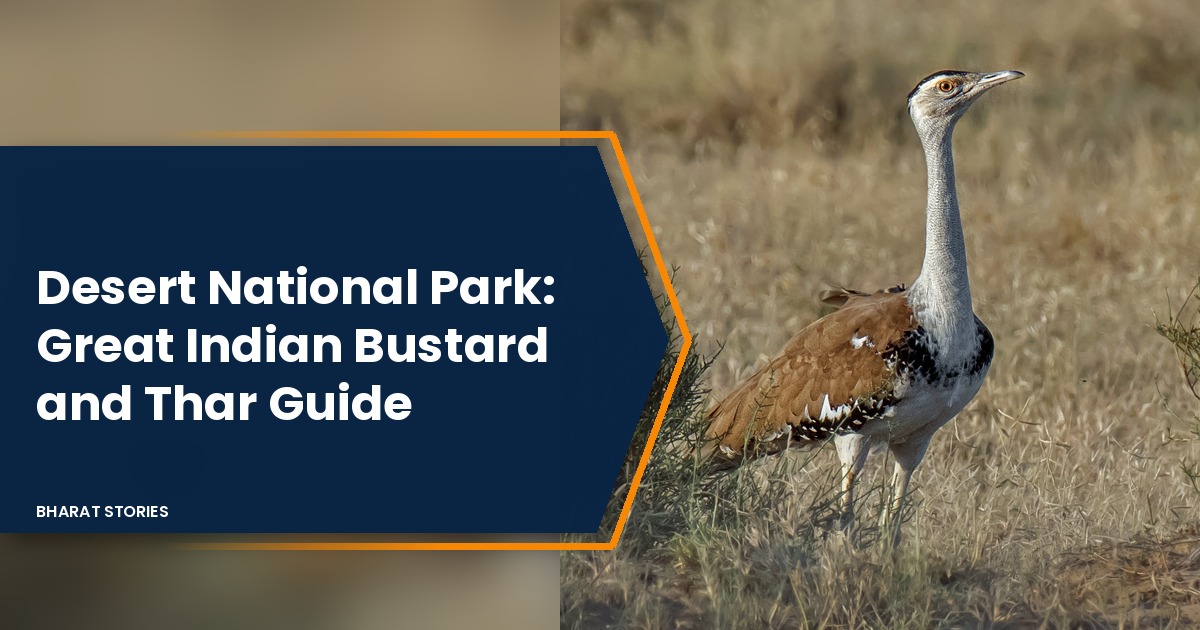
The great Indian bustard is a large, heavy bird that stands about a metre tall, with a black crown, pale neck and brown back. Males inflate a throat pouch and puff out their white feathers in a striking display during the breeding season. Once found across the grasslands of western and central India, it is now critically endangered, with recent estimates putting the wild population at fewer than 200 birds, most of them in and around Desert National Park.
The biggest threat in recent years has been collisions with overhead power lines. Bustards have poor forward vision and are heavy fliers, and many have been killed hitting wires strung across their habitat, much of which is also attractive for solar and wind energy. Habitat loss, disturbance and predation of eggs by dogs and foxes add to the pressure.
The Conservation Breeding Programme
To build a safety net, the Union environment ministry, the Rajasthan Forest Department and the Wildlife Institute of India set up conservation breeding centres at Sam and Ramdevra in Jaisalmer district, with technical help from the International Fund for Houbara Conservation. According to a Press Information Bureau release of October 2026, the two centres now hold 97 birds, 40 of them hatched from eggs collected in the wild and 57 bred in captivity. Captive breeding produced 24 live chicks in 2025 and 29 in 2026.
On 4 October 2026, Union Environment Minister Bhupender Yadav released two captive bred male bustards into the wild at Sam, the first step from building a captive population towards restoring the species in its natural habitat. A further group of birds has been set aside for future releases, and lessons from the first release will shape the next ones.
Scientists have also tried a method called jumpstart, in which eggs laid in captivity are placed in wild nests for incubating females to hatch. The ministry reports that this has produced six chicks in Rajasthan and two in Gujarat. Inside the park, the forest department has fenced around 200 sq km of grassland enclosures, which tracking studies have identified as prime breeding habitat.
The Supreme Court and Power Lines
The bustard’s fate has also been shaped in court. In a judgment delivered on 19 December 2025, the Supreme Court accepted an expert committee’s revised priority areas of about 14,013 sq km in Rajasthan and 740 sq km in Gujarat. It directed mitigation of existing power lines in these areas, including putting lines underground or rerouting them where needed, allowed new overhead lines only through dedicated power corridors, and restricted new wind turbines and large solar projects inside the priority zones. The ruling tries to balance India’s renewable energy goals with the survival of the species.
Other Wildlife
The park is one of the best places in India to see desert wildlife. Chinkara, the Indian gazelle, are common and often seen in small groups. Desert foxes, Indian foxes, desert cats and jackals hunt rodents such as the desert jird. The spiny tailed lizard, a plant eating reptile that lives in burrows, is a symbol of the gravel plains.
Birds of prey are the other great draw. Tawny eagles, steppe eagles, short toed snake eagles, laggar falcons and long legged buzzards are seen in winter, along with large numbers of vultures, including Eurasian griffons that arrive from Central Asia. Sandgrouse gather at waterholes in the mornings, and the MacQueen’s bustard, a smaller cousin of the great Indian bustard, visits from the north in winter.
Fossils of an Ancient Sea Coast
Long before it became a desert, this region lay near the edge of a warm sea. At the Akal Wood Fossil Park, about 17 km from Jaisalmer on the road to Barmer, the trunks of trees that grew around 180 million years ago in the Jurassic period lie preserved in stone where they fell. Other rocks in the Jaisalmer basin have yielded marine fossils and the remains of Jurassic reptiles. Older claims of dinosaur remains only a few million years old are not correct; dinosaurs other than birds died out about 66 million years ago.
Visiting Desert National Park
Jaisalmer is the base for visits. The Sam dunes, about 40 km west of the city, are the most visited part of the landscape, though the busy camel safari and camp area there is quite different from the protected core. For wildlife, the Sudasari area inside the park is the best known stop, with a forest post, grassland enclosures and good chances of chinkara and raptors.
Entry into the park needs a permit from the forest department, usually arranged in Jaisalmer or at the check posts, and visits are made in your own or a hired vehicle with a local guide. Some areas, especially bustard breeding enclosures, are closed to visitors. Because the park lies close to the international border, carry identity documents and follow any security instructions.
Best Time to Go
November to February is the best season, with pleasant days, cold nights and winter migrant birds. March can still be comfortable. From April to June the heat is extreme and travel in the open desert is risky without experience.
Getting There
Jaisalmer has rail links with Jodhpur, Jaipur and Delhi, and an airport with seasonal flights. Jodhpur, about 285 km away by road, has a larger airport. From Jaisalmer, roads run west to Sam and south towards Barmer through the park area.
Visiting Responsibly
- Stay on existing tracks; driving across open ground damages grass and can crush nests.
- Never chase or approach bustards or other birds for photographs.
- Do not use drones; they disturb wildlife and are restricted near the border.
- Carry back all plastic and food waste, which attracts dogs that prey on eggs.
- Respect village life and ask before photographing people.
For more about the state, see our guide to Rajasthan.
Frequently Asked Questions
Where is Desert National Park?
It is in western Rajasthan, in Jaisalmer and Barmer districts, covering about 3,162 sq km near the city of Jaisalmer.
Why is Desert National Park important?
It is the main remaining stronghold of the critically endangered great Indian bustard and protects a rare example of the Thar desert ecosystem.
How many great Indian bustards are left?
Recent estimates put the wild population at fewer than 200 birds. In addition, the breeding centres at Sam and Ramdevra held 97 birds in October 2026.
When were captive bred bustards first released?
Two captive bred males were released into the wild at Sam in Desert National Park on 4 October 2026.
What is the best time to visit Desert National Park?
November to February offers the most comfortable weather and the best birdwatching.
What is the Akal Wood Fossil Park?
It is a site about 17 km from Jaisalmer where fossilised tree trunks around 180 million years old, from the Jurassic period, are preserved.