

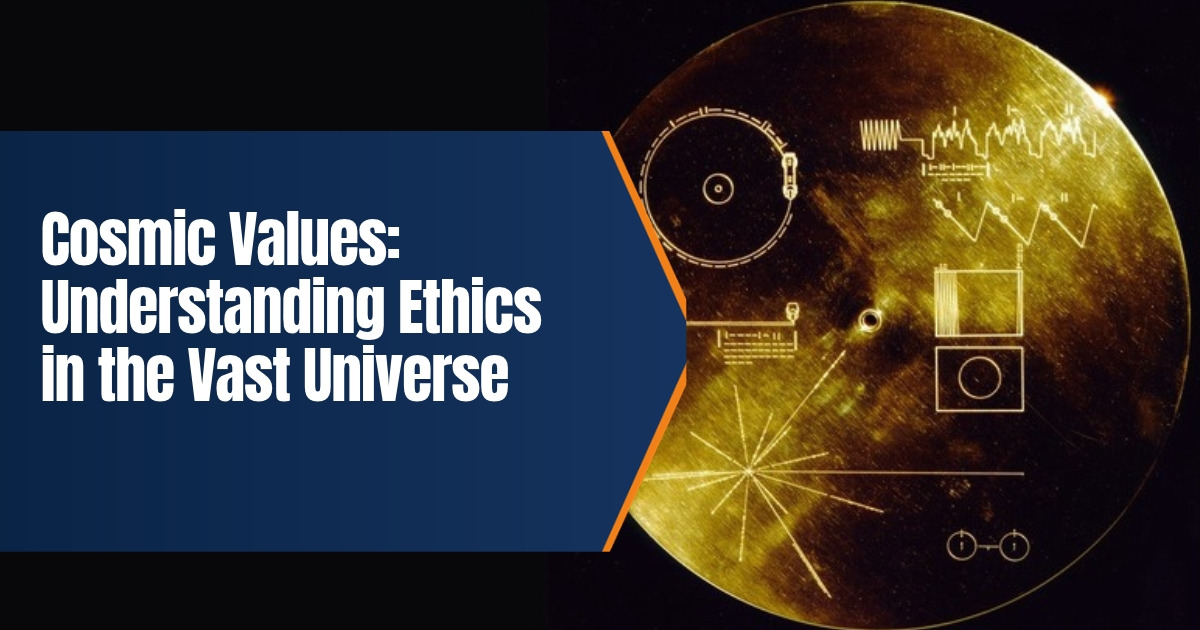
Cosmic Values: Understanding Ethics in the Vast Universe
Cosmic values is a name for the ideas people use to think about right and wrong beyond Earth. How should we treat other worlds? Should we send messages to possible alien life, and who decides what they say? Who owns the Moon? These questions once sounded like science fiction, but space missions from many countries, including India, have made them practical. This guide explains the main ideas, the real agreements and projects behind them, and the open questions that scientists and thinkers still debate.
Table of Contents
Key Moments in Space Ethics
| Year | Event | Why it matters |
|---|---|---|
| 1961 | Drake equation presented | A way to think about how many civilisations might exist |
| 1967 | Outer Space Treaty | Basic law of space, signed by most spacefaring nations |
| 1974 | Arecibo message sent | One of the first deliberate signals to the stars |
| 1977 | Voyager Golden Records launched | A message from humanity carried into deep space |
| 1989 | Post detection principles adopted | Guidance on what to do if a signal is found |
| 1990 | Pale Blue Dot image taken | A view of Earth that changed how many people see our planet |
What Are Cosmic Values?
The phrase does not refer to one official code. It covers a set of questions that come up when humans act in space or think about life elsewhere:
- How we share space, which no country owns.
- How we protect other planets and moons from our germs, and Earth from anything brought back.
- How we speak, if at all, to other possible civilisations.
- How we use resources such as water ice on the Moon.
- How we keep orbits around Earth safe and usable for future generations.
Many of these values grow from familiar ideas on Earth: fairness, care for shared spaces, honesty and responsibility to people not yet born.
The Outer Space Treaty: Space Belongs to Everyone
The Outer Space Treaty of 1967 is the foundation of space law. India is a party to it. Its main ideas include:
- Exploring and using outer space should benefit all countries and is the province of all mankind.
- No nation can claim the Moon or any other celestial body as its own territory.
- Nuclear weapons and other weapons of mass destruction may not be placed in orbit or on celestial bodies.
- The Moon and other bodies are to be used only for peaceful purposes.
- Countries are responsible for their national space activities, including those of private companies.
- States should avoid harmful contamination of space and of Earth.
These rules turn values such as peace and sharing into commitments that governments have signed.
Planetary Protection: Do No Harm
When a spacecraft lands on Mars or flies past a moon that may hide an ocean, it could carry tiny Earth microbes. If they survived, they might confuse the search for native life, or in theory harm it. This is called forward contamination. Bringing samples back raises the opposite worry, backward contamination of Earth.
The Committee on Space Research, known as COSPAR, keeps a planetary protection policy that space agencies follow. Missions are placed in categories based on where they go and what they do. A mission to a place that could hold life faces strict cleaning rules, while a mission to a body with no chance of life faces fewer. This is a cosmic value in practice: take care not to damage what you are trying to study.
Should We Message the Stars?
On 16 November 1974, the Arecibo radio telescope in Puerto Rico sent a short coded message towards the star cluster M13. It held 1,679 binary digits that formed a simple picture of numbers, the chemistry of DNA, a human figure and our solar system. The cluster is so far away that the message will take about 25,000 years to arrive.
The message was mainly a demonstration, but it started a long debate. Some scientists argue that sending messages, sometimes called METI, is a natural step and that any advanced civilisation would already know about us. Others warn that we do not know who might be listening and that one group should not speak for all of humanity. There is still no global agreement on this question.
The Golden Record: Who Speaks for Earth?
In 1977 NASA launched Voyager 1 and Voyager 2, each carrying a gold plated copper record. A committee led by Carl Sagan chose its contents: sounds of Earth, images, greetings in 55 languages and music from many cultures. Indian music is part of it, with the Hindustani classical singer Kesarbai Kerkar performing “Jaat Kahan Ho”.
The record raises an ethical question that still matters. Choosing what represents humanity means choosing whose voices are heard. The committee tried to include many cultures, but any such choice leaves things out. Future messages, if any, may need wider voices in the decision.
If We Find a Signal
In 1989 the International Academy of Astronautics adopted a declaration of principles for what scientists should do after detecting a signal from extraterrestrial intelligence. The main points are simple: confirm the signal carefully, share the finding openly with other scientists and the public, and do not reply until there has been international consultation. The values here are honesty, openness and caution.
The Pale Blue Dot
On 14 February 1990, at Carl Sagan’s suggestion, Voyager 1 turned its camera back and photographed Earth from about six billion kilometres away. Earth appeared as a tiny point of light in a sunbeam. Sagan later wrote that the image showed how small and fragile our home is, and how much we depend on one another. For many people, this picture is the clearest expression of cosmic values: a reminder of shared responsibility for a single planet.
The Drake Equation and Humility
In 1961 the astronomer Frank Drake presented an equation at a meeting at Green Bank in the United States. It lists the factors that would decide how many civilisations in our galaxy might be able to communicate, such as the rate of star formation, the share of stars with planets and how long civilisations last. Most of its values are still unknown. Its lesson is partly about humility: we do not know whether we are alone, and our actions should allow for both answers.
Keeping Earth’s Orbit Clean
Closer to home, thousands of satellites and pieces of debris circle Earth. Collisions can create more fragments and make some orbits risky for everyone. Responsible behaviour includes moving old satellites out of busy orbits, sharing tracking data and avoiding tests that create debris. These steps protect a shared space for future users, a value much like caring for a shared river or forest.
India and Cosmic Values
India’s space programme has long stressed peaceful use and benefit to society, from weather and communication satellites to disaster warning. Missions such as Chandrayaan and the planned Gaganyaan human flight bring new duties, including planetary protection, data sharing and safe disposal of spacecraft. Read more in our stories on how India is emerging as a leader in space exploration, India’s path from Chandrayaan to Gaganyaan and how India built its space legacy.
Open Questions
- Should private companies be allowed to mine the Moon or asteroids, and who should share the benefits?
- If simple life is found on Mars, should human visits be limited?
- Who should decide whether, and what, humanity says to other civilisations?
- How should cultures that see the sky as sacred be heard in space decisions?
Many of these questions have no single right answer, which is why open public discussion matters.
Students can explore these topics through debates, essays and science clubs, linking astronomy with ethics.
Looking up at a clear night sky is still the simplest way to feel how large the universe is.
Space law continues to grow through United Nations talks, where India takes part.
The Voyager probes are still sending data, decades after launch, from beyond the bubble of the solar wind.
Telescopes now find planets around other stars regularly, which makes questions about life elsewhere more concrete.
Ethics in space often starts with simple habits: share data, plan for the end of a mission and think about the next user.
Different cultures, including Indian traditions, have long linked the sky with ideas of order and duty.
What We Changed From the Old Post
The old post spoke about ethics in the universe in general terms, with few facts. We rewrote it around real agreements and projects: the Outer Space Treaty, COSPAR planetary protection, the Arecibo message, the Voyager Golden Record and its Indian music, the 1989 post detection principles, the Pale Blue Dot, the Drake equation, orbital debris and India’s place in these debates.
Frequently Asked Questions
What does cosmic values mean?
It is a name for the ethical ideas people apply to space, such as sharing, care for other worlds, honesty and caution about contact with other life.
Can any country own the Moon?
No. The Outer Space Treaty bars national claims of sovereignty over the Moon and other celestial bodies.
Is there Indian music on the Voyager Golden Record?
Yes. It includes “Jaat Kahan Ho” sung by Kesarbai Kerkar.
What is planetary protection?
Rules followed by space agencies to avoid carrying Earth life to other worlds and to keep returned samples from harming Earth.